Drd3
D(3) dopamine receptor (Dopamine D3 receptor)
Spatial tier: STRICT_EXCLUSIVE · Class: GPCR · Top region: OT (Olfactory tubercle) · Positive regions: 12/554
47.4Discovery Score
43.9Targetability Score
CEvidence grade C
What this means: Drd3: predicted fine-region profile is strict-exclusive, with 12 positive regions out of 554 (limit 12); direct spatial validation is required.
Priority review: This gene was requested explicitly and is shown even if the spatial gate rejected it. Treat this as a hypothesis/evidence record, not as a confirmed region-specific call.
Function in OT: evidence, prediction, innovation
- Gene function
- Drd3 encodes the dopamine D3 receptor, a Gi/o-coupled D2-like GPCR that inhibits cAMP/PKA signalling and reduces excitability. Higher dopamine affinity than D2 and restricted limbic distribution make it an antipsychotic and addiction target.
- Region function
- The olfactory tubercle is the olfactory ventral striatum: olfactory bulb and VTA dopamine input, D1/D2 spiny neurons, islands of Calleja, encoding odour valence and reward.
- Published in this region
- direct OT islands of Calleja granule cells are defined by D3 expression (Ridray et al. 1998: D1/D3 coexpression, opposing and synergistic, in islands and accumbens shell). Zhang et al. 2021: optogenetic activation of OT D3 neurons initiates self-grooming and suppresses ongoing behaviour; inhibition halts and ablation reduces grooming. Zhang et al. 2023: restraint stress lowers OT D3 excitability; ablation or inhibition gives depression-like behaviour, activation rescues it.
- Predicted function
- Prediction: D3 on island granule cells is an autoinhibitory brake on dopamine-driven excitability; agonists (PD128907) should suppress grooming initiation, antagonists (SB-277011A, PG01037) or OT-restricted Drd3 deletion should increase grooming. Conditional knockouts are needed because existing work manipulates the D3-Cre cell type, not the receptor.
- Innovation
- ★★☆☆☆ 2/5 The D3 island cell type is heavily studied, but the receptor's own signalling role is not genetically isolated.
- Tools
- Tg(Drd3-cre)KI198Gsat BAC line (MMRRC) for OT islands, crossed with Ai9 tdTomato (JAX 007909) and Ai32 ChR2 (JAX 024109); Drd3 knockouts; agonists PD128907, 7-OH-DPAT; antagonists SB-277011A, PG01037, nafadotride; anti-D3 antibodies.
- References
Direct evidence located at the region
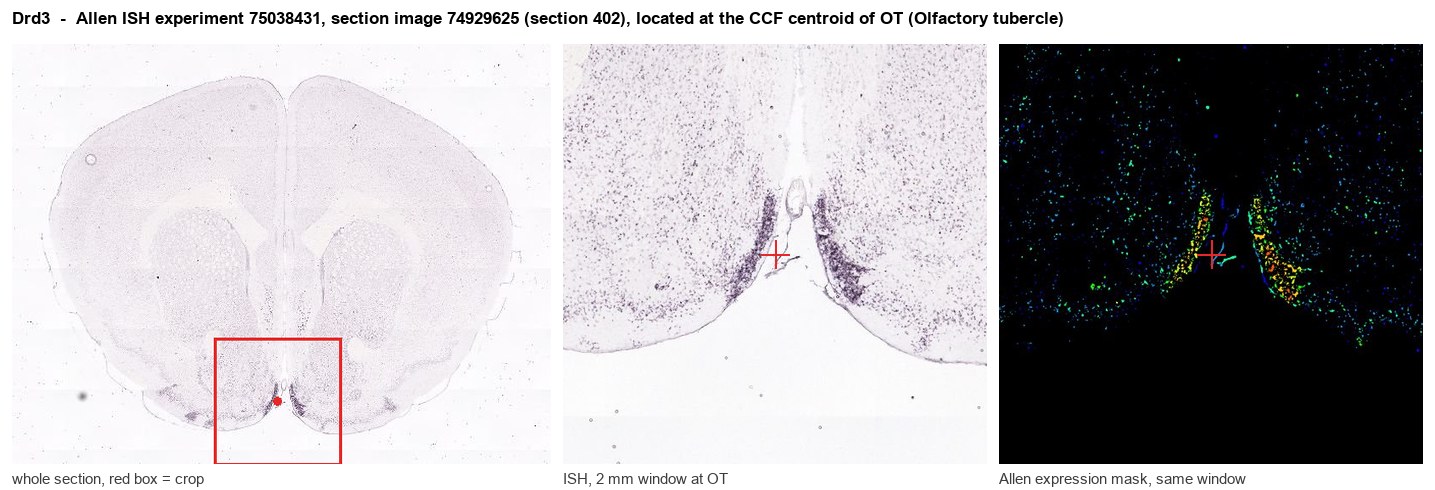
Allen ISH experiment 75038431, section image 74929625 (section 402): the section that contains the CCF centroid of Olfactory tubercle according to the Allen image-to-atlas alignment (reference_to_image), with a 2 mm window around that point. Left: whole section, red box = window. Middle: ISH signal. Right: Allen's expression-mask view of the same window. open this image in the Allen viewer
Look it up yourself: Allen Mouse Brain ISH for Drd3Allen reference atlas: OT (structure 754)ABC Atlas MERFISH viewer(in the ABC Atlas choose dataset MERFISH-C57BL6J-638850-CCF, colour cells by gene "Drd3" or by parcellation_substructure "OT")All genes confined to OT + 3-D brain
Direct spatial evidence
DIRECT ALLEN ISH
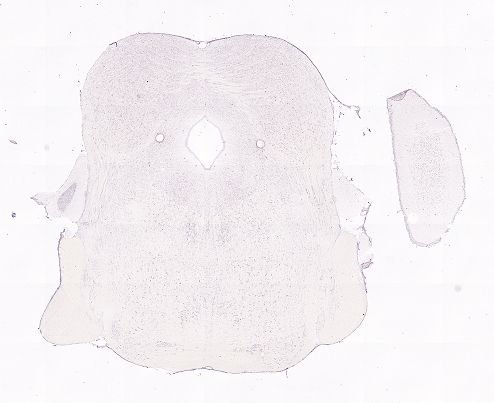
DIRECT ALLEN ISH
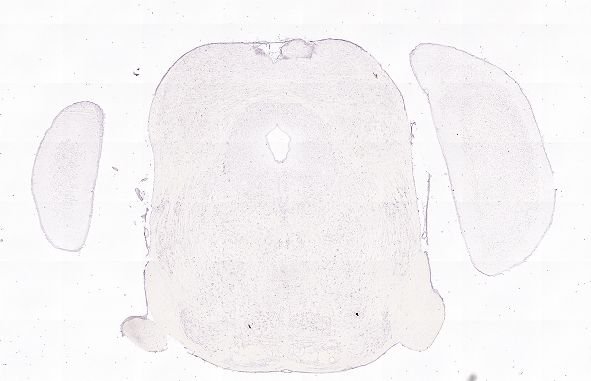
Regional expression figure
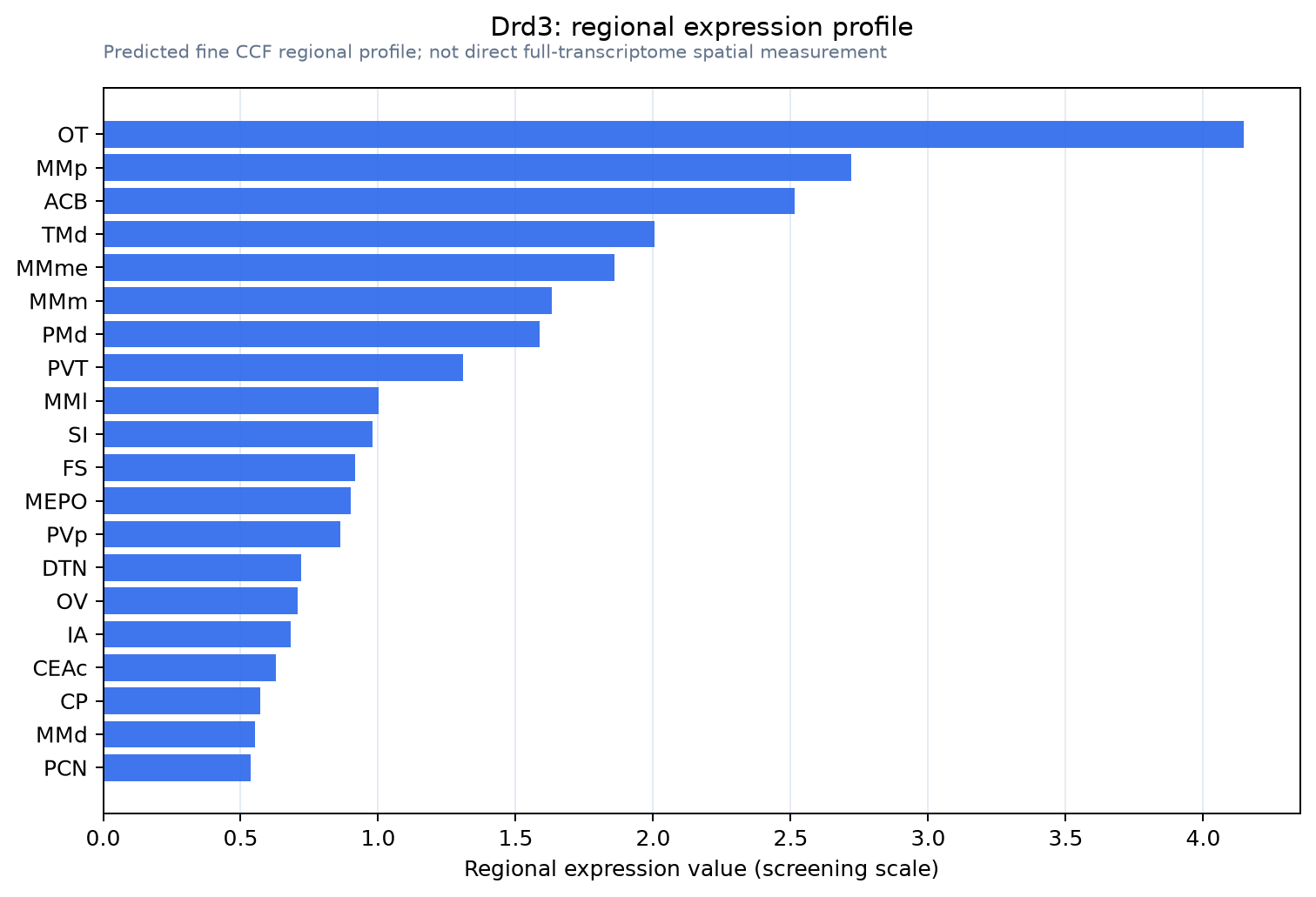
Predicted WMB × fine-CCF profile; not direct full-transcriptome spatial measurement.
CCF fine-region location
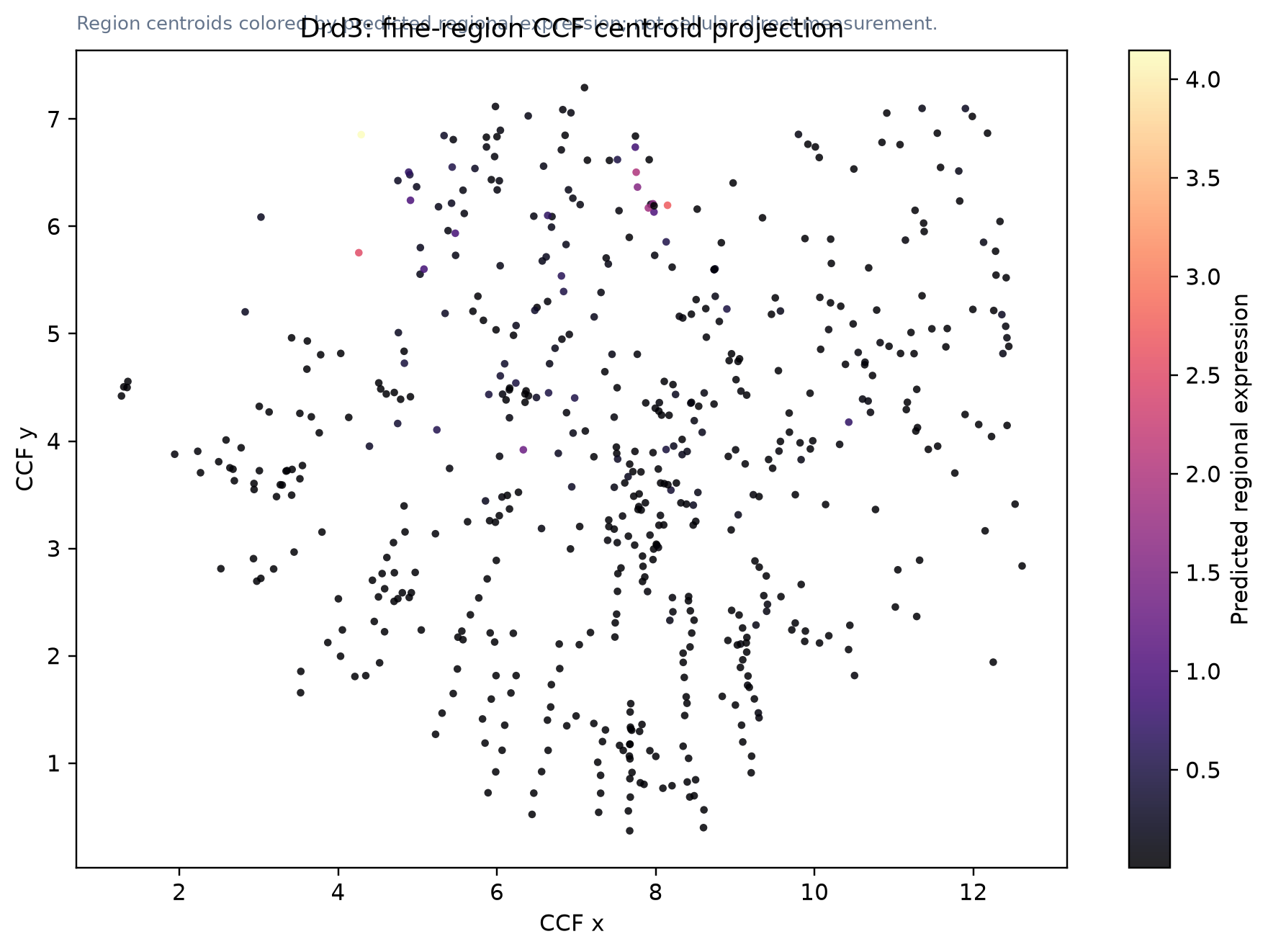
Region-centroid map colored by predicted expression; not a direct cellular expression image.
Spatial profile
Evidence and specificity
- Evidence status
- PREDICTED_FINE
- Direct sources
- None; predicted localization only
- Exclusive threshold
- 12 positive regions out of 554
- Spatial specificity
- 0.374
- Top-region fraction
- 0.106
- Filter status
- PASS
Interpretation limits
- Cell-type-to-region projection is imputed expression, not direct spatial measurement.
- Adult reference atlases do not establish stability across age, sex, strain, state, or disease.
- Transcript abundance does not guarantee protein abundance or genetic-tool performance.