Tpte
Transmembrane phosphatase with tensin homology
Spatial tier: STRICT_EXCLUSIVE · Class: ION_CHANNEL · Top region: OV (Vascular organ of the lamina terminalis) · Positive regions: 10/554
46.0Discovery Score
36.9Targetability Score
CEvidence grade C
What this means: Tpte: predicted fine-region profile is strict-exclusive, with 10 positive regions out of 554 (limit 12); direct spatial validation is required.
Function in OV: evidence, prediction, innovation
- Gene function
- TPTE is a PTEN-family enzyme with a voltage-sensor-like transmembrane region, phosphatase domain and C2 tensin-type domain. Unlike PTEN it is membrane-anchored, acting on phosphoinositides to generate PI(4,5)P2 and restrain AKT/mTOR. Expression is essentially testis-restricted; loss causes defective meiotic double-strand break repair, sperm flagellar defects and low sperm count.
- Region function
- The OVLT is a barrier-free sensory circumventricular organ transducing plasma osmolality and sodium into thirst, vasopressin release and thermoregulatory adjustments.
- Published in this region
- inferred No region-specific literature found. Closest is TPTE being testis-specific, its only characterised in vivo role in spermatogenesis (Chen et al. 2026), whereas paralogue PTEN is broadly expressed in hypothalamic and lamina terminalis neurons, so any OVLT Tpte signal is unverified.
- Predicted function
- Prediction: if real, the signal would reflect TPTE acting as a local phosphoinositide phosphatase setting membrane PI(4,5)P2 in osmosensory cells. Because PI(4,5)P2 gates TRPV1/TRPV4 and mechanosensitive osmosensing channels, TPTE loss should shift the drinking and vasopressin threshold, not abolish thirst. AKT/mTOR control of metabolic load is an alternative; RNAscope with a testis positive control comes first, as weak vascular-tissue signal is often false positive.
- Innovation
- ★★★☆☆ 3/5 Completely unstudied in brain, but the OVLT signal is unlikely to be genuine and no brain-usable reagents exist.
- Tools
- Tpte-deficient mouse (Chen et al. 2026); commercial anti-TPTE antibodies validated only for testis/tumour work; no Cre driver, pharmacology or AAV enhancer.
- References
Direct evidence located at the region
No Allen ISH section could be located at this region's centroid for the recorded experiments.
Look it up yourself: Allen Mouse Brain ISH for TpteAllen reference atlas: OV (structure 763)ABC Atlas MERFISH viewer(in the ABC Atlas choose dataset MERFISH-C57BL6J-638850-CCF, colour cells by gene "Tpte" or by parcellation_substructure "OV")All genes confined to OV + 3-D brain
Direct spatial evidence
MERFISH REGION LOCATOR
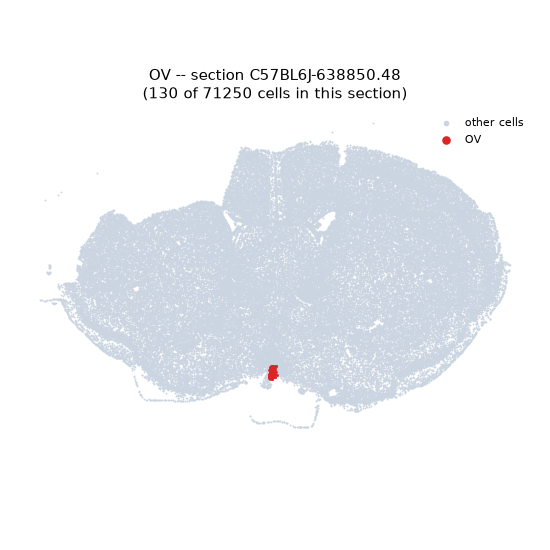
Regional expression figure
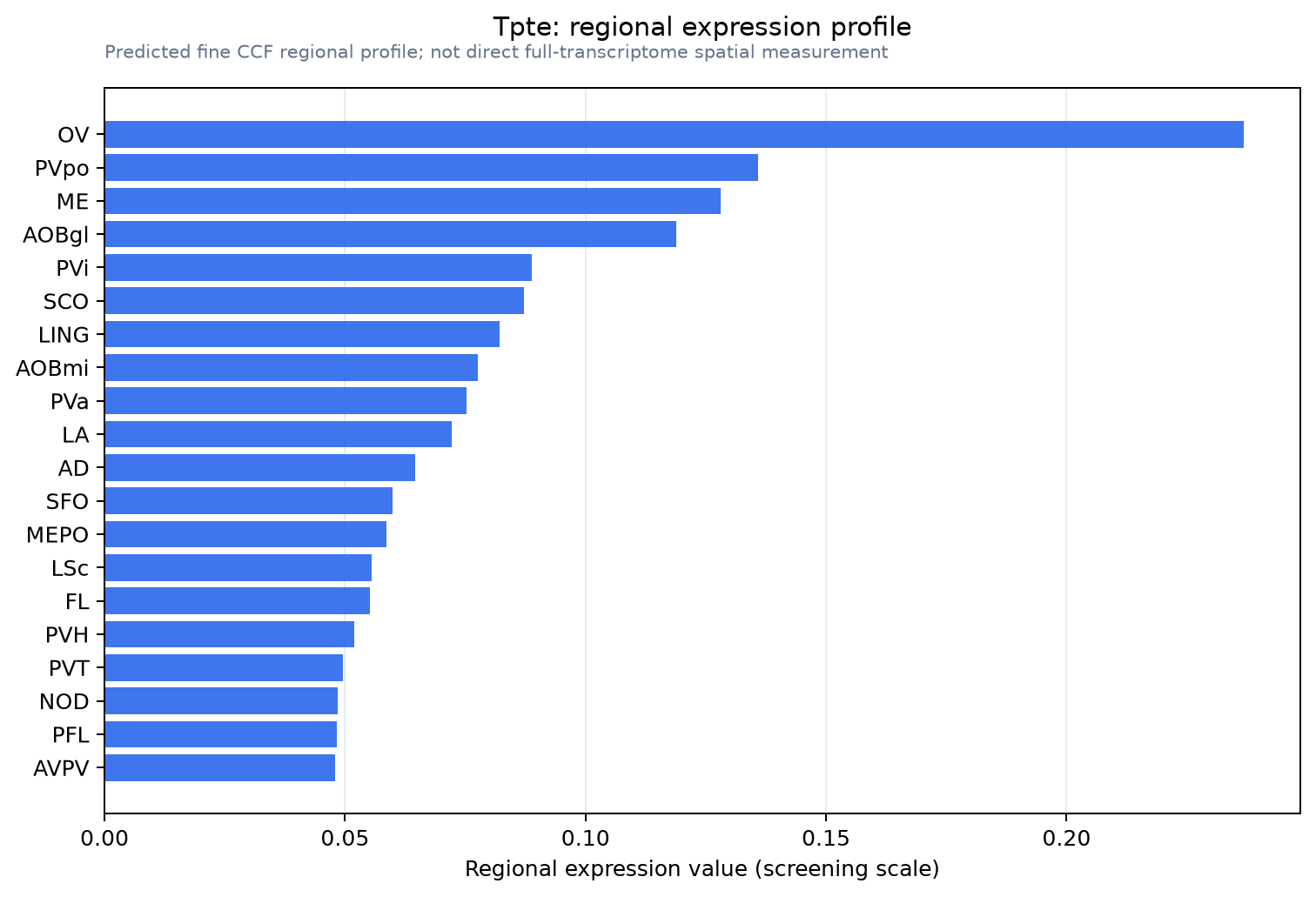
Predicted WMB × fine-CCF profile; not direct full-transcriptome spatial measurement.
Spatial profile
Evidence and specificity
- Evidence status
- PREDICTED_FINE
- Direct sources
- None; predicted localization only
- Exclusive threshold
- 12 positive regions out of 554
- Spatial specificity
- 0.358
- Top-region fraction
- 0.117
- Filter status
- PASS
Interpretation limits
- Cell-type-to-region projection is imputed expression, not direct spatial measurement.
- Adult reference atlases do not establish stability across age, sex, strain, state, or disease.
- Transcript abundance does not guarantee protein abundance or genetic-tool performance.