Tacr3
Neuromedin-K receptor (NKR) (NK-3 receptor) (NK-3R) (Neurokinin B receptor) (Tachykinin receptor 3)
Spatial tier: REGION_BIASED · Class: GPCR · Top region: IPR (Interpeduncular nucleus, rostral) · Positive regions: 36/554
43.4Discovery Score
40.2Targetability Score
CEvidence grade C
What this means: Tacr3: fine CCF profile is region-biased toward IPR (top regions: IPR, IPDM, IPC, VTA, IF); this is a discovery lead, not direct proof.
Function in IPR: evidence, prediction, innovation
- Gene function
- TACR3 encodes the neurokinin 3 receptor (NK3R), a Gq-coupled tachykinin receptor whose preferred ligand is neurokinin B. Activation drives phospholipase C, IP3 and DAG production, Ca2+ release and PKC activation, typically giving slow, long-lasting depolarisation. NK3R is best known in hypothalamic KNDy neurons driving GnRH pulsatility; TACR3 loss-of-function causes hypogonadotropic hypogonadism.
- Region function
- The rostral interpeduncular nucleus is the main GABAergic target of cholinergic and tachykinin-containing medial habenula efferents, a pathway controlling nicotine aversion and withdrawal and anxiety.
- Published in this region
- expression only Shughrue et al. 1996 detected NK-3 mRNA in the rat interpeduncular nucleus by in situ hybridisation, and Langlois et al. 2001 showed with [3H]senktide and [3H]SR142801 autoradiography that IPN is one of few structures with consistently high NK3 binding across rat, guinea pig and gerbil. Marksteiner et al. 1992 found dense neurokinin B-immunoreactive fibres there, supplying the ligand. Allen ISH places Tacr3 in IPR (energy 5.0) above IPC and every other region screened. No functional study of NK3R in IPN exists.
- Predicted function
- Prediction: NK3R on rostral IPN GABAergic neurons converts neurokinin B from medial habenula terminals into slow PKC-dependent excitation outlasting fast cholinergic transmission, sustaining IPN activity during nicotine withdrawal. Intra-IPN senktide should raise IPN firing and produce anxiety-like behaviour and place aversion, while local NK3R antagonism in Tacr3-positive IPR neurons should blunt withdrawal-induced anxiety.
- Innovation
- ★★★★☆ 4/5 Dense NK3R binding in the interpeduncular nucleus was reported in 1990, yet its circuit function is untested.
- Tools
- Agonist senktide; antagonists osanetant, talnetant, SB-222200 and fezolinetant; Tacr3 knockout mice; Tac2-Cre for ligand neurons; AAV-shRNA or CRISPR for IPR-restricted deletion.
- References
Direct evidence located at the region
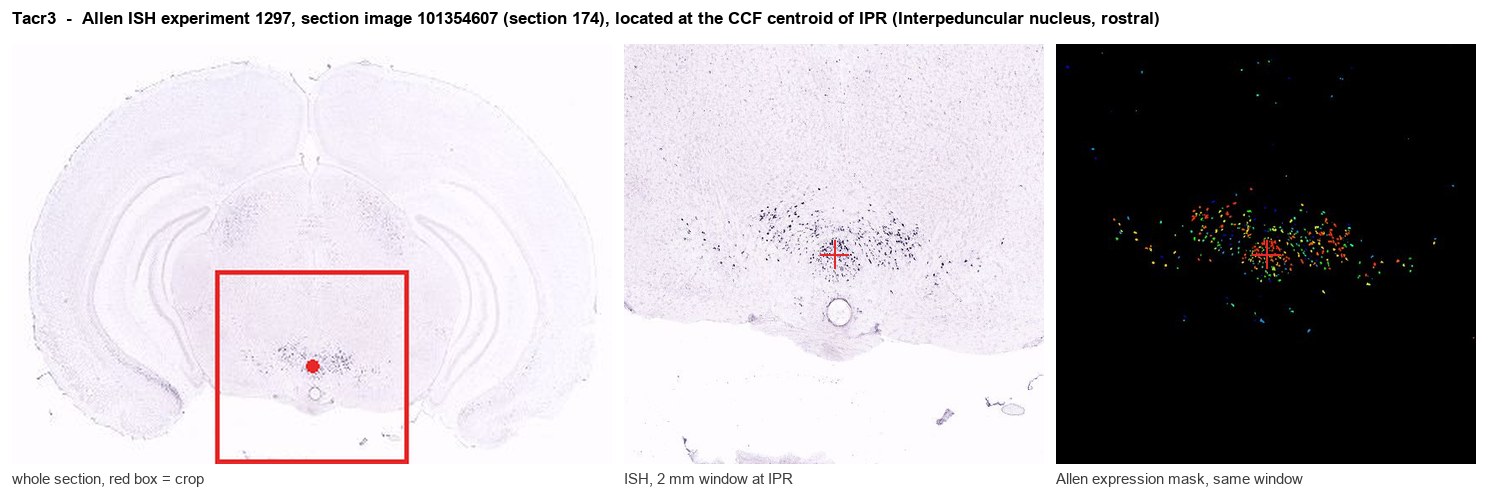
Allen ISH experiment 1297, section image 101354607 (section 174): the section that contains the CCF centroid of Interpeduncular nucleus, rostral according to the Allen image-to-atlas alignment (reference_to_image), with a 2 mm window around that point. Left: whole section, red box = window. Middle: ISH signal. Right: Allen's expression-mask view of the same window. open this image in the Allen viewer
Look it up yourself: Allen Mouse Brain ISH for Tacr3Allen reference atlas: IPR (structure 607344834)ABC Atlas MERFISH viewer(in the ABC Atlas choose dataset MERFISH-C57BL6J-638850-CCF, colour cells by gene "Tacr3" or by parcellation_substructure "IPR")All genes confined to IPR + 3-D brain
Direct spatial evidence
MERFISH REGION LOCATOR
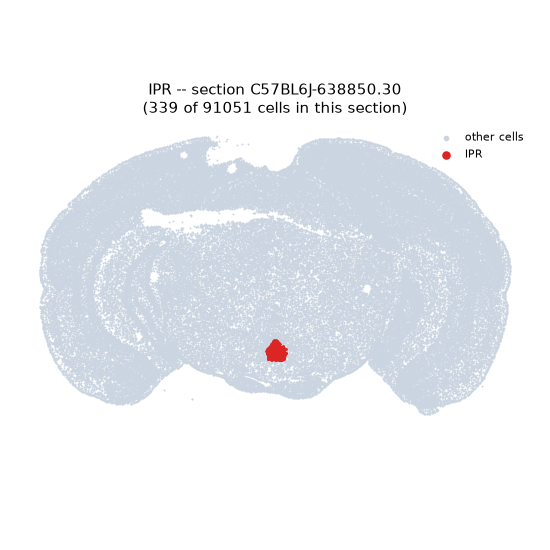
Regional expression figure
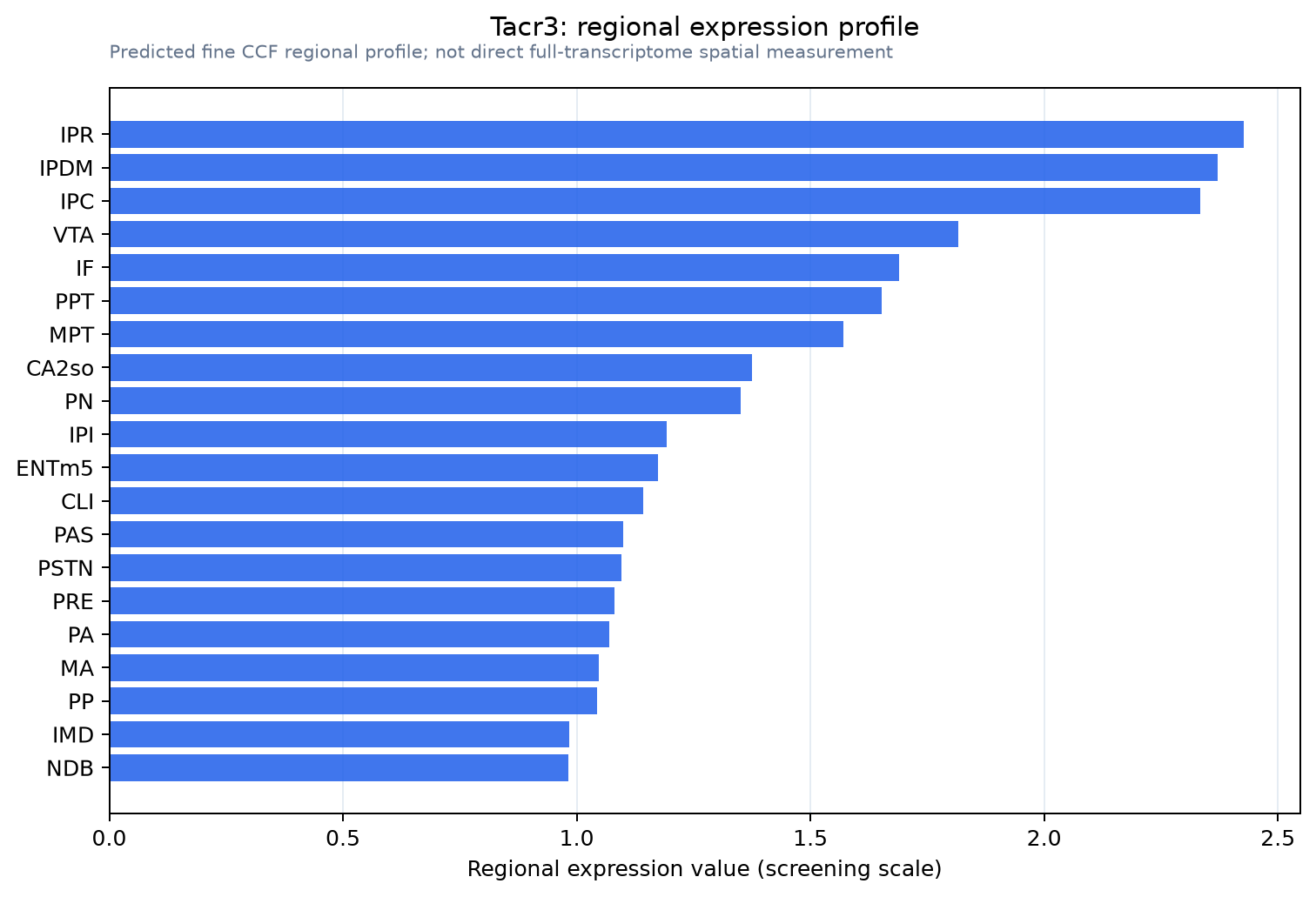
Predicted WMB × fine-CCF profile; not direct full-transcriptome spatial measurement.
Spatial profile
Evidence and specificity
- Evidence status
- PREDICTED_FINE
- Direct sources
- None; predicted localization only
- Exclusive threshold
- 12 positive regions out of 554
- Spatial specificity
- 0.298
- Top-region fraction
- 0.046
- Filter status
- PASS
Interpretation limits
- Cell-type-to-region projection is imputed expression, not direct spatial measurement.
- Adult reference atlases do not establish stability across age, sex, strain, state, or disease.
- Transcript abundance does not guarantee protein abundance or genetic-tool performance.