Slc4a11
Solute carrier family 4 member 11 (Sodium borate cotransporter 1) (NaBC1)
Spatial tier: STRICT_EXCLUSIVE · Class: ION_CHANNEL · Top region: CEAl (Central amygdalar nucleus, lateral part) · Positive regions: 10/554
44.1Discovery Score
37.3Targetability Score
CEvidence grade C
What this means: Slc4a11: predicted fine-region profile is strict-exclusive, with 10 positive regions out of 554 (limit 12); direct spatial validation is required.
Function in CEAl: evidence, prediction, innovation
- Gene function
- Slc4a11 encodes SLC4A11/NaBC1, an atypical SLC4-family member. Rather than moving bicarbonate it acts as an electrogenic sodium-borate cotransporter and, mainly, as an NH3- and alkaline-pH-stimulated H+(OH-) permeation pathway with water flux; at the inner mitochondrial membrane it supports glutamine catabolism and limits superoxide. Loss-of-function mutations cause congenital hereditary endothelial corneal dystrophy and Harboyan syndrome.
- Region function
- The lateral central amygdala is a GABAergic nucleus of PKC-delta, somatostatin and CRH neurons that gates threat learning, defensive freezing, pain modulation and appetite suppression via projections to CEAm, PAG and brainstem.
- Published in this region
- inferred No region-specific literature found. The closest evidence is that Slc4a11 disruption in mice produces sensorineural deficits with the transporter in inner-ear and other neural support cells (Lopez et al. 2009), while SLC4A11 protein is reported broadly in brain with pH/ammonia-handling function (Kao et al. 2020); nothing is published on CEA cell types.
- Predicted function
- Prediction: if SLC4A11 is enriched in CEAl neurons it most likely acts as a proton/ammonia leak pathway buffering intracellular pH and supporting mitochondrial glutamine oxidation in these tonically active GABAergic cells, i.e. a metabolic rather than signalling gene. Knockout should not abolish threat learning but should make CEAl neurons vulnerable to acid load and oxidative stress, potentially exaggerating freezing or nociceptive responses under metabolic challenge. Its restricted expression makes it attractive mainly as a genetic handle on a CEAl subtype.
- Innovation
- ★★★★★ 5/5 There is no published work at all on Slc4a11 in the amygdala, yet CEAl is a heavily studied fear and pain hub where a selective molecular marker would be immediately useful.
- Tools
- Slc4a11 germline knockout mice (Lopez et al. 2009), anti-SLC4A11 antibodies validated in cornea and kidney; no Cre driver, agonist or antagonist. CEAl access relies on Prkcd-Cre, Sst-Cre and Crh-Cre.
- References
Direct evidence located at the region
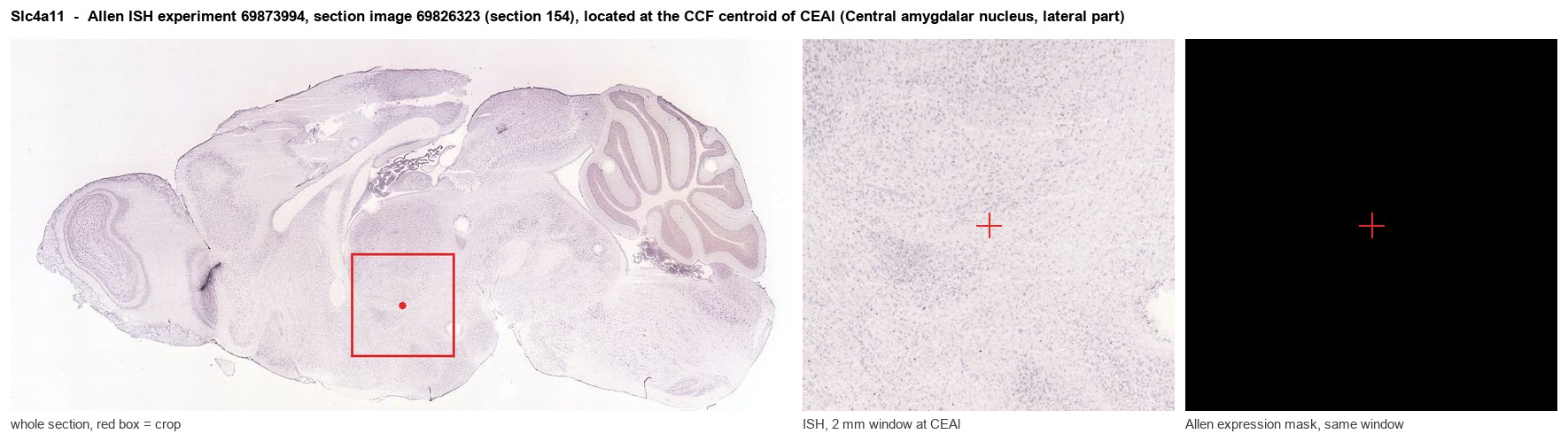
Allen ISH experiment 69873994, section image 69826323 (section 154): the section that contains the CCF centroid of Central amygdalar nucleus, lateral part according to the Allen image-to-atlas alignment (reference_to_image), with a 2 mm window around that point. Left: whole section, red box = window. Middle: ISH signal. Right: Allen's expression-mask view of the same window. open this image in the Allen viewer
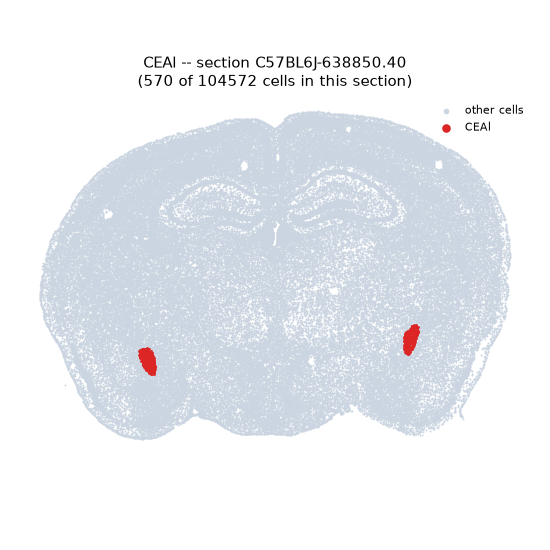
Look it up yourself: Allen Mouse Brain ISH for Slc4a11Allen reference atlas: CEAl (structure 551)ABC Atlas MERFISH viewer(in the ABC Atlas choose dataset MERFISH-C57BL6J-638850-CCF, colour cells by gene "Slc4a11" or by parcellation_substructure "CEAl")All genes confined to CEAl + 3-D brain
Direct spatial evidence
MERFISH REGION LOCATOR
DIRECT ALLEN ISH
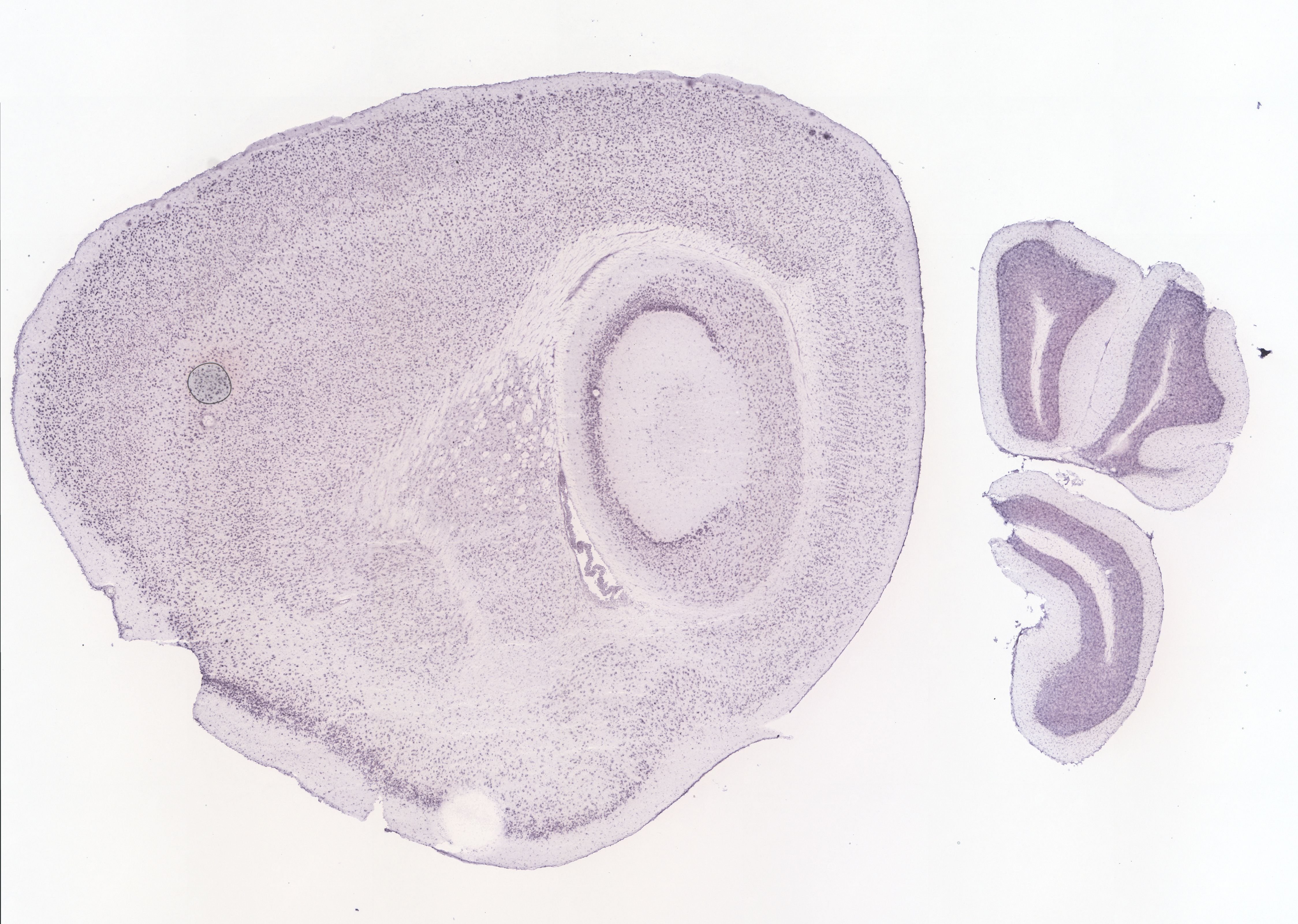
DIRECT ALLEN ISH
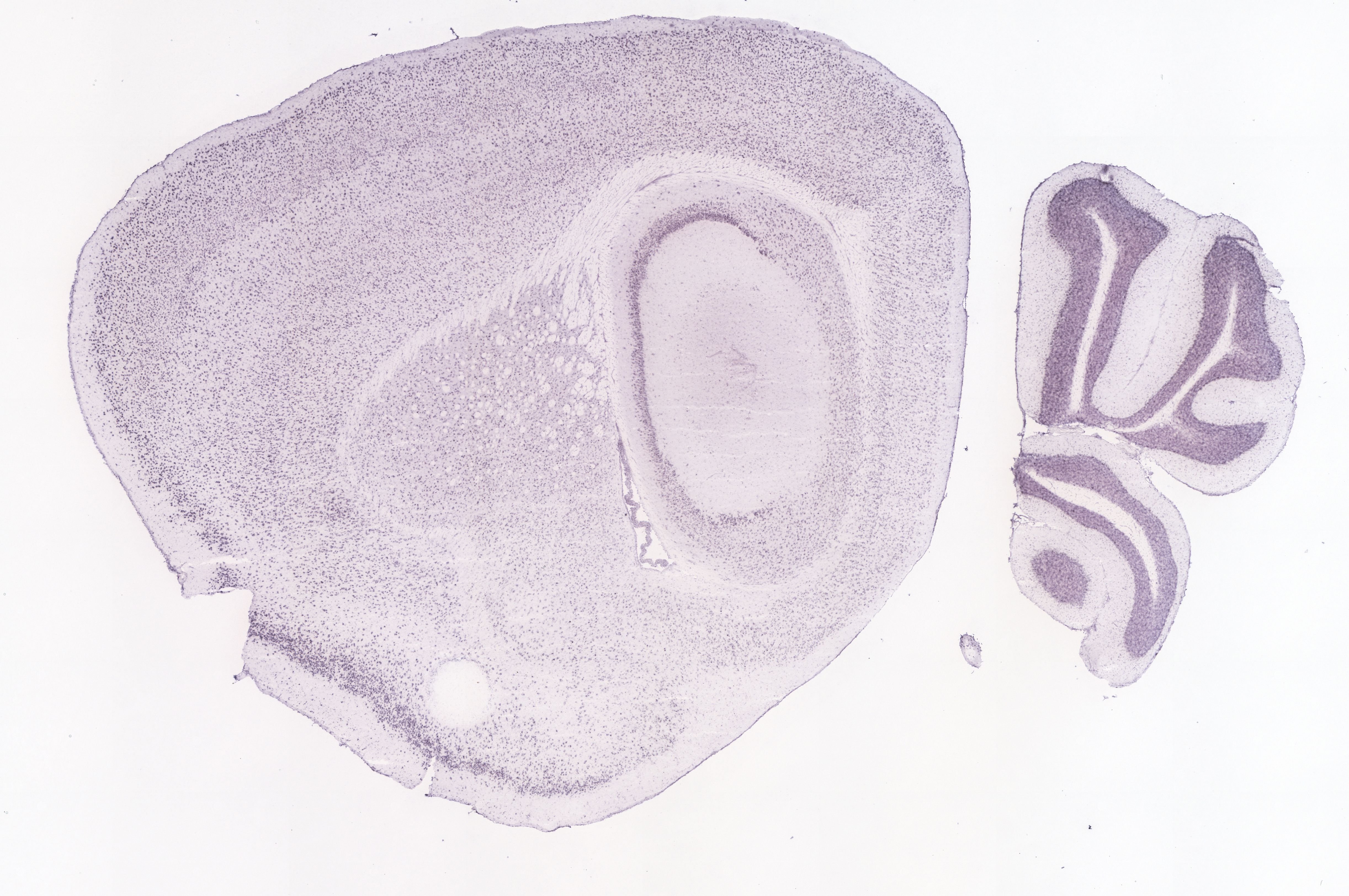
Regional expression figure
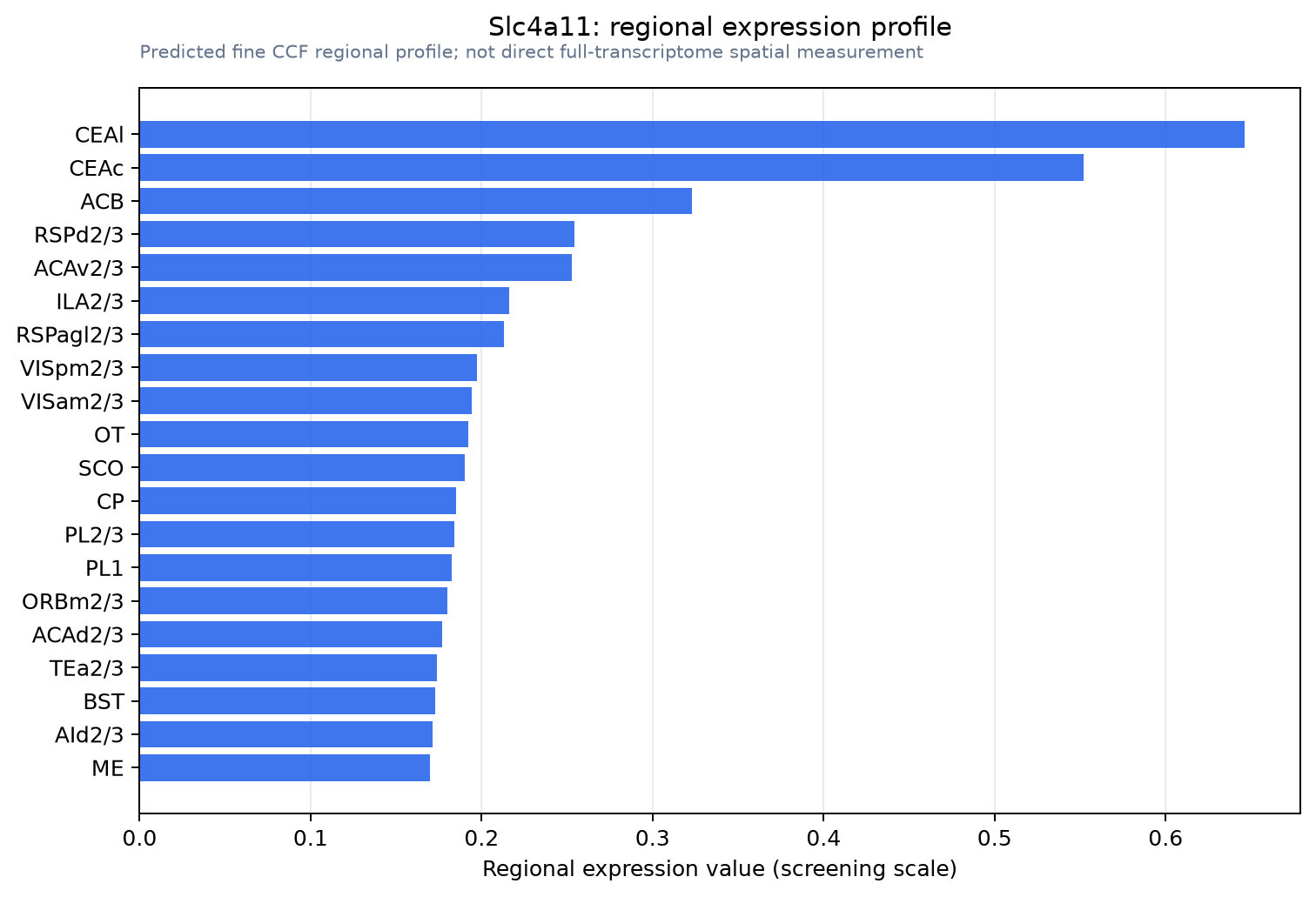
Predicted WMB × fine-CCF profile; not direct full-transcriptome spatial measurement.
Spatial profile
Evidence and specificity
- Evidence status
- PREDICTED_FINE
- Direct sources
- None; predicted localization only
- Exclusive threshold
- 12 positive regions out of 554
- Spatial specificity
- 0.316
- Top-region fraction
- 0.081
- Filter status
- PASS
Interpretation limits
- Cell-type-to-region projection is imputed expression, not direct spatial measurement.
- Adult reference atlases do not establish stability across age, sex, strain, state, or disease.
- Transcript abundance does not guarantee protein abundance or genetic-tool performance.