Slc17a8
Vesicular glutamate transporter 3 (VGluT3) (Solute carrier family 17 member 8)
Spatial tier: RESTRICTED · Class: ION_CHANNEL · Top region: DR (Dorsal nucleus raphe) · Positive regions: 14/554
46.2Discovery Score
41.4Targetability Score
CEvidence grade C
What this means: Slc17a8: fine CCF profile is restricted toward DR (top regions: DR, IMD, RH, PT, IAM; 14 positive regions); direct spatial validation is still required.
Function in DR: evidence, prediction, innovation
- Gene function
- SLC17A8 encodes VGLUT3, the third vesicular glutamate transporter. Like VGLUT1 and VGLUT2 it uses the proton gradient across the synaptic vesicle membrane to load glutamate, but unlike them it is expressed almost exclusively in neurons whose primary transmitter is something else - serotonin, acetylcholine or GABA - so it is the molecular substrate of glutamate co-release. Loading glutamate also acidifies the vesicle and boosts monoamine filling, a process called vesicular synergy.
- Region function
- The dorsal raphe nucleus is the largest serotonergic cell group in the brain, projecting broadly to cortex, striatum and limbic structures; it shapes mood, patience and reward processing, arousal state and stress responses, and also contains GABAergic, dopaminergic and glutamatergic neurons.
- Published in this region
- direct Direct. VGLUT3 is expressed by a large fraction of dorsal raphe serotonergic neurons, and Voisin et al. 2016 and Belmer et al. 2019 mapped how VGLUT3 is distributed within serotonergic axons and showed that 5-HT and glutamate markers are largely co-localised rather than segregated in mouse forebrain projections. Gagnon & Parent 2014 traced VGLUT3 in the highly collateralised axons of rat dorsal raphe neurons, and Gullino et al. 2024 provided evidence that 5-HT-glutamate co-releasing neurons contribute to acute stress responses.
- Predicted function
- Prediction: VGLUT3 should prove to be the switch that gives dorsal raphe serotonergic projections a fast, spatially precise glutamatergic component on top of slow volume serotonin transmission. Conditional Slc17a8 deletion in Sert-Cre neurons is predicted to abolish the fast EPSC evoked by optogenetic stimulation of raphe terminals in prefrontal cortex and nucleus accumbens while leaving serotonin release only modestly reduced, and behaviourally to impair rapid reward and stress signalling - slower behavioural responses to acute stressors and blunted cocaine-induced locomotor sensitisation - without producing the global serotonin-depletion phenotype.
- Innovation
- ★★☆☆☆ 2/5 VGLUT3 in raphe serotonergic neurons is an active and well-populated field, though conditional deletion restricted to defined raphe projection targets is still incompletely explored.
- Tools
- Slc17a8 knockout, Slc17a8 floxed and VGLUT3-Cre and VGLUT3-tdTomato mice; anti-VGLUT3 antibodies; VGLUT inhibitors such as Rose Bengal and Chicago Sky Blue (non-selective); Sert-Cre and Pet1-Cre for intersectional restriction; GRAB-5HT and iGluSnFR for dual-transmitter readout.
- References
Direct evidence located at the region
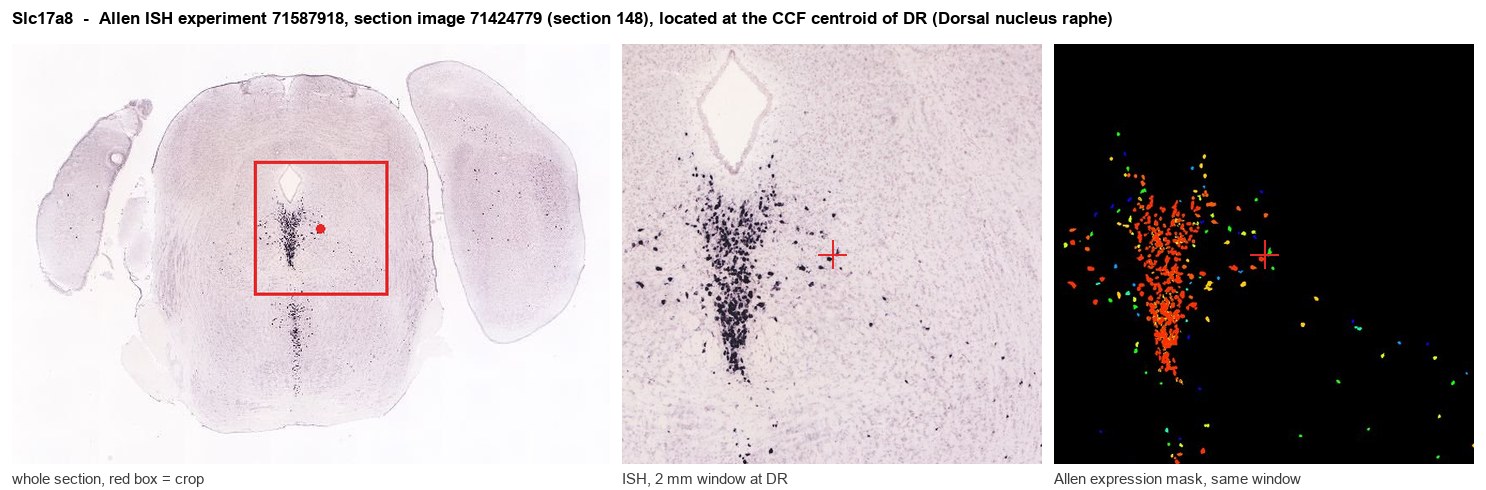
Allen ISH experiment 71587918, section image 71424779 (section 148): the section that contains the CCF centroid of Dorsal nucleus raphe according to the Allen image-to-atlas alignment (reference_to_image), with a 2 mm window around that point. Left: whole section, red box = window. Middle: ISH signal. Right: Allen's expression-mask view of the same window. open this image in the Allen viewer
Look it up yourself: Allen Mouse Brain ISH for Slc17a8Allen reference atlas: DR (structure 872)ABC Atlas MERFISH viewer(in the ABC Atlas choose dataset MERFISH-C57BL6J-638850-CCF, colour cells by gene "Slc17a8" or by parcellation_substructure "DR")All genes confined to DR + 3-D brain
Direct spatial evidence
MERFISH REGION LOCATOR
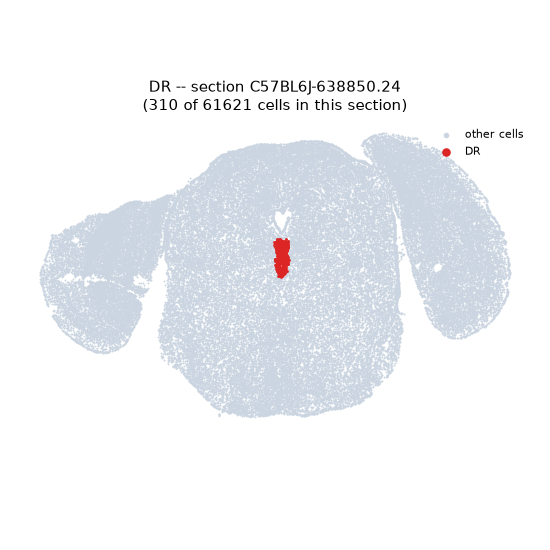
Regional expression figure
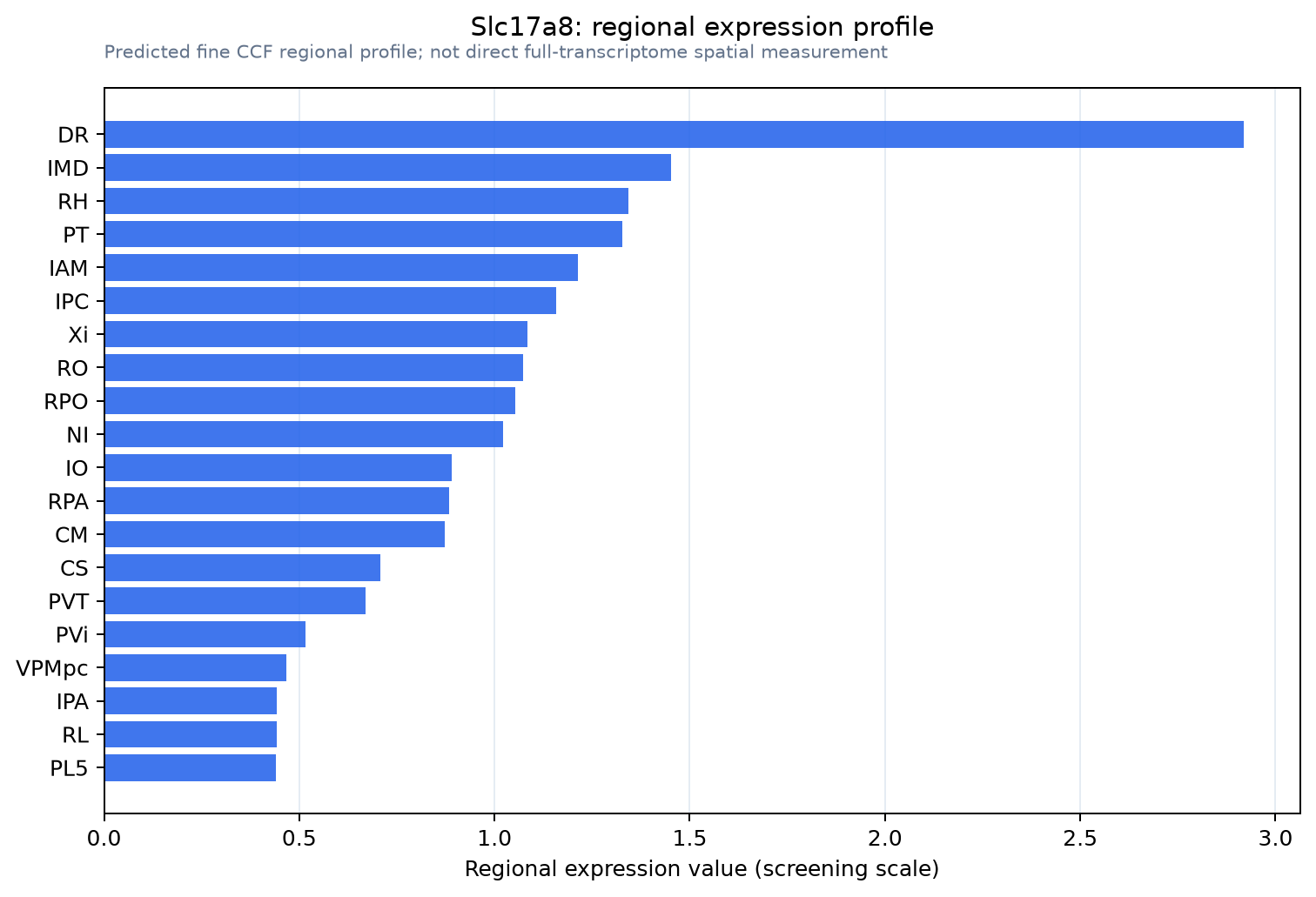
Predicted WMB × fine-CCF profile; not direct full-transcriptome spatial measurement.
Spatial profile
Evidence and specificity
- Evidence status
- PREDICTED_FINE
- Direct sources
- None; predicted localization only
- Exclusive threshold
- 12 positive regions out of 554
- Spatial specificity
- 0.323
- Top-region fraction
- 0.089
- Filter status
- PASS
Interpretation limits
- Cell-type-to-region projection is imputed expression, not direct spatial measurement.
- Adult reference atlases do not establish stability across age, sex, strain, state, or disease.
- Transcript abundance does not guarantee protein abundance or genetic-tool performance.