Sctr
Secretin receptor (SCT-R)
Spatial tier: STRICT_EXCLUSIVE · Class: GPCR · Top region: OV (Vascular organ of the lamina terminalis) · Positive regions: 6/554
49.7Discovery Score
41.1Targetability Score
CEvidence grade C
What this means: Sctr: predicted fine-region profile is strict-exclusive, with 6 positive regions out of 554 (limit 12); direct spatial validation is required.
Function in OV: evidence, prediction, innovation
- Gene function
- SCTR is the class B (secretin/glucagon family) Gs-coupled GPCR for secretin, raising cAMP and PKA to drive pancreatic and biliary bicarbonate secretion. Centrally the secretin-SCTR axis amplifies angiotensin II signalling, promoting water intake and vasopressin expression and release.
- Region function
- The OVLT, a lamina terminalis circumventricular organ, detects plasma hyperosmolality and angiotensin II, relaying to MnPO, SON and PVH for thirst and vasopressin secretion.
- Published in this region
- expression only Lee et al. 2010: secretin and SCTR transcript and protein throughout the lamina terminalis, including OVLT; Sct-/- and Sctr-/- mice lose most ANGII-evoked drinking and vasopressin responses. Chu et al. 2009: secretin is a neurohypophysial factor acting on SON/PVH. Zhang et al. 2022 deleted Sctr in adjacent SFO, cutting water but not salt intake in dehydrated mice; secretin evoked inward currents in SFO nNOS neurons.
- Predicted function
- Prediction: OVLT SCTR mirrors SFO SCTR, a Gs-coupled amplifier of glutamatergic/nNOS osmosensory excitability. AAV-Cre deletion of floxed Sctr should blunt dehydration- and ANGII-induced drinking and reduce SON/PVH Fos, sparing sodium appetite; local secretin should be dipsogenic and preferentially osmotic rather than volumetric.
- Innovation
- ★★★☆☆ 3/5 The secretin-SCTR thirst axis is established in SFO and magnocellular nuclei; the OVLT node is untested.
- Tools
- Sctr-/- and Sct-/- global knockouts; floxed Sctr plus AAV-Cre for region-restricted deletion (Zhang et al. 2022); secretin agonist; Nos1-Cre and Slc17a6-Cre for lamina terminalis osmosensory neurons.
- References
Direct evidence located at the region
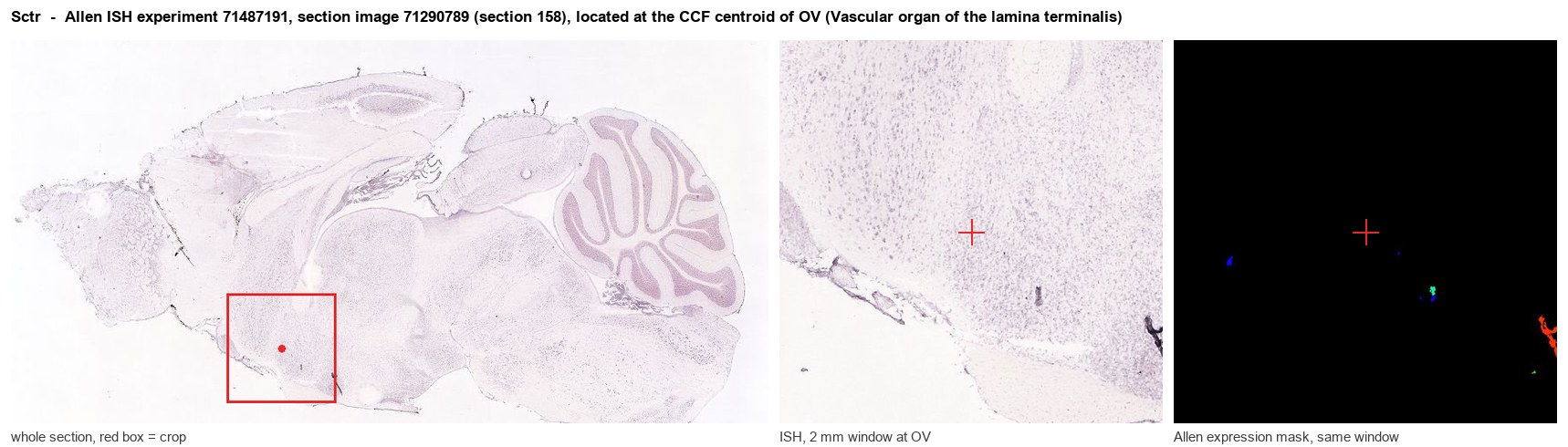
Allen ISH experiment 71487191, section image 71290789 (section 158): the section that contains the CCF centroid of Vascular organ of the lamina terminalis according to the Allen image-to-atlas alignment (reference_to_image), with a 2 mm window around that point. Left: whole section, red box = window. Middle: ISH signal. Right: Allen's expression-mask view of the same window. open this image in the Allen viewer
Look it up yourself: Allen Mouse Brain ISH for SctrAllen reference atlas: OV (structure 763)ABC Atlas MERFISH viewer(in the ABC Atlas choose dataset MERFISH-C57BL6J-638850-CCF, colour cells by gene "Sctr" or by parcellation_substructure "OV")All genes confined to OV + 3-D brain
Direct spatial evidence
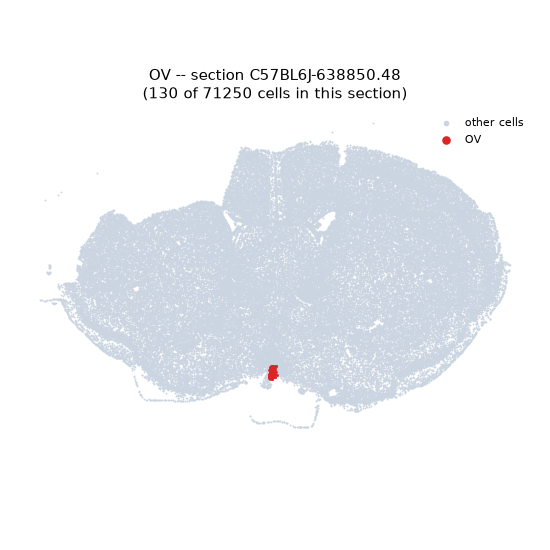
MERFISH REGION LOCATOR
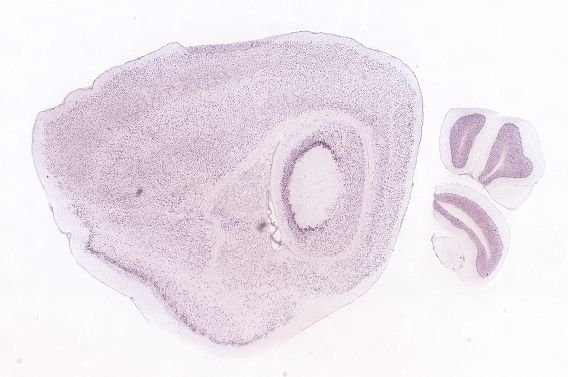
DIRECT ALLEN ISH
DIRECT ALLEN ISH
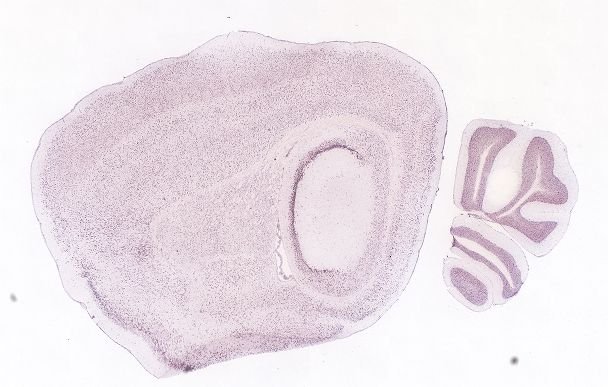
Regional expression figure
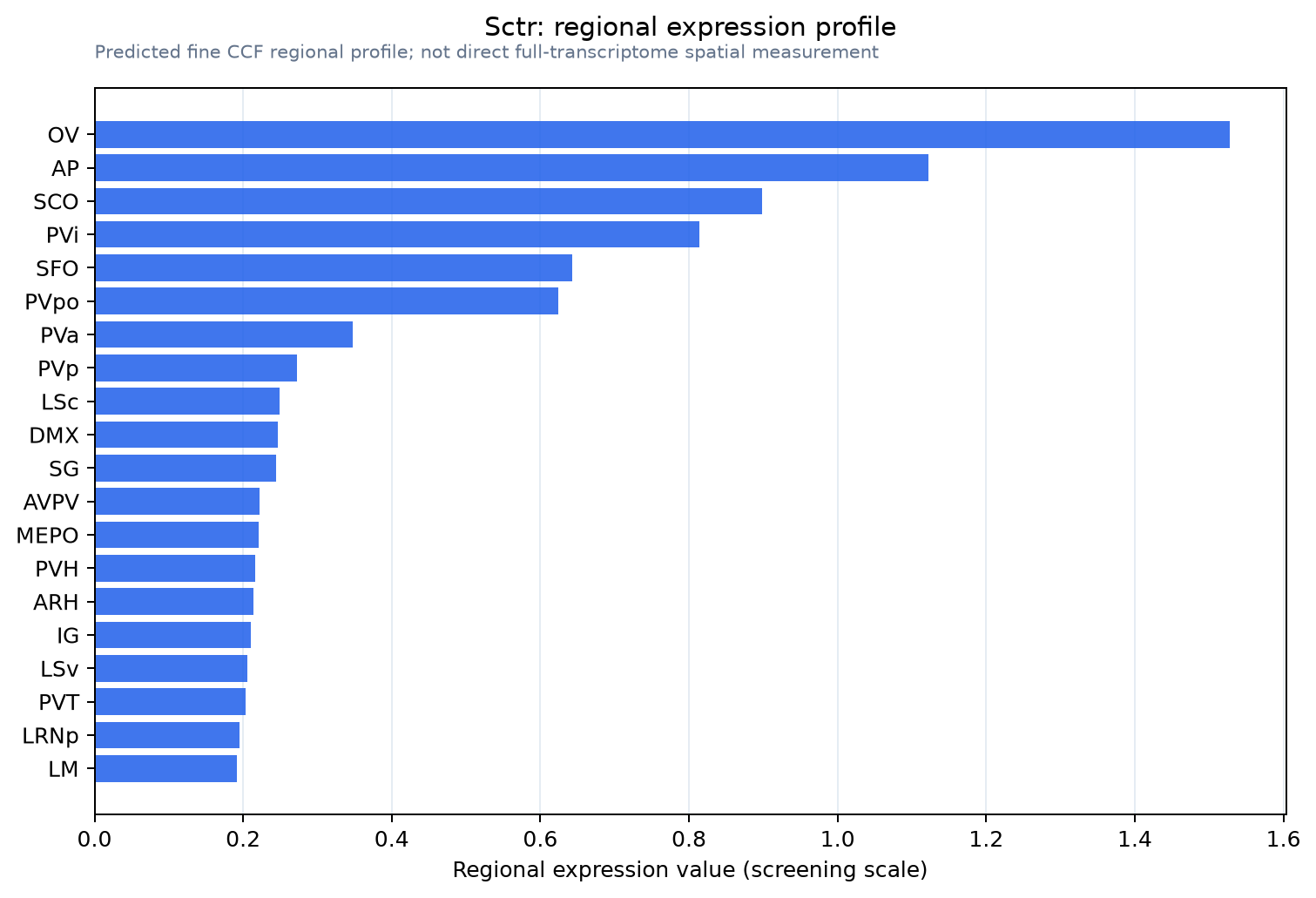
Predicted WMB × fine-CCF profile; not direct full-transcriptome spatial measurement.
Spatial profile
Evidence and specificity
- Evidence status
- PREDICTED_FINE
- Direct sources
- None; predicted localization only
- Exclusive threshold
- 12 positive regions out of 554
- Spatial specificity
- 0.361
- Top-region fraction
- 0.122
- Filter status
- PASS
Interpretation limits
- Cell-type-to-region projection is imputed expression, not direct spatial measurement.
- Adult reference atlases do not establish stability across age, sex, strain, state, or disease.
- Transcript abundance does not guarantee protein abundance or genetic-tool performance.