Prokr1
Prokineticin receptor 1 (PK-R1) (G protein-coupled receptor 73)
Spatial tier: RESTRICTED · Class: GPCR · Top region: SAG (Nucleus sagulum) · Positive regions: 18/554
47.9Discovery Score
36.9Targetability Score
CEvidence grade C
What this means: Prokr1: fine CCF profile is restricted toward SAG (top regions: SAG, ARH, DMX, PPN, CUN; 18 positive regions); direct spatial validation is still required.
Function in SAG: evidence, prediction, innovation
- Gene function
- Prokr1 encodes prokineticin receptor 1 (GPR73), a class A GPCR for the secreted cysteine-rich proteins prokineticin-1 (EG-VEGF) and prokineticin-2 (Bv8). It couples to Gq and Gi, mobilising calcium and activating MAPK signalling. The prokineticin system controls gut motility, angiogenesis, nociception, neurogenesis and neuroinflammation, and its paralogue PROKR2 is essential for GnRH neuron migration and circadian output.
- Region function
- The nucleus sagulum is a small lateral tegmental cell group in the lateral midbrain next to the inferior colliculus and lateral lemniscus; it projects to the inferior colliculus and auditory thalamus and contributes to multisensory and auditory-limbic processing of salient or aversive sounds.
- Published in this region
- inferred No region-specific literature found. CNS prokineticin receptor expression has been mapped mainly to the suprachiasmatic nucleus, olfactory bulb, hypothalamus and spinal nociceptive circuits, with PROKR1 predominating in sensory and immune cells (Chen 2005; Lattanzi 2021); the sagulum itself is defined anatomically by its projection to the inferior colliculus (Henkel 1988) and neighbouring lateral tegmental circuits have recently been implicated in noise-induced negative valence (Zhou 2025).
- Predicted function
- Prediction: if PROKR1 is enriched in sagulum neurons, prokineticin-2 released from nearby tegmental or circadian sources would act through Gq to depolarise them and raise their gain, biasing inferior-colliculus and auditory-thalamic output toward salient or threatening sounds and providing a route by which time of day and inflammatory state modulate auditory salience. Local infusion of the PROKR antagonist PC1, or Prokr1 deletion, is predicted to reduce acoustic startle and defensive responses to loud sounds and to weaken noise-induced aversive learning, without changing hearing thresholds.
- Innovation
- ★★★★★ 5/5 Neither the prokineticin system nor much else has been examined in the sagulum, yet it is an accessible node of the ascending auditory-aversive pathway with usable knockout and antagonist tools.
- Tools
- Prokr1 knockout mice; non-peptide PROKR antagonists PC1 and PC7; agonists Bv8/PROK2; anti-PROKR1 antibodies; the sagulum is reachable with retro-AAV or CAV2-Cre injected into the inferior colliculus; no Prokr1 driver line in common use.
- References
Direct evidence located at the region
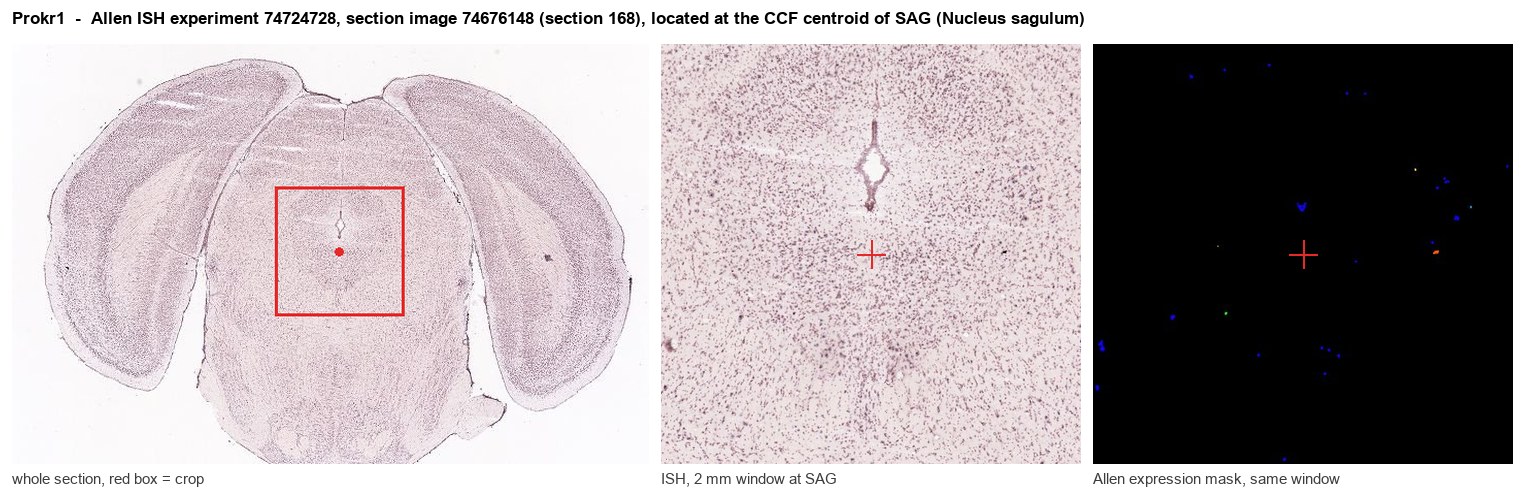
Allen ISH experiment 74724728, section image 74676148 (section 168): the section that contains the CCF centroid of Nucleus sagulum according to the Allen image-to-atlas alignment (reference_to_image), with a 2 mm window around that point. Left: whole section, red box = window. Middle: ISH signal. Right: Allen's expression-mask view of the same window. open this image in the Allen viewer
Look it up yourself: Allen Mouse Brain ISH for Prokr1Allen reference atlas: SAG (structure 271)ABC Atlas MERFISH viewer(in the ABC Atlas choose dataset MERFISH-C57BL6J-638850-CCF, colour cells by gene "Prokr1" or by parcellation_substructure "SAG")All genes confined to SAG + 3-D brain
Direct spatial evidence
MERFISH REGION LOCATOR
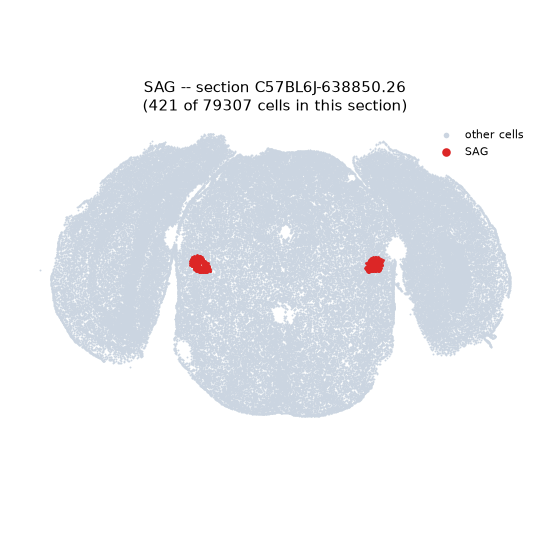
Regional expression figure
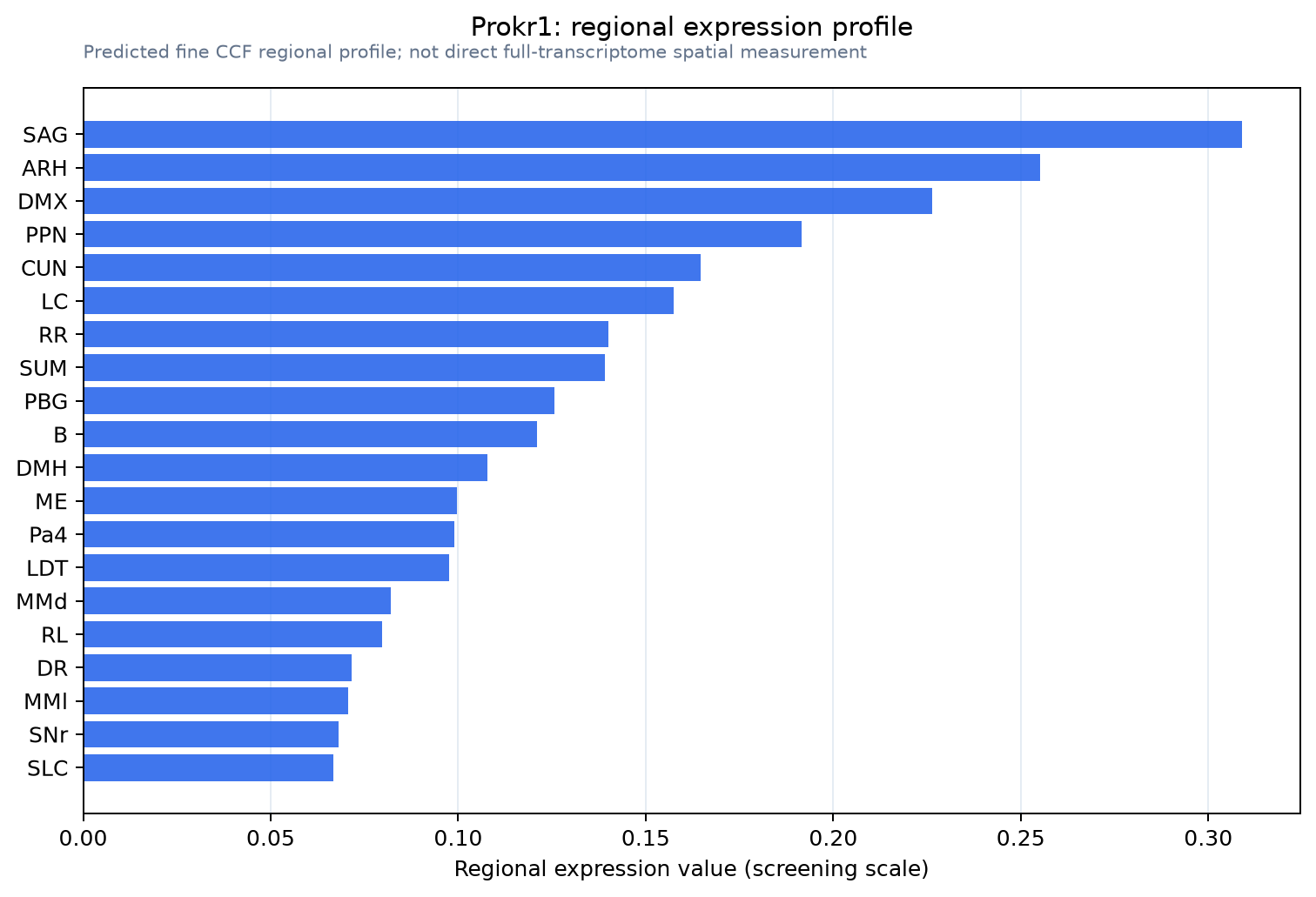
Predicted WMB × fine-CCF profile; not direct full-transcriptome spatial measurement.
Spatial profile
Evidence and specificity
- Evidence status
- PREDICTED_FINE
- Direct sources
- None; predicted localization only
- Exclusive threshold
- 12 positive regions out of 554
- Spatial specificity
- 0.349
- Top-region fraction
- 0.072
- Filter status
- PASS
Interpretation limits
- Cell-type-to-region projection is imputed expression, not direct spatial measurement.
- Adult reference atlases do not establish stability across age, sex, strain, state, or disease.
- Transcript abundance does not guarantee protein abundance or genetic-tool performance.