Pkd2l2
Polycystin-2-like protein 2 (Polycystin-2L2) (Polycystic kidney disease 2-like 2 protein) (Polycystin-L2)
Spatial tier: RESTRICTED · Class: ION_CHANNEL · Top region: SCO (Subcommissural organ) · Positive regions: 27/554
42.0Discovery Score
36.1Targetability Score
CEvidence grade C
What this means: Pkd2l2: fine CCF profile is restricted toward SCO (top regions: SCO, IPR, AD, AOBgr, IMD; 27 positive regions); direct spatial validation is still required.
Function in SCO: evidence, prediction, innovation
- Gene function
- Pkd2l2 encodes polycystin-2-like 2 (TRPP5), a six-transmembrane TRPP-family subunit related to polycystin-2 (PKD2) and PKD2L1. Unlike its relatives it has no established conductance in heterologous systems and its expression is largely restricted to testis and male germ cells. By analogy with other polycystins it is thought to act as a calcium-permeable channel, or a channel partner, in ciliary membranes.
- Region function
- The subcommissural organ is a tiny ependymal secretory gland at the entrance of the cerebral aqueduct beneath the posterior commissure; it releases SCO-spondin into the CSF, where it condenses into Reissner's fibre, and its failure causes aqueductal stenosis and hydrocephalus.
- Published in this region
- inferred No region-specific literature found. The closest functional analogue is the paralogue PKD2L1, the defining marker of CSF-contacting neurons lining the central canal and ventricles and of sour-taste cells; PKD2L2 itself has only been examined in germ cells, alongside the related germ-cell polycystin PKDREJ (Sutton 2006).
- Predicted function
- Prediction: by analogy with PKD2L1 in CSF-contacting neurons and polycystin-2 in renal primary cilia, PKD2L2 in the SCO would most plausibly sit in the apical cilia of ependymocytes as a calcium-permeable, flow- or pH-sensitive channel, letting the gland sense CSF movement and acidity and adjust SCO-spondin secretion accordingly. Knockout is predicted to give no behavioural phenotype but to blunt flow-evoked calcium transients in SCO cilia and mildly destabilise Reissner's-fibre output. Because this is otherwise a testis gene, RNAscope validation should precede any manipulation.
- Innovation
- ★★★★☆ 4/5 A polycystin at the CSF-sensing surface of the subcommissural organ is an untouched idea, but the absence of any Pkd2l2-specific reagent makes it harder than the SCO's other candidates.
- Tools
- None known for Pkd2l2 itself: no knockout, Cre line, selective blocker or validated antibody in common use. The closest tool set is the PKD2L1 reagents (Pkd2l1-Cre, Pkd2l1 knockout) used for CSF-contacting neurons, plus FoxJ1-CreER (JAX 027012) for generic ependymal manipulation.
- References
Direct evidence located at the region
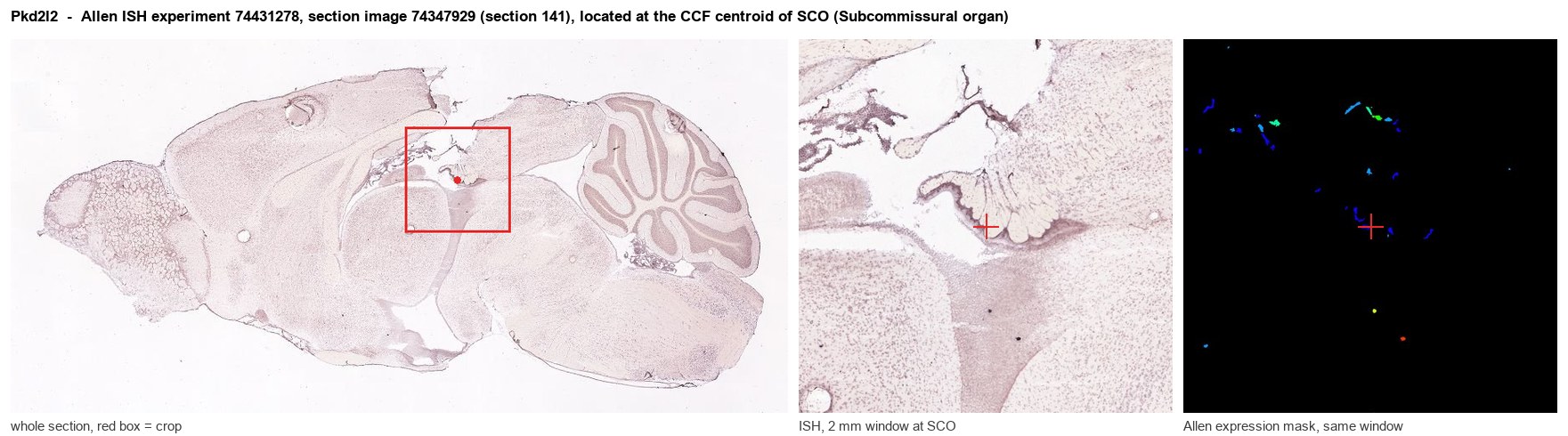
Allen ISH experiment 74431278, section image 74347929 (section 141): the section that contains the CCF centroid of Subcommissural organ according to the Allen image-to-atlas alignment (reference_to_image), with a 2 mm window around that point. Left: whole section, red box = window. Middle: ISH signal. Right: Allen's expression-mask view of the same window. open this image in the Allen viewer
Look it up yourself: Allen Mouse Brain ISH for Pkd2l2Allen reference atlas: SCO (structure 599626923)ABC Atlas MERFISH viewer(in the ABC Atlas choose dataset MERFISH-C57BL6J-638850-CCF, colour cells by gene "Pkd2l2" or by parcellation_substructure "SCO")All genes confined to SCO + 3-D brain
Direct spatial evidence
MERFISH REGION LOCATOR
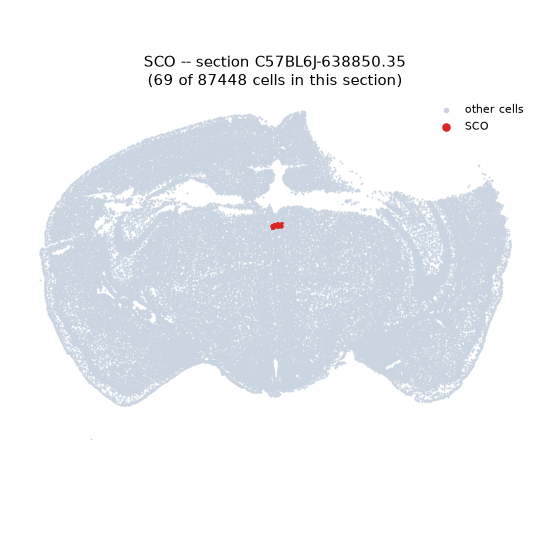
Regional expression figure
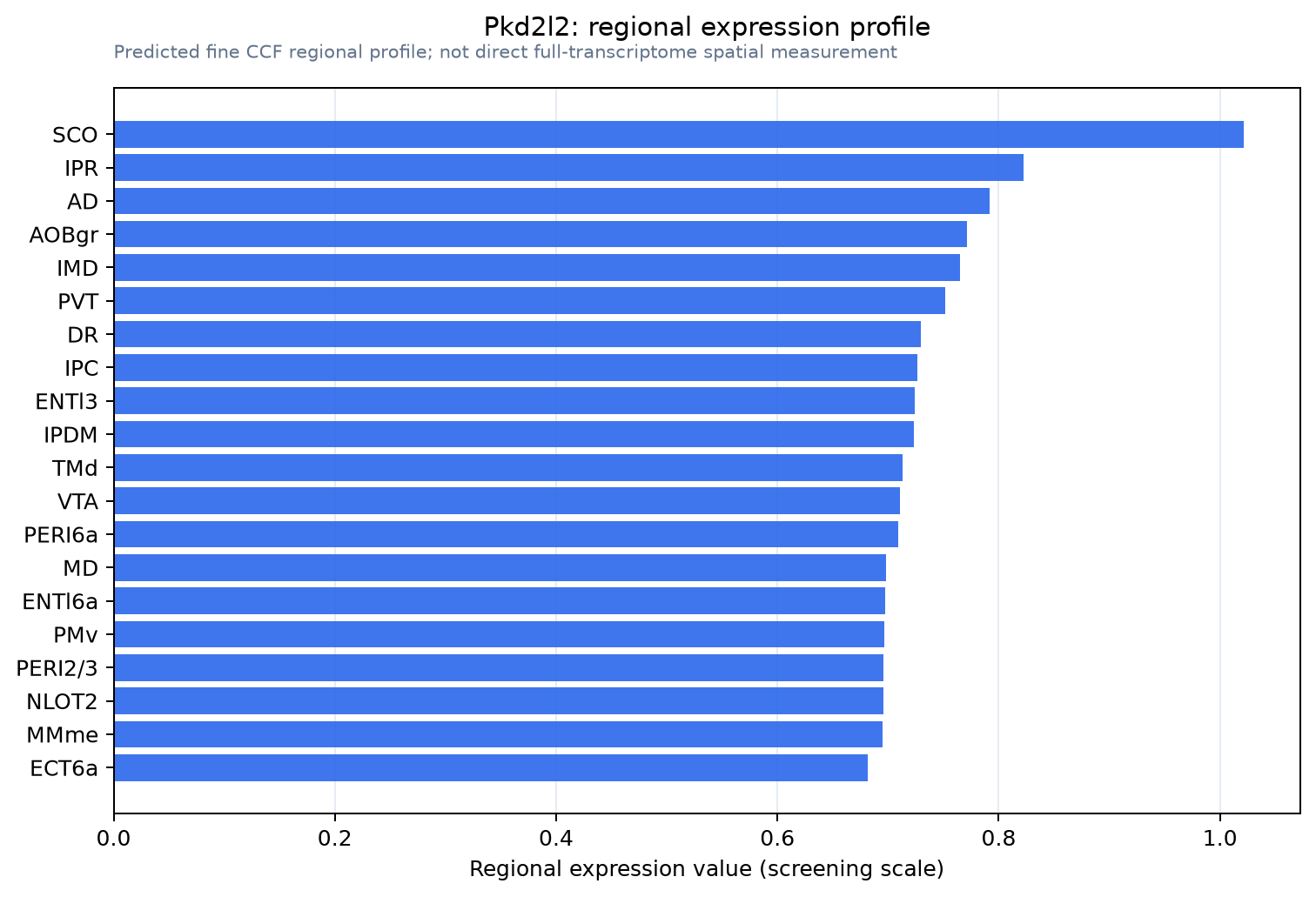
Predicted WMB × fine-CCF profile; not direct full-transcriptome spatial measurement.
Spatial profile
Evidence and specificity
- Evidence status
- PREDICTED_FINE
- Direct sources
- None; predicted localization only
- Exclusive threshold
- 12 positive regions out of 554
- Spatial specificity
- 0.291
- Top-region fraction
- 0.058
- Filter status
- PASS
Interpretation limits
- Cell-type-to-region projection is imputed expression, not direct spatial measurement.
- Adult reference atlases do not establish stability across age, sex, strain, state, or disease.
- Transcript abundance does not guarantee protein abundance or genetic-tool performance.