Npy6r
Neuropeptide Y receptor type 6 (NPY6-R) (Pancreatic polypeptide receptor 2) (PP2)
Spatial tier: STRICT_EXCLUSIVE · Class: GPCR · Top region: SCH (Suprachiasmatic nucleus) · Positive regions: 1/554
64.7Discovery Score
65.7Targetability Score
CEvidence grade C
What this means: Npy6r: predicted fine-region profile is strict-exclusive, with 1 positive regions out of 554 (limit 12); direct spatial validation is required.
Function in SCH: evidence, prediction, innovation
- Gene function
- Npy6r encodes the Y6 receptor, a class-A GPCR binding NPY, PYY and especially pancreatic polypeptide (PP), signalling via Gi/o to lower cAMP. Functional in mouse but a truncated pseudogene in humans and most primates, it gates hypothalamic Ghrh and the GH/IGF-1 axis.
- Region function
- The suprachiasmatic nucleus is the master circadian pacemaker: retinorecipient VIP neurons entrain an AVP shell, timing sleep-wake, feeding, corticosterone, temperature and peripheral clocks.
- Published in this region
- direct Direct. Yulyaningsih et al. 2014: Npy6r is in SCN VIP neurons; PP raises hypothalamic Ghrh mRNA and serum IGF-1 via VIP release, and Npy6r-null mice have reduced lean mass and a blunted GH axis. Khor et al. 2016: Y6 suppresses bone resorption and promotes bone formation via an SCN relay. Earlier ISH: Npy6r in SCN, anterior hypothalamus, BNST, VMH.
- Predicted function
- Prediction: Y6 lets the SCN read the pancreatic meal signal PP, so nutritional state gates VIP-neuron output and circadian drive to the GH axis, bone and peripheral clocks. Vip-Cre Npy6r deletion should spare free-running period but blunt food-entrainable phase shifts, GH/IGF-1 pulsatility and bone accrual.
- Innovation
- ★★★☆☆ 3/5 The SCN-Npy6r link is established for metabolism and bone, but its circadian role and cell-type-specific circuitry remain unexplored.
- Tools
- Npy6r-null mice (Herzog lab); Vip-IRES-Cre (JAX 010908), Avp-IRES2-Cre-D (JAX 023530); agonists PP and [Pro34]PYY (no Y6-selective small molecule); antagonists BIBO3304, BIIE0246, L-152,804.
- References
Direct evidence located at the region
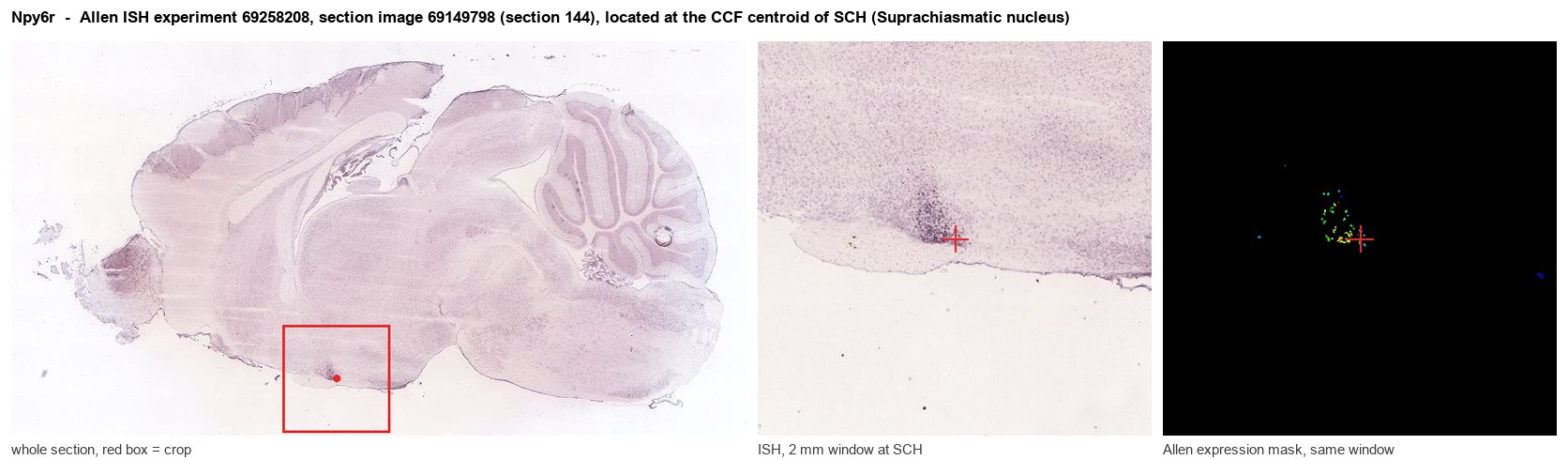
Allen ISH experiment 69258208, section image 69149798 (section 144): the section that contains the CCF centroid of Suprachiasmatic nucleus according to the Allen image-to-atlas alignment (reference_to_image), with a 2 mm window around that point. Left: whole section, red box = window. Middle: ISH signal. Right: Allen's expression-mask view of the same window. open this image in the Allen viewer
Look it up yourself: Allen Mouse Brain ISH for Npy6rAllen reference atlas: SCH (structure 286)ABC Atlas MERFISH viewer(in the ABC Atlas choose dataset MERFISH-C57BL6J-638850-CCF, colour cells by gene "Npy6r" or by parcellation_substructure "SCH")All genes confined to SCH + 3-D brain
Direct spatial evidence
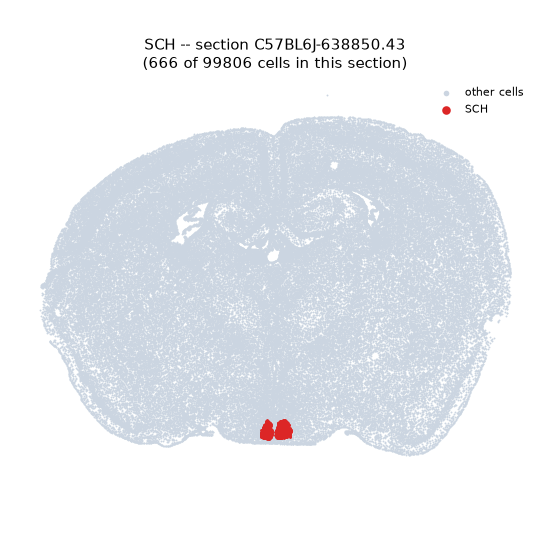
MERFISH REGION LOCATOR
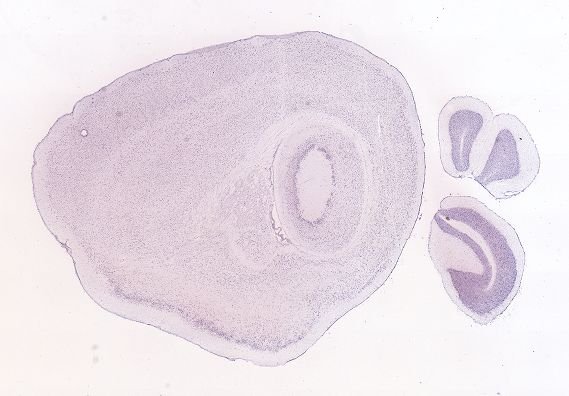
DIRECT ALLEN ISH
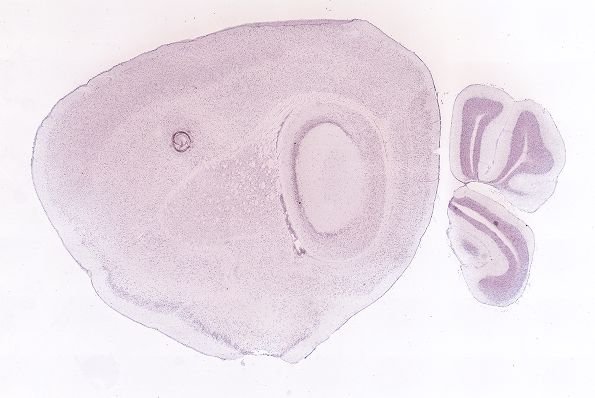
DIRECT ALLEN ISH
Regional expression figure
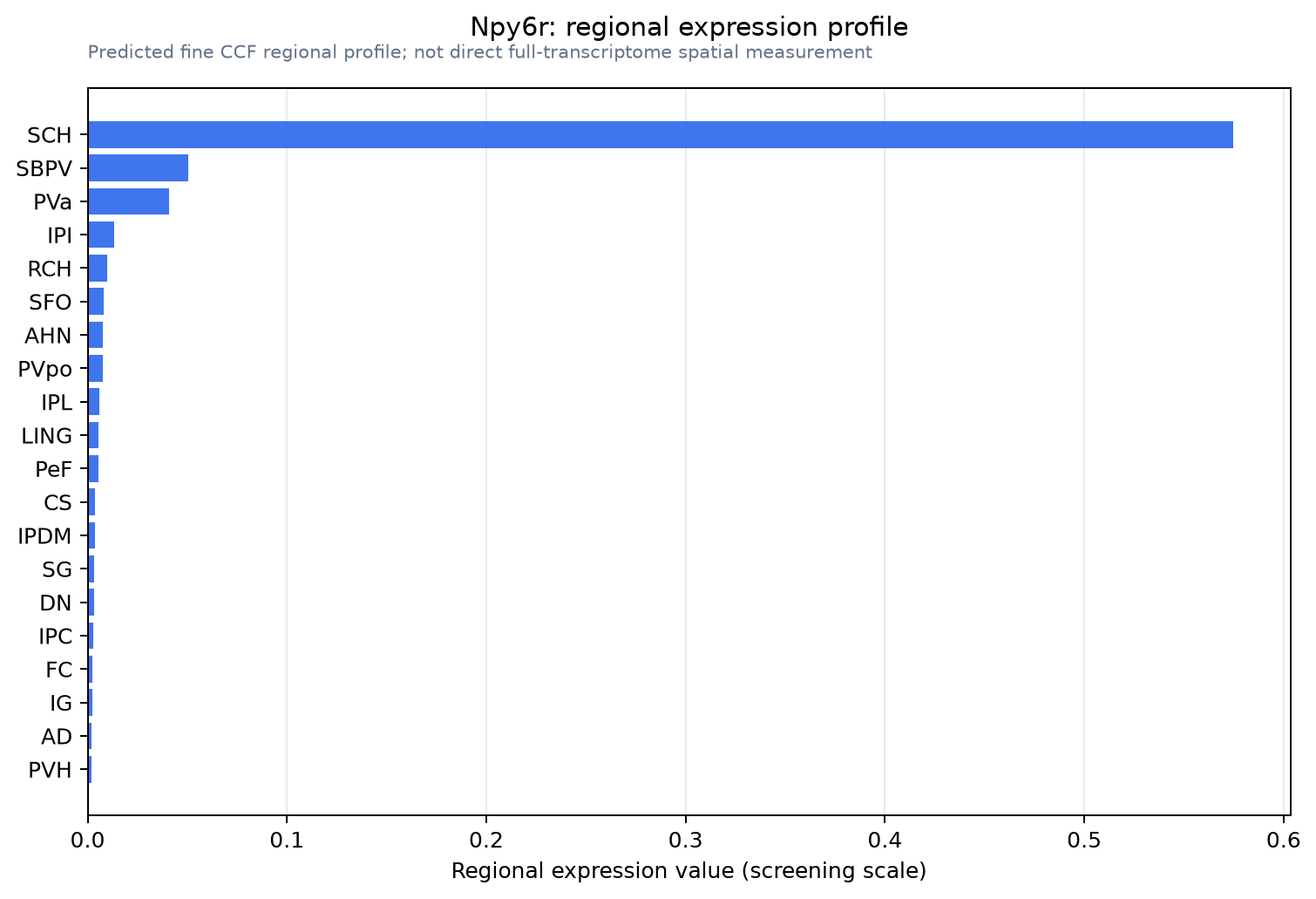
Predicted WMB × fine-CCF profile; not direct full-transcriptome spatial measurement.
Spatial profile
Evidence and specificity
- Evidence status
- PREDICTED_FINE
- Direct sources
- None; predicted localization only
- Exclusive threshold
- 12 positive regions out of 554
- Spatial specificity
- 0.755
- Top-region fraction
- 0.716
- Filter status
- PASS
Interpretation limits
- Cell-type-to-region projection is imputed expression, not direct spatial measurement.
- Adult reference atlases do not establish stability across age, sex, strain, state, or disease.
- Transcript abundance does not guarantee protein abundance or genetic-tool performance.