Nppb
Spatial tier: STRICT_EXCLUSIVE · Class: OTHER · Top region: DMX (Dorsal motor nucleus of the vagus nerve) · Positive regions: 1/554
53.9Discovery Score
45.7Targetability Score
CEvidence grade C
What this means: Nppb: predicted fine-region profile is strict-exclusive, with 1 positive regions out of 554 (limit 12); direct spatial validation is required.
Function in DMX: evidence, prediction, innovation
- Gene function
- Nppb encodes B-type (brain) natriuretic peptide, a secreted peptide hormone of the natriuretic peptide family released mainly by cardiac myocytes under wall stress. BNP binds the receptor guanylyl cyclase NPR-A (Npr1), raising cGMP and PKG signalling to promote natriuresis, vasodilation and reduced sympathetic drive; it is cleared by NPR-C. In the nervous system BNP acts as a neuropeptide transmitter, most famously in the spinal itch pathway.
- Region function
- The dorsal motor nucleus of the vagus supplies the cholinergic preganglionic parasympathetic outflow to the gut, pancreas and heart, controlling gastric motility and secretion, insulin release and vagal tone.
- Published in this region
- expression only Tao et al. 2021 (Neuron) profiled DMV motor neurons by single-cell RNA-seq and defined seven subtypes, one of which is marked by Nppb, with subtype-specific Cre drivers used to show labelled-line brain-to-gut control of the glandular stomach. Hornung et al. 2024 (iScience) mapped cardiac-projecting DMV neurons and explicitly aligned their transcriptomic subtype 2 to the 'Nppb and Trpv1 neurons from Tao et al.' No study has manipulated Nppb itself in the DMV.
- Predicted function
- Prediction: BNP is a co-transmitter released alongside acetylcholine by one labelled-line class of vagal preganglionic neurons, acting on NPR-A/cGMP in enteric or cardiac ganglion targets to slow and smooth cholinergic drive. Conditional Nppb deletion from DMV neurons should leave gross vagal tone intact but alter gastric secretion/accommodation or heart-rate variability; chemogenetic activation of Nppb+ DMV neurons should produce a selective visceral output distinct from Cck+ or Pdyn+ DMV lines, and NPR-A blockade in the target organ should occlude it.
- Innovation
- ★★★★☆ 4/5 Nppb is established as a DMV subtype marker but its peptide function in vagal output has never been tested.
- Tools
- Nppb-Cre and Nppb knockout mice (used in the itch field); Chat-Cre and Phox2b drivers for vagal motor neurons; Npr1 (NPR-A) knockout and the antagonist A-71915; anti-proBNP antibodies and BNP RIA/ELISA; Allen mouse ISH dataset 69174475.
- References
Direct evidence located at the region
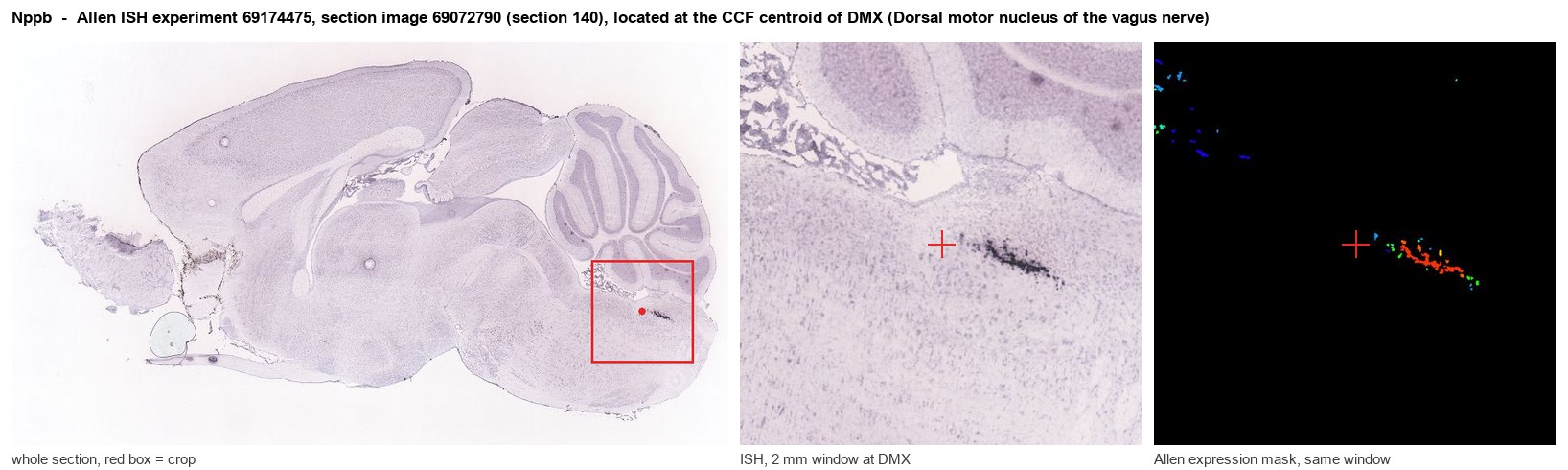
Allen ISH experiment 69174475, section image 69072790 (section 140): the section that contains the CCF centroid of Dorsal motor nucleus of the vagus nerve according to the Allen image-to-atlas alignment (reference_to_image), with a 2 mm window around that point. Left: whole section, red box = window. Middle: ISH signal. Right: Allen's expression-mask view of the same window. open this image in the Allen viewer
Look it up yourself: Allen Mouse Brain ISH for NppbAllen reference atlas: DMX (structure 839)ABC Atlas MERFISH viewer(in the ABC Atlas choose dataset MERFISH-C57BL6J-638850-CCF, colour cells by gene "Nppb" or by parcellation_substructure "DMX")All genes confined to DMX + 3-D brain
Direct spatial evidence
MERFISH REGION LOCATOR
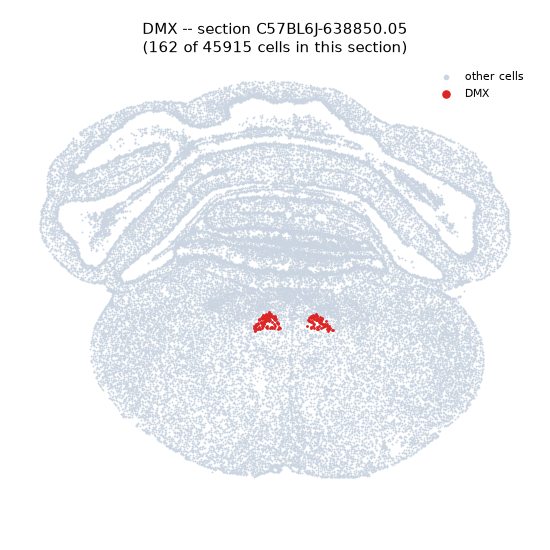
Regional expression figure
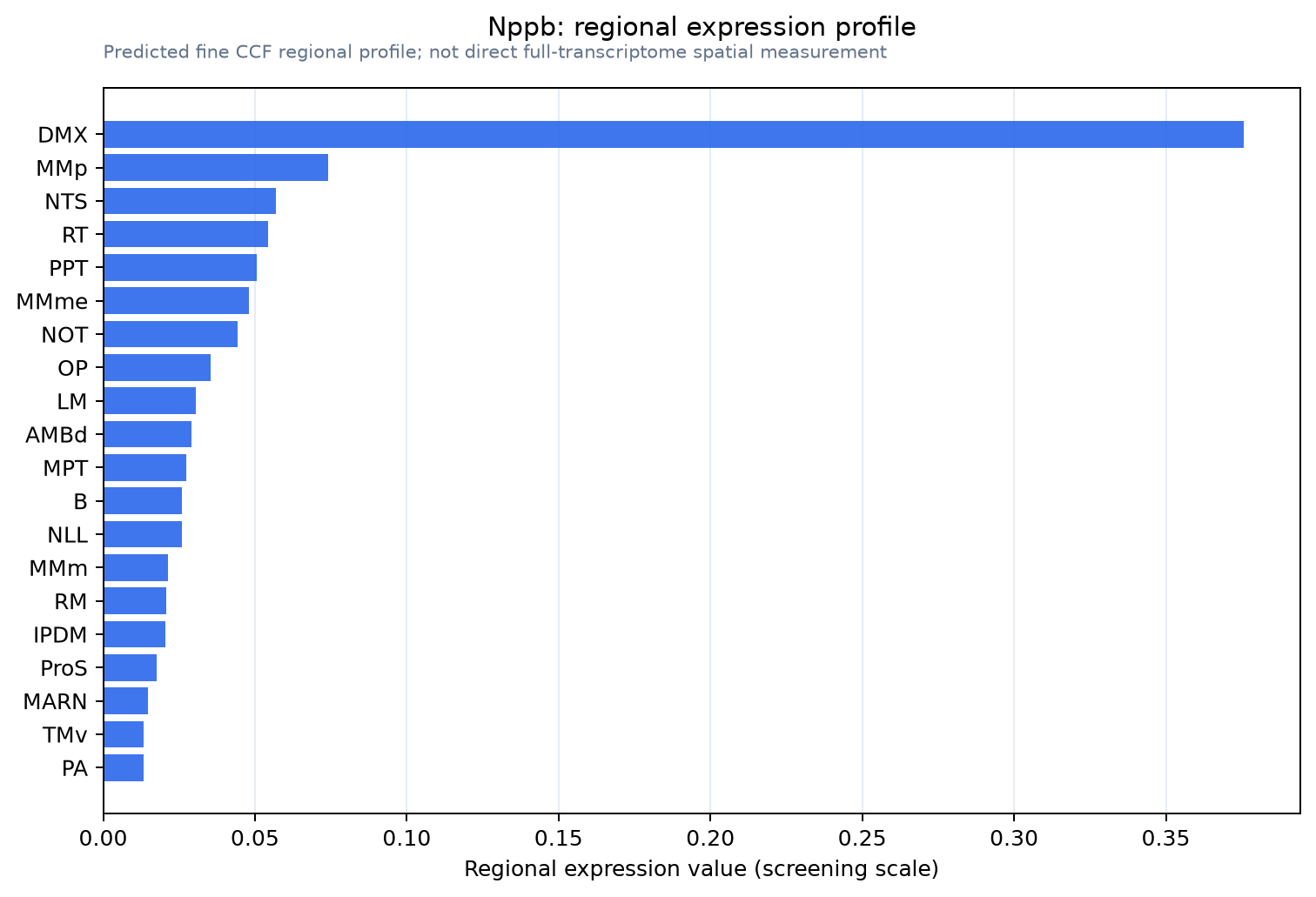
Predicted WMB × fine-CCF profile; not direct full-transcriptome spatial measurement.
Spatial profile
Evidence and specificity
- Evidence status
- PREDICTED_FINE
- Direct sources
- None; predicted localization only
- Exclusive threshold
- 12 positive regions out of 554
- Spatial specificity
- 0.479
- Top-region fraction
- 0.310
- Filter status
- PASS
Interpretation limits
- Cell-type-to-region projection is imputed expression, not direct spatial measurement.
- Adult reference atlases do not establish stability across age, sex, strain, state, or disease.
- Transcript abundance does not guarantee protein abundance or genetic-tool performance.