Kcng4
Voltage-gated potassium channel regulatory subunit KCNG4 (Potassium voltage-gated channel subfamily G member 4) (Voltage-gated potassium channel subunit Kv6.3) (Voltage-gated potassium channel subunit
Spatial tier: RESTRICTED · Class: ION_CHANNEL · Top region: MH (Medial habenula) · Positive regions: 20/554
Function in MH: evidence, prediction, innovation
- Gene function
- KCNG4 encodes Kv6.3, a member of the electrically silent KvS subfamily of voltage-gated potassium channel subunits. Kv6.3 cannot form functional homotetramers; instead it obligatorily co-assembles with Kv2.1 (KCNB1), and the resulting heterotetramers show a large hyperpolarising shift in steady-state inactivation and slowed recovery. KvS subunits therefore act as tuning modules that convert the broadly expressed Kv2.1 delayed rectifier into cell-type-specific conductances.
- Region function
- The medial habenula is a dorsal diencephalic nucleus whose cholinergic, glutamatergic and substance-P neurons project almost exclusively through the fasciculus retroflexus to the interpeduncular nucleus; it controls nicotine aversion and withdrawal, anxiety and mood.
- Published in this region
- inferred No region-specific literature found. Kv6.3 biology is known almost entirely from heterologous expression and from recent work using Kv2-inhibitor combinations to reveal native Kv2/KvS heteromeric conductances in neurons (Stewart et al. 2025); comparable work on Kv2.1/Kv6.4 defines the stoichiometry and gating consequences (Moller et al. 2020), but no study has examined any KvS subunit in the habenula.
- Predicted function
- Prediction: medial habenular neurons are unusual in firing tonically and regularly at several hertz without synaptic input, a property that depends on a finely balanced delayed-rectifier conductance, and Kv6.3 is predicted to be the subunit that sets this balance by shifting Kv2.1 inactivation into the range of the MH resting potential. Kcng4 deletion is predicted to leave Kv2.1 protein levels unchanged but to depolarise the inactivation curve, increase available potassium current at rest and slow or silence spontaneous MH firing, which should reduce tonic cholinergic drive to the interpeduncular nucleus and blunt nicotine withdrawal signs; the Kv2-inhibitor combination approach of Stewart et al. offers a pharmacological test in slices before committing to a knockout.
- Innovation
- ★★★★★ 5/5 Silent KvS subunits are almost entirely unexplored in identified brain circuits, and the medial habenula's distinctive pacemaking makes it an ideal place to show that Kv6.3 matters.
- Tools
- Kcng4 knockout-first alleles from IMPC; the Kv2-selective blockers guangxitoxin-1E and RY785 combined as in Stewart et al. 2025 to isolate Kv2/KvS conductances; stromatoxin; anti-Kv6.3 antibodies require knockout validation; Tac1-Cre and Chat-Cre for medial habenula neuron subtypes.
- References
Direct evidence located at the region
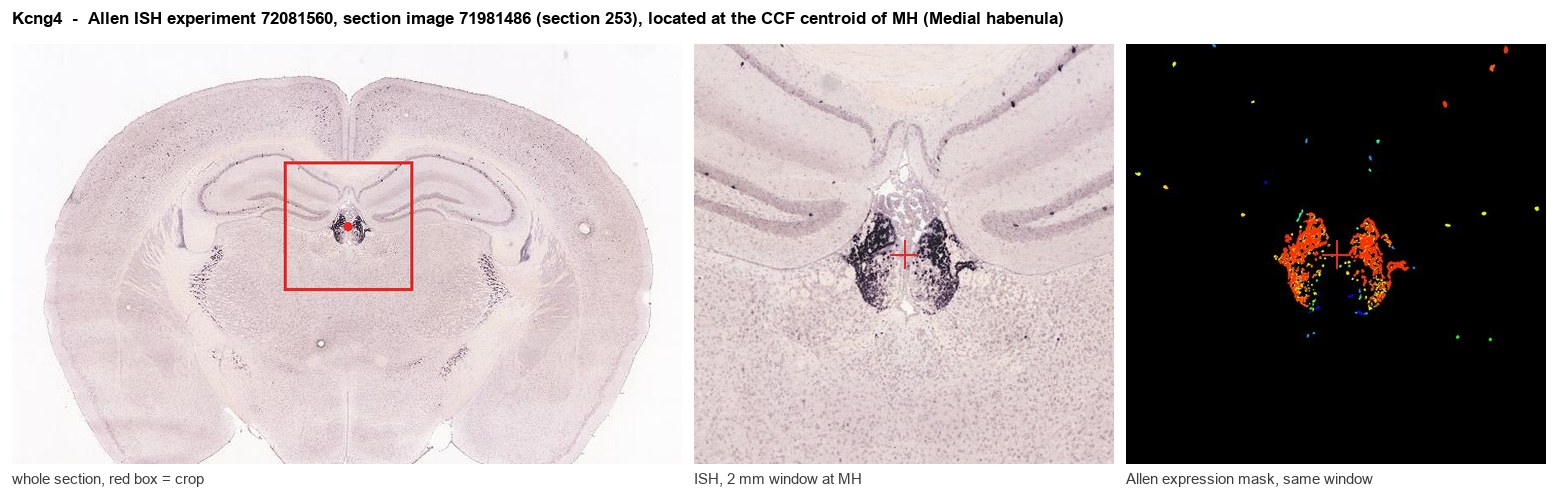
Allen ISH experiment 72081560, section image 71981486 (section 253): the section that contains the CCF centroid of Medial habenula according to the Allen image-to-atlas alignment (reference_to_image), with a 2 mm window around that point. Left: whole section, red box = window. Middle: ISH signal. Right: Allen's expression-mask view of the same window. open this image in the Allen viewer
Direct spatial evidence
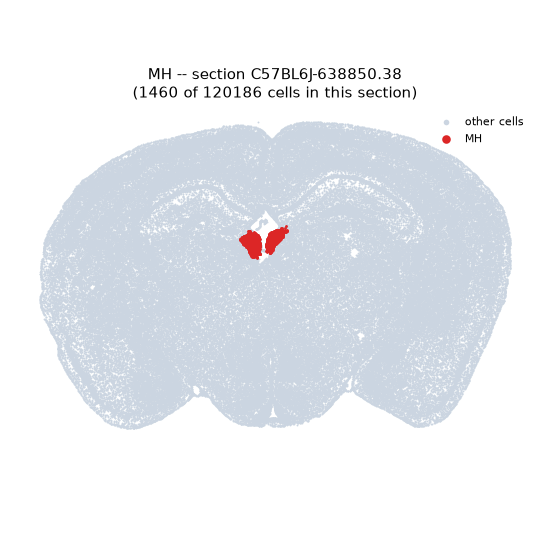
Regional expression figure
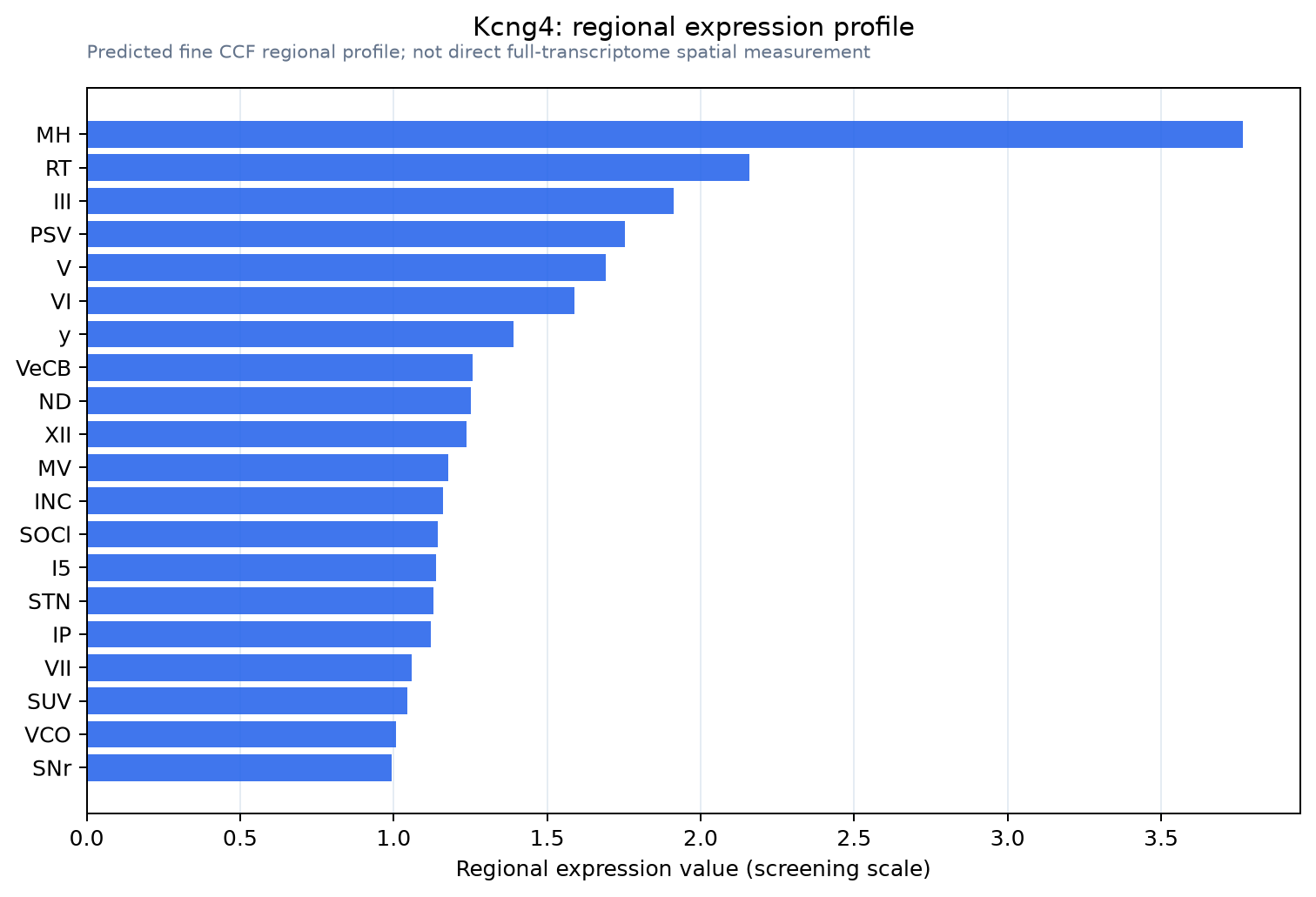
Predicted WMB × fine-CCF profile; not direct full-transcriptome spatial measurement.
Spatial profile
Evidence and specificity
- Evidence status
- PREDICTED_FINE
- Direct sources
- None; predicted localization only
- Exclusive threshold
- 12 positive regions out of 554
- Spatial specificity
- 0.310
- Top-region fraction
- 0.071
- Filter status
- PASS
Interpretation limits
- Cell-type-to-region projection is imputed expression, not direct spatial measurement.
- Adult reference atlases do not establish stability across age, sex, strain, state, or disease.
- Transcript abundance does not guarantee protein abundance or genetic-tool performance.