Kcnd1
A-type voltage-gated potassium channel KCND1 (Potassium voltage-gated channel subfamily D member 1) (Voltage-gated potassium channel subunit Kv4.1) (mShal)
Spatial tier: REGION_BIASED · Class: ION_CHANNEL · Top region: V (Motor nucleus of trigeminal) · Positive regions: 30/554
Function in V: evidence, prediction, innovation
- Gene function
- KCND1 encodes Kv4.1, a pore-forming subunit of the Shal/Kv4 family that carries fast-activating, fast-inactivating subthreshold A-type potassium current (I_A). A-type current delays the first spike, limits firing rate and damps back-propagating dendritic excitation; Kv4.1 is the least abundant and least studied Kv4 subunit compared with Kv4.2 and Kv4.3.
- Region function
- The motor nucleus of the trigeminal nerve contains the alpha and gamma motoneurons that innervate the jaw-closing and jaw-opening muscles; it is the output stage of the brainstem masticatory central pattern generator and controls chewing, gnawing and biting force.
- Published in this region
- inferred No region-specific literature found. The closest evidence is that Kv4.1 sets firing rate in other identified brainstem/hypothalamic neurons, e.g. Hermanstyne 2017 showed acute Kv4.1 knockdown changes repetitive firing rates and clock gene expression in suprachiasmatic neurons and alters locomotor rhythms, while classic mapping (Serodio 1998) shows differential Kv4 subunit expression across rat brain including motor nuclei.
- Predicted function
- Prediction: Kv4.1-mediated A-type current in trigeminal motoneurons would set spike threshold latency and the gain of their frequency-current relationship, determining how smoothly jaw-closer motoneurons are recruited during the slow isometric contractions of chewing. Knocking down Kcnd1 in the trigeminal motor nucleus should shorten first-spike latency and increase firing gain, predicted to produce exaggerated or poorly graded bite force, altered chewing rhythm and, over time, abnormal incisor wear; A-type block with 4-aminopyridine or AmmTX3 should mimic this acutely.
- Innovation
- ★★★★★ 5/5 Motoneuron excitability in the trigeminal nucleus is usually attributed to Kv4.2/4.3 and persistent sodium current, and Kv4.1 has never been examined there despite a clear biomechanical readout.
- Tools
- Kcnd1 knockout/knockdown approaches (AAV-shRNA); A-type blockers 4-aminopyridine, AmmTX3 and phrixotoxin; anti-Kv4.1 antibodies; trigeminal motoneuron access via ChAT-Cre plus retrograde AAV from masseter muscle.
- References
Direct evidence located at the region
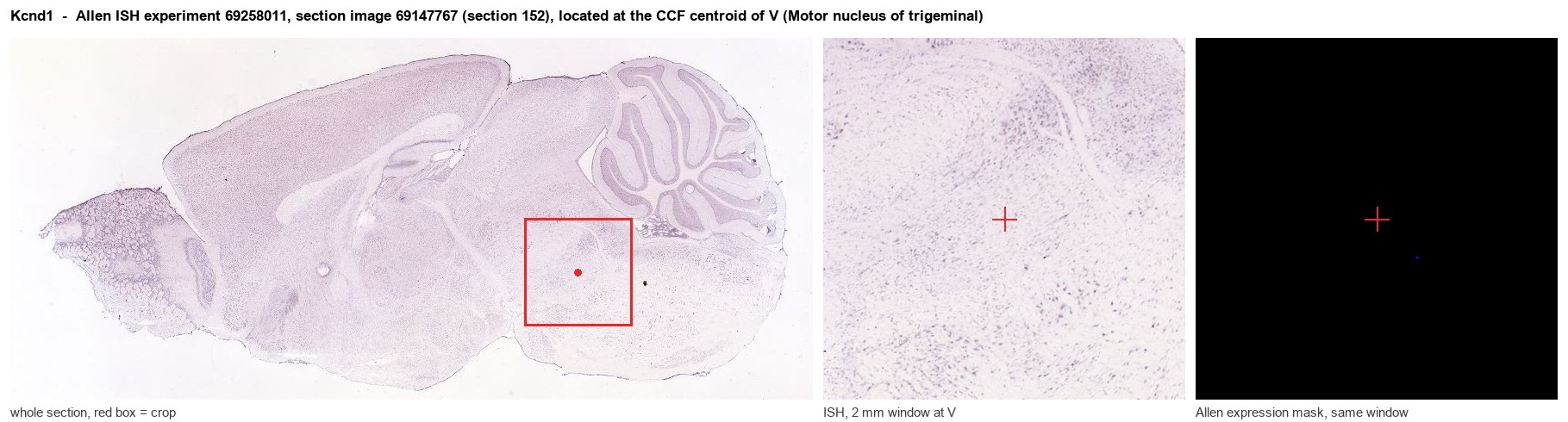
Allen ISH experiment 69258011, section image 69147767 (section 152): the section that contains the CCF centroid of Motor nucleus of trigeminal according to the Allen image-to-atlas alignment (reference_to_image), with a 2 mm window around that point. Left: whole section, red box = window. Middle: ISH signal. Right: Allen's expression-mask view of the same window. open this image in the Allen viewer
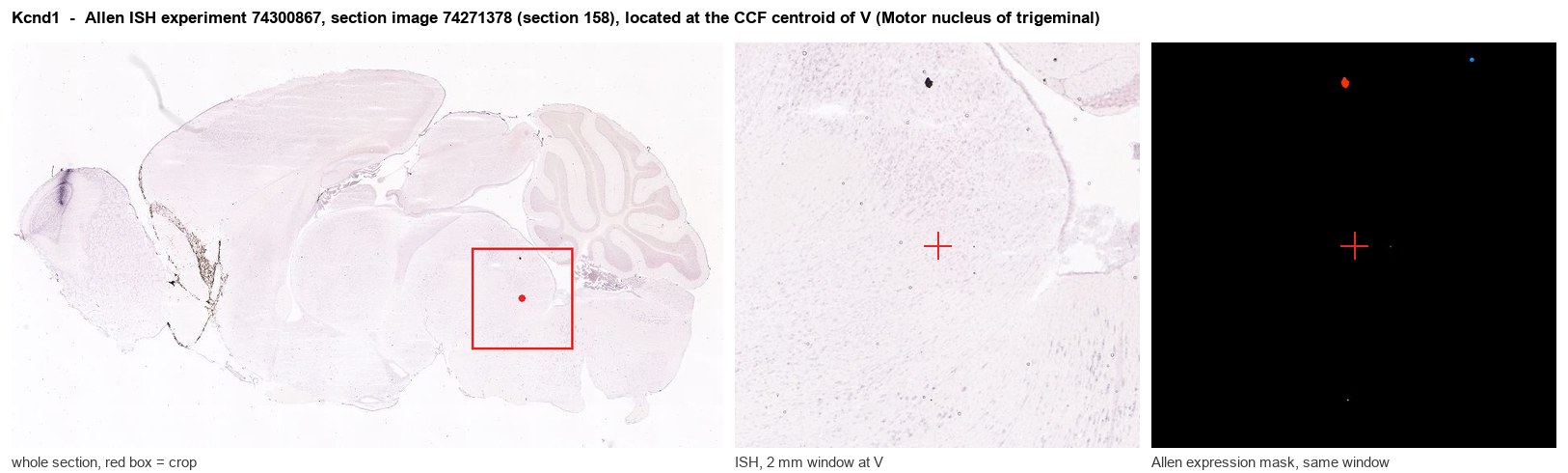
Allen ISH experiment 74300867, section image 74271378 (section 158): the section that contains the CCF centroid of Motor nucleus of trigeminal according to the Allen image-to-atlas alignment (reference_to_image), with a 2 mm window around that point. Left: whole section, red box = window. Middle: ISH signal. Right: Allen's expression-mask view of the same window. open this image in the Allen viewer
Direct spatial evidence
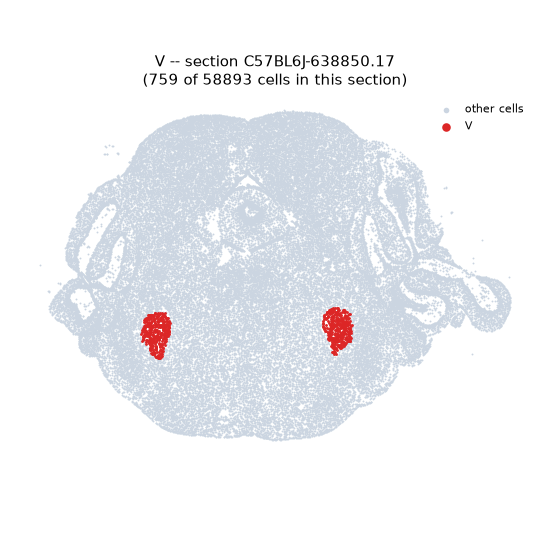
Regional expression figure
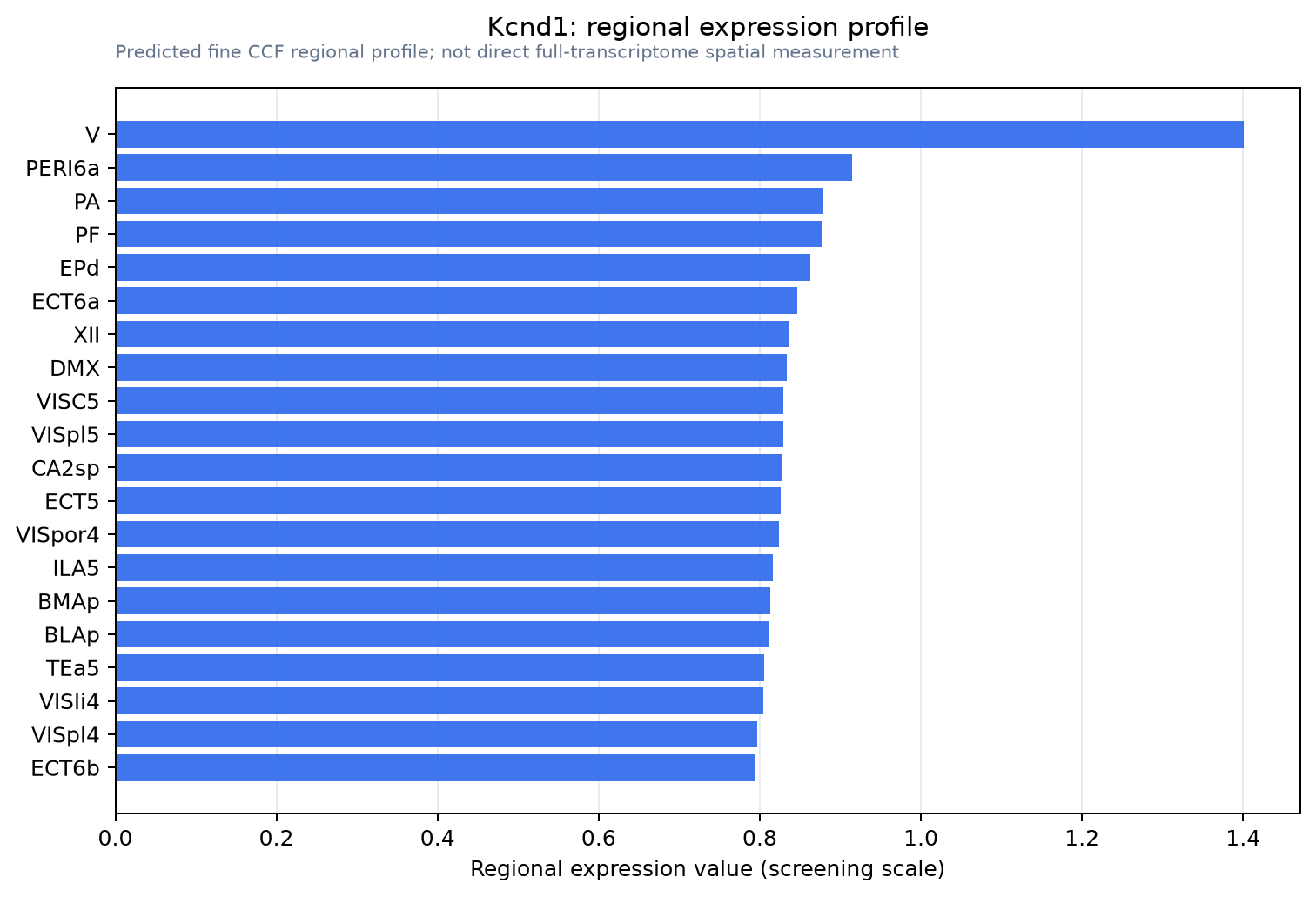
Predicted WMB × fine-CCF profile; not direct full-transcriptome spatial measurement.
Spatial profile
Evidence and specificity
- Evidence status
- PREDICTED_FINE
- Direct sources
- None; predicted localization only
- Exclusive threshold
- 12 positive regions out of 554
- Spatial specificity
- 0.266
- Top-region fraction
- 0.054
- Filter status
- PASS
Interpretation limits
- Cell-type-to-region projection is imputed expression, not direct spatial measurement.
- Adult reference atlases do not establish stability across age, sex, strain, state, or disease.
- Transcript abundance does not guarantee protein abundance or genetic-tool performance.