Grpr
Gastrin-releasing peptide receptor (GRP-R) (GRP-preferring bombesin receptor)
Spatial tier: STRICT_EXCLUSIVE · Class: GPCR · Top region: SCH (Suprachiasmatic nucleus) · Positive regions: 6/554
46.3Discovery Score
39.6Targetability Score
CEvidence grade C
What this means: Grpr: predicted fine-region profile is strict-exclusive, with 6 positive regions out of 554 (limit 12); direct spatial validation is required.
Function in SCH: evidence, prediction, innovation
- Gene function
- Grpr encodes the gastrin-releasing peptide receptor (BB2), a bombesin-family Gq-coupled GPCR driving PLCbeta, IP3/Ca2+ and ERK; its ligand GRP is the mammalian bombesin homolog. Known peripherally for mitogenic actions, it acts centrally in spinal dorsal horn GRPR interneurons relaying itch.
- Region function
- The suprachiasmatic nucleus is the master pacemaker; its retinorecipient core of VIP and GRP neurons passes photic input to the AVP-rich shell.
- Published in this region
- direct Direct. Aida et al. 2002: GRP conveys photic entrainment from ventral to dorsal SCN, inducing mPer1, mPer2 and c-Fos where GRPR is abundant. Karatsoreos et al. 2006: SCN GRPR binding varies with time of day under light-dark but not constant darkness (light- not clock-driven); GRPR-deficient mice show blunted photic phase shifting. Li et al. 2025 (Grp-iCre mice): chemogenetic stimulation of SCN GRP neurons phase-shifts behaviour, and they respond rapidly to light.
- Predicted function
- Prediction: GRPR on shell neurons is the receptor arm of an intra-SCN core-to-shell photic relay. SCN-restricted Grpr deletion should impair light-induced phase delays and shell Per1/Per2 induction, sparing free-running period; local RC-3095 at CT16 should block light-induced delays.
- Innovation
- ★★☆☆☆ 2/5 The GRP ligand and SCN GRP neurons are well studied, but receptor-side, cell-type-specific Grpr manipulation remains undone.
- Tools
- Grp-iCre knock-in mice, Grpr-eGFP and Grpr-CreERT2 lines, Grpr knockout and floxed alleles; antagonists RC-3095 and PD176252, agonists GRP(18-27) and bombesin; partners via Vip-Cre, Vipr2 knockouts and Avp-Cre.
- References
Direct evidence located at the region
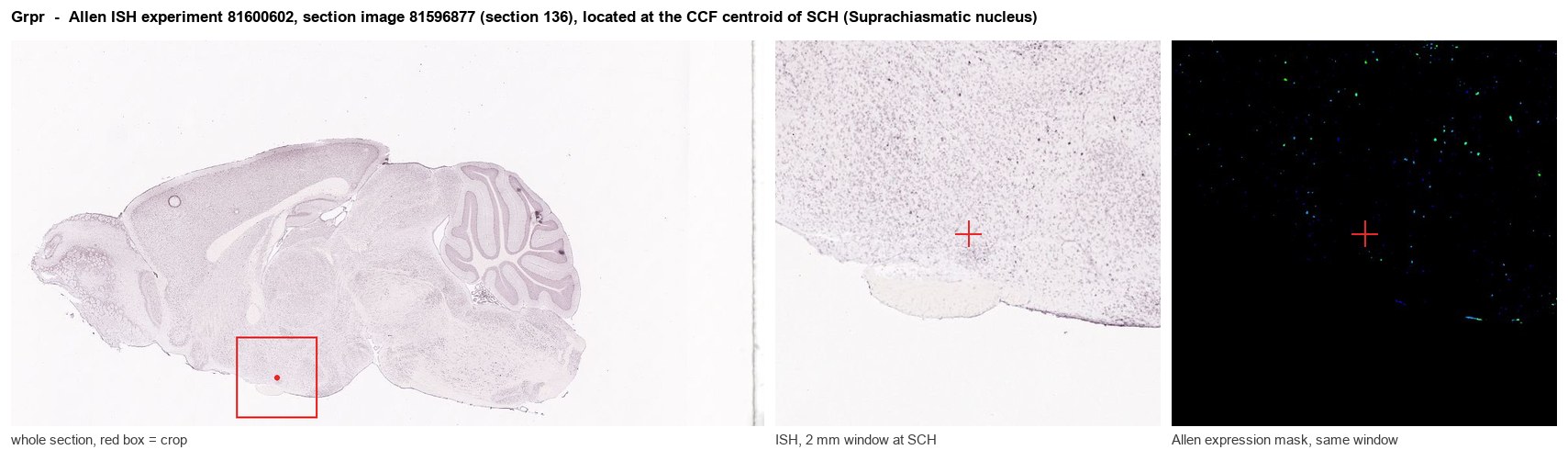
Allen ISH experiment 81600602, section image 81596877 (section 136): the section that contains the CCF centroid of Suprachiasmatic nucleus according to the Allen image-to-atlas alignment (reference_to_image), with a 2 mm window around that point. Left: whole section, red box = window. Middle: ISH signal. Right: Allen's expression-mask view of the same window. open this image in the Allen viewer
Look it up yourself: Allen Mouse Brain ISH for GrprAllen reference atlas: SCH (structure 286)ABC Atlas MERFISH viewer(in the ABC Atlas choose dataset MERFISH-C57BL6J-638850-CCF, colour cells by gene "Grpr" or by parcellation_substructure "SCH")All genes confined to SCH + 3-D brain
Direct spatial evidence
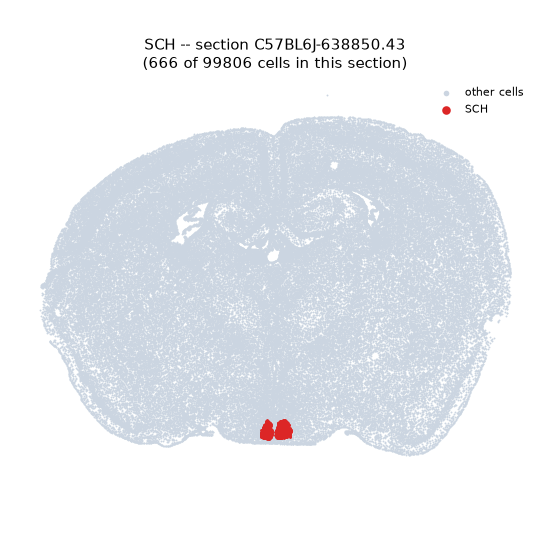
MERFISH REGION LOCATOR
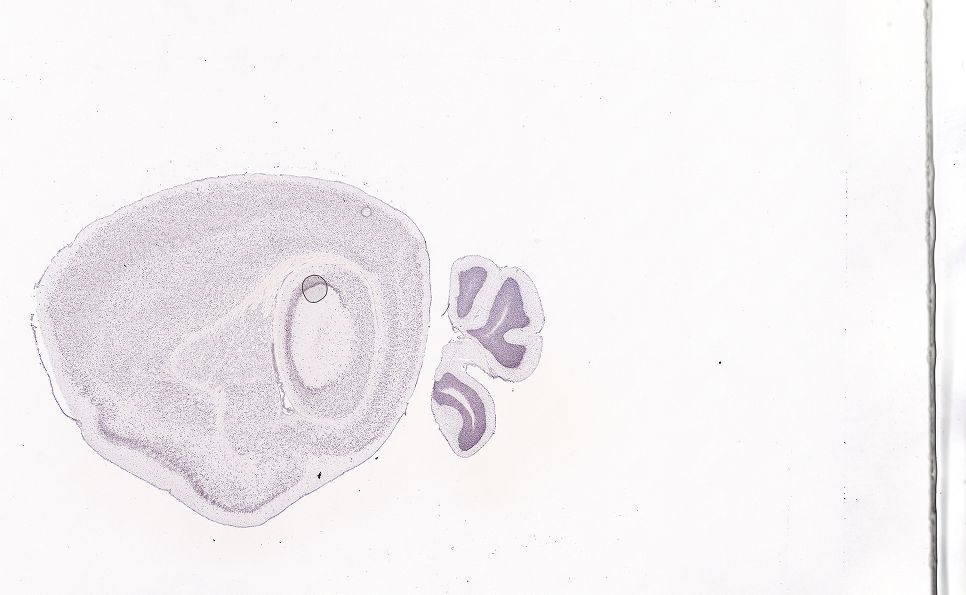
DIRECT ALLEN ISH
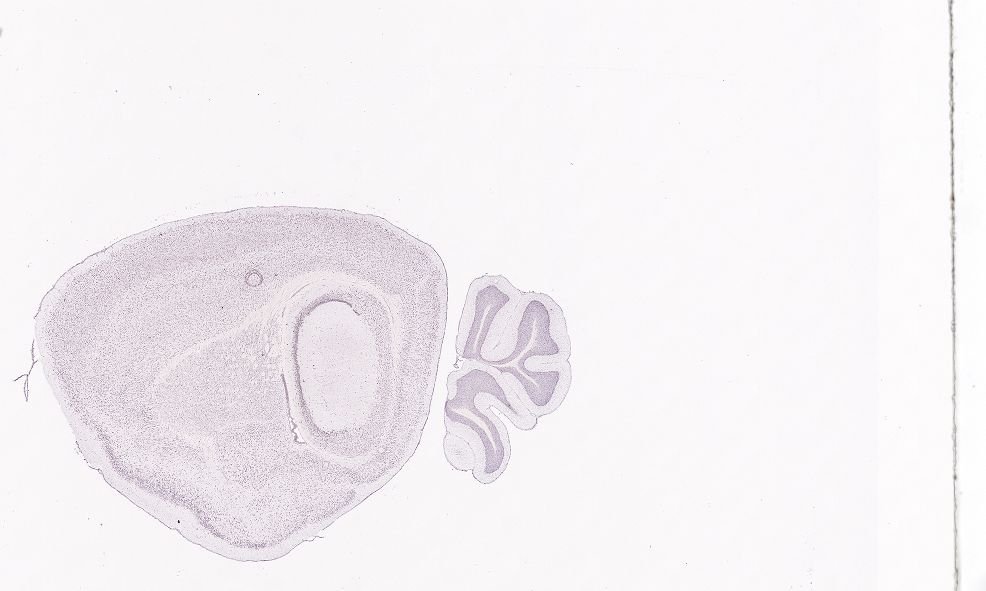
DIRECT ALLEN ISH
Regional expression figure
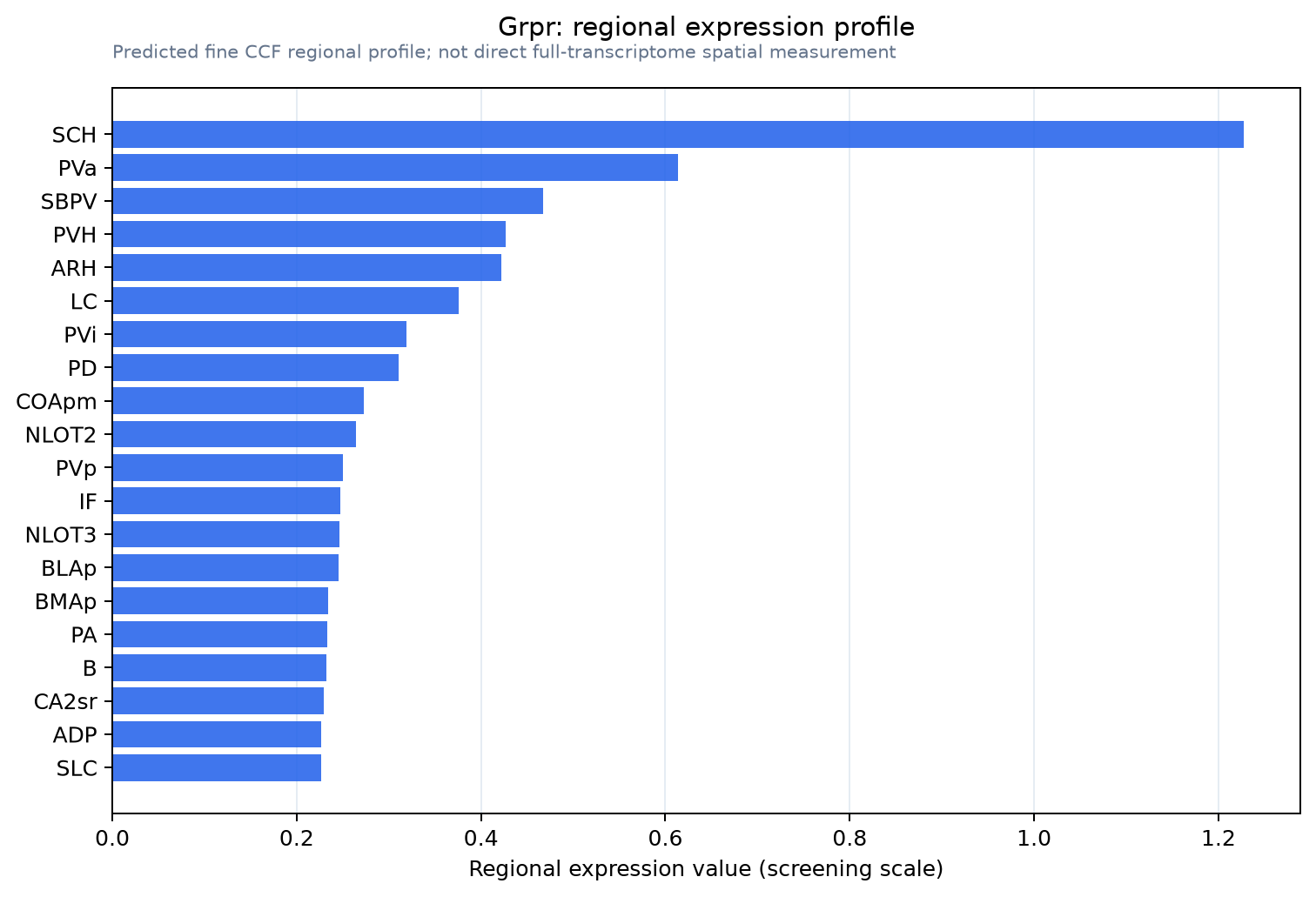
Predicted WMB × fine-CCF profile; not direct full-transcriptome spatial measurement.
Spatial profile
Evidence and specificity
- Evidence status
- PREDICTED_FINE
- Direct sources
- None; predicted localization only
- Exclusive threshold
- 12 positive regions out of 554
- Spatial specificity
- 0.331
- Top-region fraction
- 0.117
- Filter status
- PASS
Interpretation limits
- Cell-type-to-region projection is imputed expression, not direct spatial measurement.
- Adult reference atlases do not establish stability across age, sex, strain, state, or disease.
- Transcript abundance does not guarantee protein abundance or genetic-tool performance.