Gpr83
G protein-coupled receptor 83 (Glucocorticoid-induced receptor)
Spatial tier: RESTRICTED · Class: GPCR · Top region: TMd (Tuberomammillary nucleus, dorsal part) · Positive regions: 21/554
42.9Discovery Score
41.8Targetability Score
CEvidence grade C
What this means: Gpr83: fine CCF profile is restricted toward TMd (top regions: TMd, PMd, OT, ACB, RSPv2/3; 21 positive regions); direct spatial validation is still required.
Function in TMd: evidence, prediction, innovation
- Gene function
- Gpr83 encodes GPR83, the glucocorticoid-induced receptor, a class A GPCR deorphanised as the receptor for the proSAAS-derived neuroendocrine peptide PEN and, in later work, for FAM237A. It couples to Gq and G13, is strongly induced by glucocorticoids, and is expressed in striatum, nucleus accumbens, amygdala and hypothalamus, where it modulates reward, anxiety and energy balance.
- Region function
- The dorsal tuberomammillary nucleus is part of the posterior hypothalamic histaminergic cell group, the brain's sole source of histamine; its neurons fire fastest during waking, fall silent in REM sleep, and stabilise arousal and attention.
- Published in this region
- inferred No region-specific literature found. GPR83's characterised sites of action are the reward circuitry and amygdala: Fakira 2019 showed sex-dependent GPR83 effects in the reward pathway and Fakira 2021 dissected anxiety-like behaviour with global versus amygdalar knockdown; Gomes 2016 identified PEN as the ligand and Li 2023 argued for FAM237A. Hypothalamic expression is reported in the deorphanisation work, but no study addresses tuberomammillary histamine neurons.
- Predicted function
- Prediction: because GPR83 is glucocorticoid-inducible and Gq-coupled, in the dorsal tuberomammillary nucleus it would provide a stress-hormone-gated excitatory input to histaminergic neurons, so that circulating corticosterone raises the sensitivity of the arousal system to PEN. That predicts intra-tuberomammillary PEN increases wakefulness, especially after stress or glucocorticoid exposure, and that Gpr83 knockout or local knockdown blunts stress-induced hyperarousal and insomnia while leaving baseline sleep intact.
- Innovation
- ★★★★★ 5/5 A glucocorticoid-induced receptor on the brain's only histamine neurons is a clean mechanistic hypothesis for stress-induced insomnia that nobody has tested.
- Tools
- Gpr83 knockout mice and the AAV-shRNA knockdown constructs used by Fakira 2021; PEN peptide as agonist; no selective small-molecule ligand yet; anti-GPR83 antibodies; Hdc-Cre (JAX 021198) for histaminergic targeting.
- References
Direct evidence located at the region
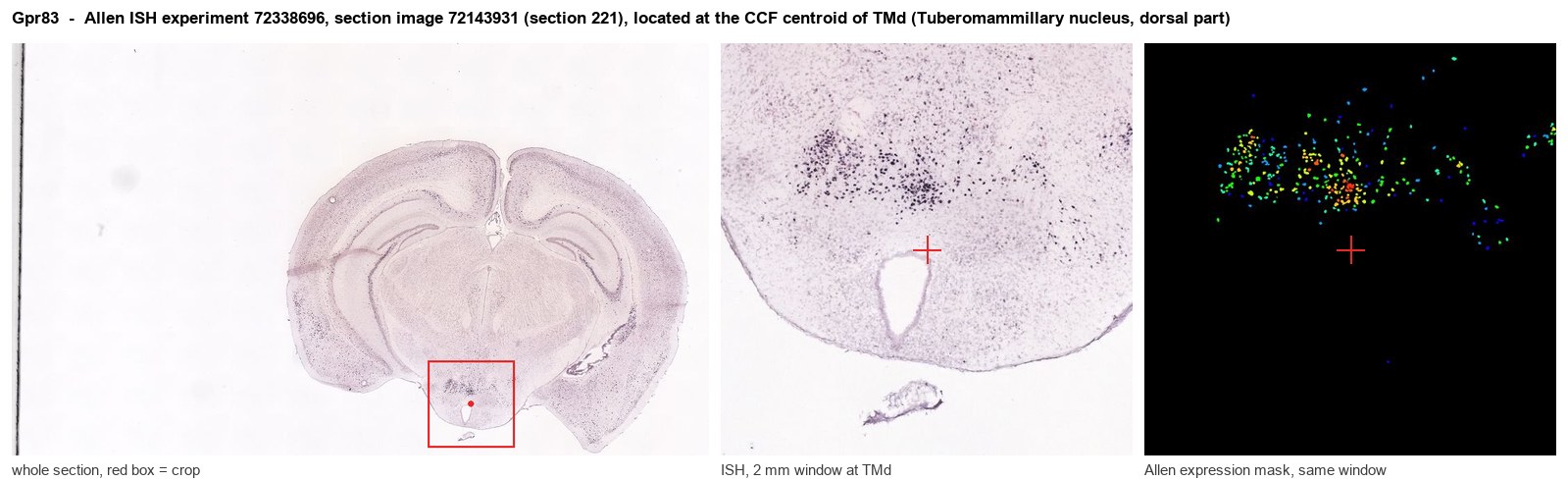
Allen ISH experiment 72338696, section image 72143931 (section 221): the section that contains the CCF centroid of Tuberomammillary nucleus, dorsal part according to the Allen image-to-atlas alignment (reference_to_image), with a 2 mm window around that point. Left: whole section, red box = window. Middle: ISH signal. Right: Allen's expression-mask view of the same window. open this image in the Allen viewer
Look it up yourself: Allen Mouse Brain ISH for Gpr83Allen reference atlas: TMd (structure 1126)ABC Atlas MERFISH viewer(in the ABC Atlas choose dataset MERFISH-C57BL6J-638850-CCF, colour cells by gene "Gpr83" or by parcellation_substructure "TMd")All genes confined to TMd + 3-D brain
Direct spatial evidence
MERFISH REGION LOCATOR
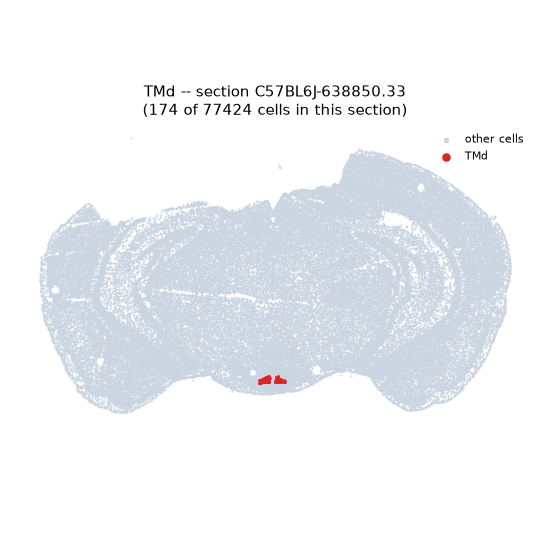
Regional expression figure
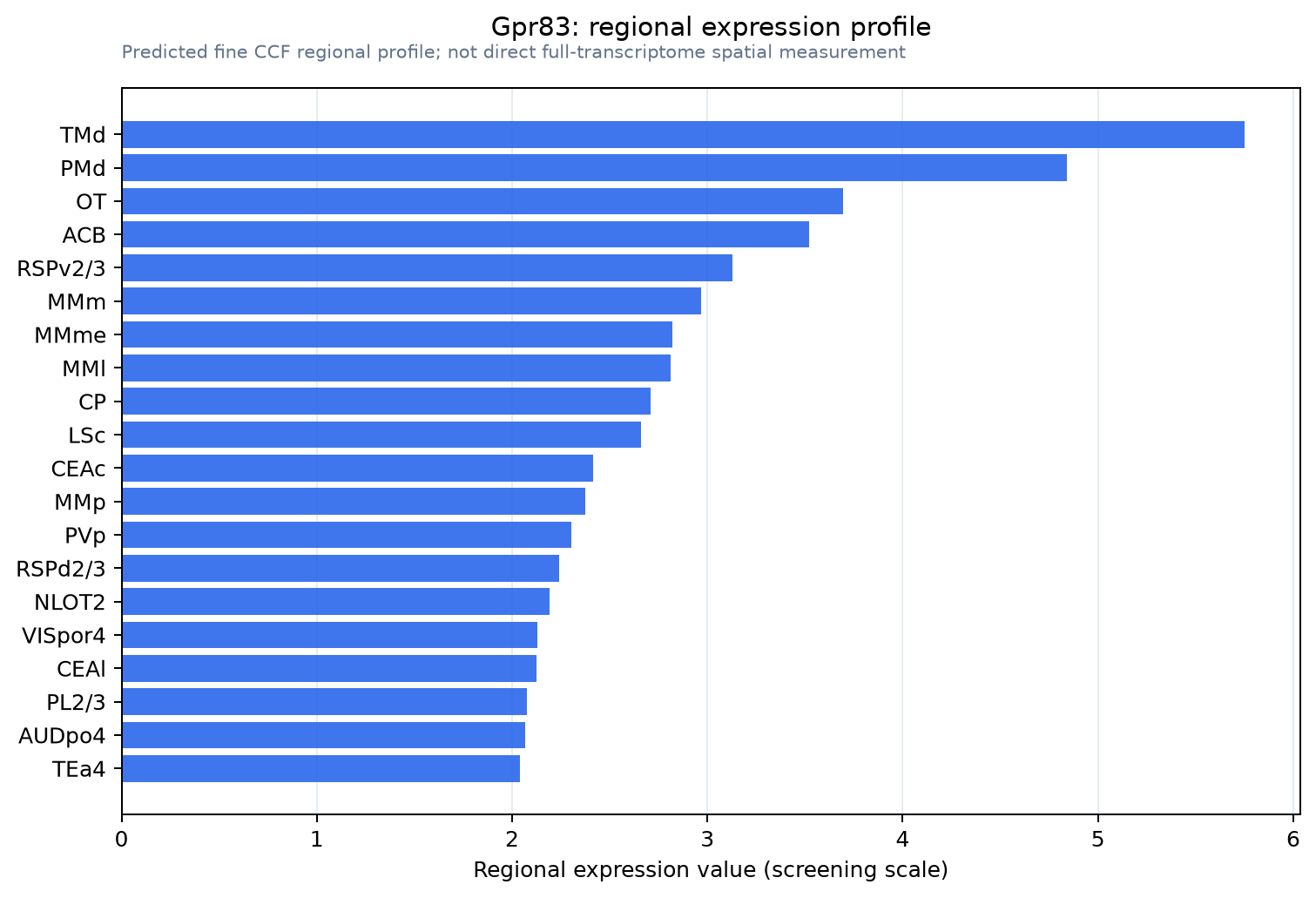
Predicted WMB × fine-CCF profile; not direct full-transcriptome spatial measurement.
Spatial profile
Evidence and specificity
- Evidence status
- PREDICTED_FINE
- Direct sources
- None; predicted localization only
- Exclusive threshold
- 12 positive regions out of 554
- Spatial specificity
- 0.290
- Top-region fraction
- 0.058
- Filter status
- PASS
Interpretation limits
- Cell-type-to-region projection is imputed expression, not direct spatial measurement.
- Adult reference atlases do not establish stability across age, sex, strain, state, or disease.
- Transcript abundance does not guarantee protein abundance or genetic-tool performance.