Gpr17
Uracil nucleotide/cysteinyl leukotriene receptor (UDP/CysLT receptor) (G protein-coupled receptor 17)
Spatial tier: REGION_BIASED · Class: GPCR · Top region: LT (Lateral terminal nucleus of the accessory optic tract) · Positive regions: 42/554
Function in LT: evidence, prediction, innovation
- Gene function
- Gpr17 encodes a class A GPCR sitting phylogenetically between P2Y nucleotide and cysteinyl-leukotriene receptors; the synthetic agonist MDL29,951 shows it engages Gi, Gs, Gq and beta-arrestin. In brain it marks a subset of NG2-glia/oligodendrocyte precursors and acts as an intrinsic brake on their differentiation: sustained expression blocks myelination, knockout accelerates it (Chen 2009). A separate arcuate neuronal pool acts downstream of FoxO1.
- Region function
- The lateral terminal nucleus is a retinorecipient accessory optic nucleus receiving ON direction-selective retinal ganglion cell input encoding retinal image slip, driving optokinetic eye movements and gaze stabilisation.
- Published in this region
- expression only No functional study of Gpr17 in the LT. Allen ISH gives Gpr17 an expression energy of 2.38 in LT versus 2.04 for grey matter (sagittal experiment 73513814), the scattered pattern expected from GPR17+ OPCs along the myelinated accessory optic tract; all functional work is confined to oligodendroglia (Chen 2009; Vigano 2016) and arcuate AgRP/POMC neurons (Ren 2012).
- Predicted function
- Prediction: the LT signal is glial, marking the slowly differentiating GPR17+ OPC subset (Miralles 2023) along accessory optic tract axons, where GPR17 would time myelination of direction-selective retinofugal fibres. Conditional deletion or MDL29,951 agonism should shift optic tract myelin thickness and conduction timing rather than LT neuronal identity, giving subtle optokinetic gain deficits on video-oculography.
- Innovation
- ★★★★☆ 4/5 GPR17 is heavily studied but never examined in the accessory optic system, where myelin timing affects a quantifiable reflex.
- Tools
- GPR17-iCreER(T2) BAC line (Vigano 2016); Gpr17 knockout and floxed alleles (Chen 2009; Reilly 2019); agonist MDL29,951; antagonists cangrelor, montelukast, pranlukast; Pdgfra-CreER/NG2-CreER for OPCs; Pcdh9-Cre and Pdzk1ip1-Cre for accessory optic circuits (Lilley 2019).
- References
Direct evidence located at the region
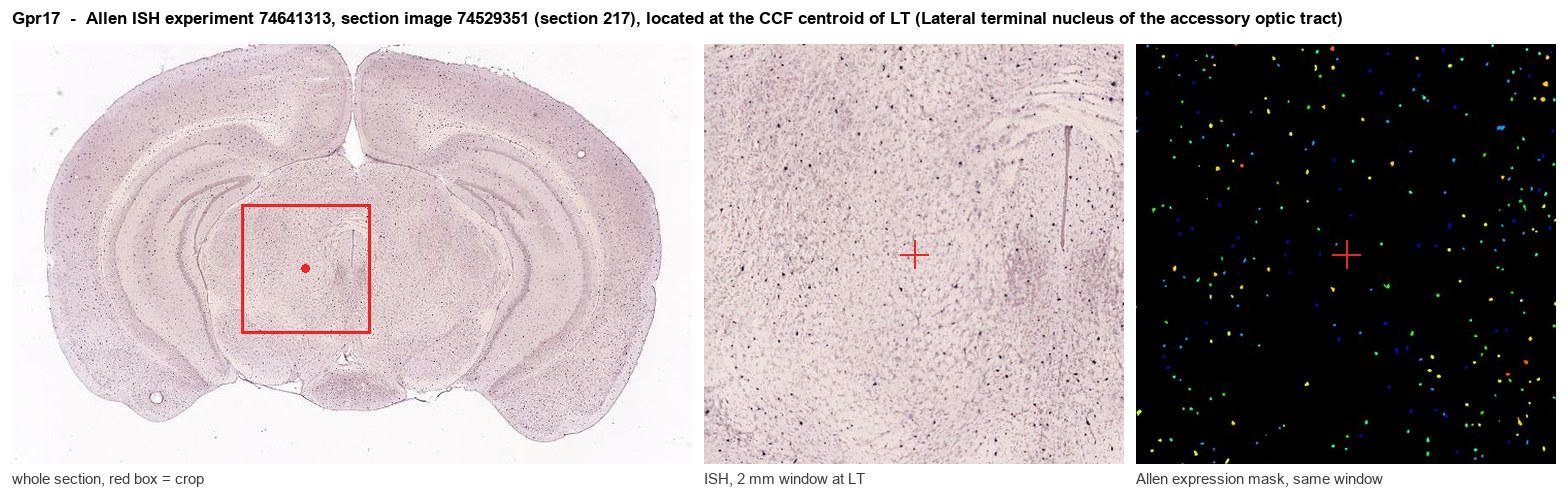
Allen ISH experiment 74641313, section image 74529351 (section 217): the section that contains the CCF centroid of Lateral terminal nucleus of the accessory optic tract according to the Allen image-to-atlas alignment (reference_to_image), with a 2 mm window around that point. Left: whole section, red box = window. Middle: ISH signal. Right: Allen's expression-mask view of the same window. open this image in the Allen viewer
Direct spatial evidence
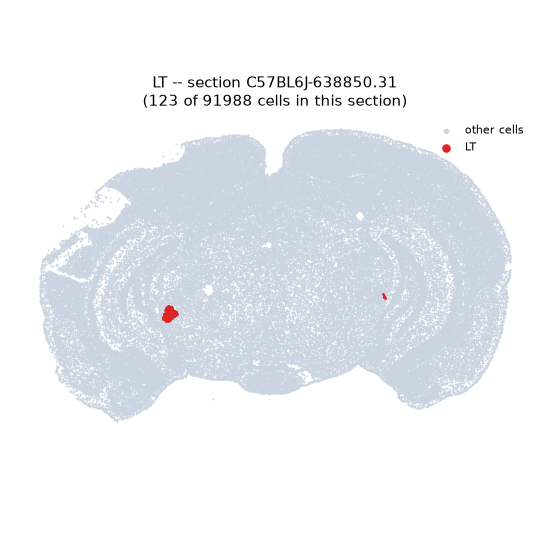
Regional expression figure
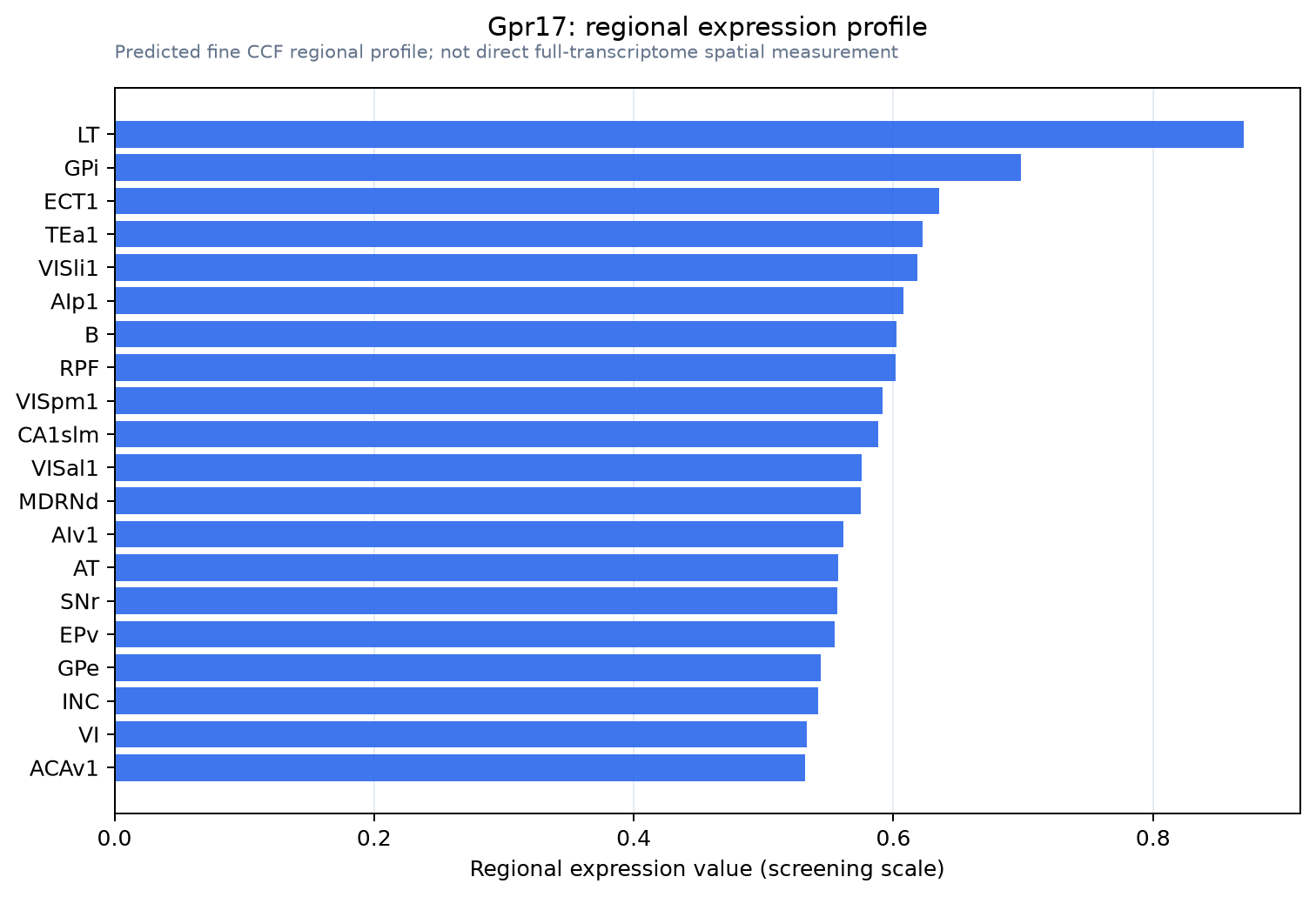
Predicted WMB × fine-CCF profile; not direct full-transcriptome spatial measurement.
Spatial profile
Evidence and specificity
- Evidence status
- PREDICTED_FINE
- Direct sources
- None; predicted localization only
- Exclusive threshold
- 12 positive regions out of 554
- Spatial specificity
- 0.284
- Top-region fraction
- 0.045
- Filter status
- PASS
Interpretation limits
- Cell-type-to-region projection is imputed expression, not direct spatial measurement.
- Adult reference atlases do not establish stability across age, sex, strain, state, or disease.
- Transcript abundance does not guarantee protein abundance or genetic-tool performance.