Gpr139
Probable G protein-coupled receptor 139 (G protein-coupled receptor PGR3) (G(q)-coupled orphan receptor GPRg1)
Spatial tier: REGION_BIASED · Class: GPCR · Top region: MH (Medial habenula) · Positive regions: 30/554
42.8Discovery Score
40.9Targetability Score
CEvidence grade C
What this means: Gpr139: fine CCF profile is region-biased toward MH (top regions: MH, MMp, TMd, MMme, PMd); this is a discovery lead, not direct proof.
Function in MH: evidence, prediction, innovation
- Gene function
- Gpr139 encodes an orphan class A G protein-coupled receptor that is essentially brain-restricted. It is activated by the essential aromatic amino acids L-tryptophan and L-phenylalanine at physiological concentrations and signals through Gq/11 to raise intracellular Ca2+ and ERK phosphorylation. It also physically associates with the mu-opioid receptor and opposes its Gi signalling, acting as an endogenous anti-opioid brake.
- Region function
- The medial habenula is an epithalamic nucleus whose cholinergic (ChAT/Slc17a6) and substance P (Tac1) neurons project almost exclusively through the fasciculus retroflexus to the interpeduncular nucleus. This pathway controls nicotine aversion and withdrawal, anxiety, fear and aversive-memory expression.
- Published in this region
- direct Liu et al. 2015 (Mol Pharmacol) showed by RNA-seq and immunohistochemistry that GPR139 is most highly expressed in habenula and septum of mouse brain, and Wagner et al. 2016 found Gpr139 among transcripts selectively elevated in rat MHb over thalamus. Kononoff et al. 2018 (eNeuro) microinjected the selective agonist JNJ-63533054 into the habenula of alcohol-dependent rats and reduced compulsive-like alcohol self-administration and withdrawal hyperalgesia, with no effect from the same injection into the interpeduncular nucleus. Wang et al. 2019 (Science) showed GPR139 is co-expressed with the mu-opioid receptor and that Gpr139 deletion amplifies morphine analgesia, reward and withdrawal. Allen ISH confirms 7-23x MH enrichment over grey matter.
- Predicted function
- Prediction: in MHb, GPR139 acts as an amino-acid-sensing Gq brake that counteracts Gi signalling from mu-opioid and GABAB receptors on cholinergic neurons, keeping the MHb-IPN aversion pathway active during drug withdrawal. MHb-selective Gpr139 knockout should therefore deepen opioid and nicotine withdrawal aversion and increase escalation of drug intake, while MHb agonist infusion should suppress both.
- Innovation
- ★★☆☆☆ 2/5 GPR139 is already a recognised habenula-enriched drug target with published intra-habenular pharmacology, although MHb cell-type-specific and circuit-resolved work is still missing.
- Tools
- Gpr139 knockout mice (Wang et al. 2019); selective brain-penetrant agonists JNJ-63533054 and TAK-041/NBI-1065846; tritiated JNJ-63533054 radioligand; combine with Oprm1-Cre, ChAT-IRES-Cre (JAX 006410) or Tac1-IRES2-Cre (JAX 021877) for MHb cell-type targeting.
- References
Direct evidence located at the region
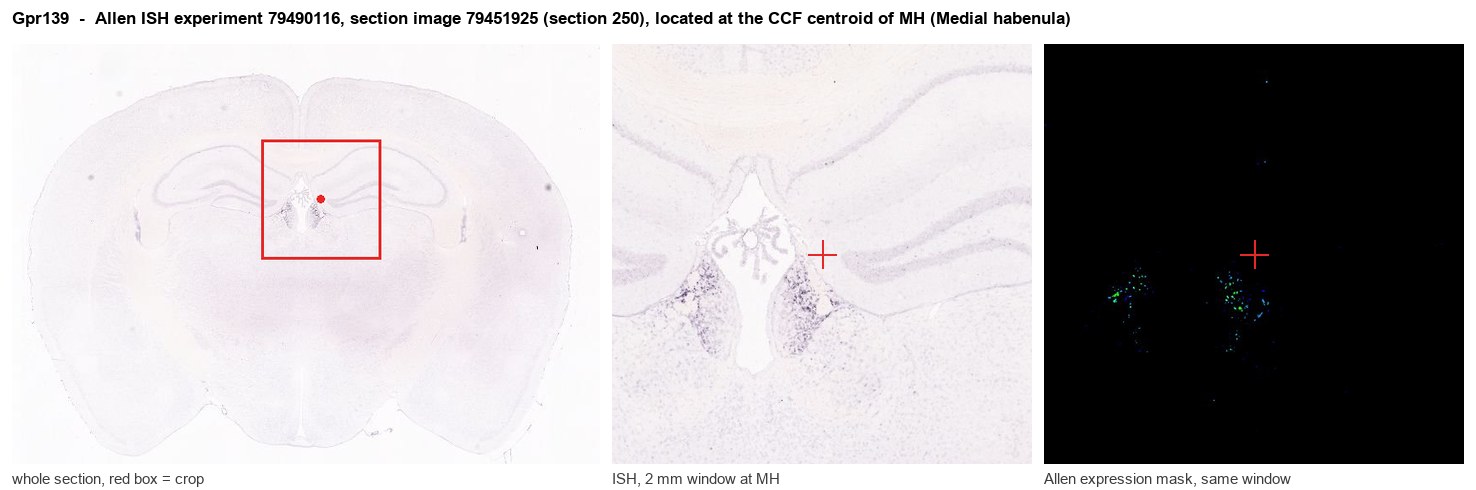
Allen ISH experiment 79490116, section image 79451925 (section 250): the section that contains the CCF centroid of Medial habenula according to the Allen image-to-atlas alignment (reference_to_image), with a 2 mm window around that point. Left: whole section, red box = window. Middle: ISH signal. Right: Allen's expression-mask view of the same window. open this image in the Allen viewer
Look it up yourself: Allen Mouse Brain ISH for Gpr139Allen reference atlas: MH (structure 483)ABC Atlas MERFISH viewer(in the ABC Atlas choose dataset MERFISH-C57BL6J-638850-CCF, colour cells by gene "Gpr139" or by parcellation_substructure "MH")All genes confined to MH + 3-D brain
Direct spatial evidence
MERFISH REGION LOCATOR
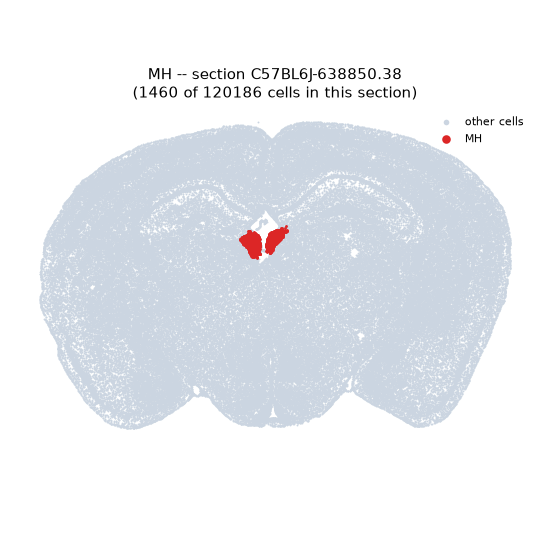
Regional expression figure
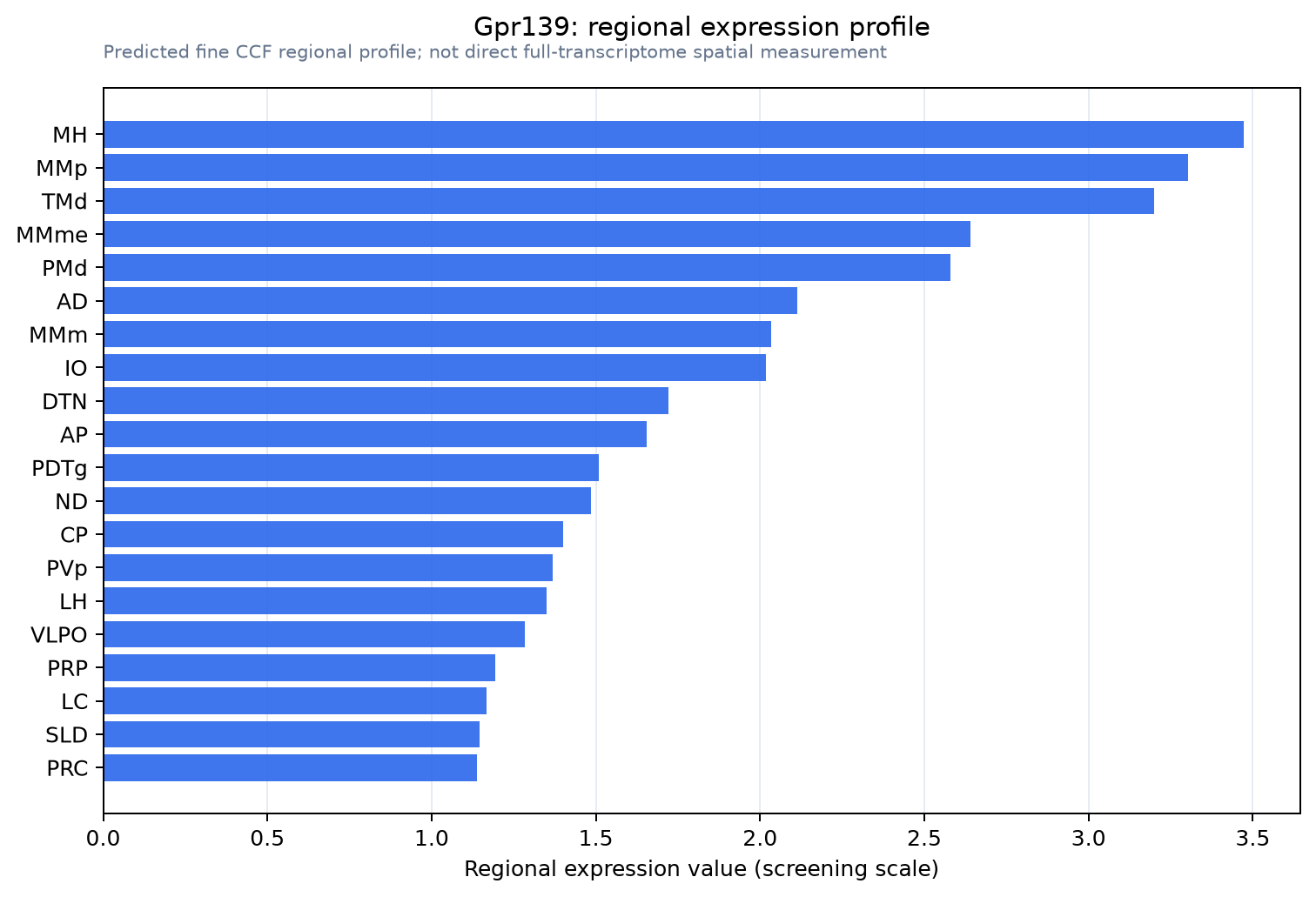
Predicted WMB × fine-CCF profile; not direct full-transcriptome spatial measurement.
Spatial profile
Evidence and specificity
- Evidence status
- PREDICTED_FINE
- Direct sources
- None; predicted localization only
- Exclusive threshold
- 12 positive regions out of 554
- Spatial specificity
- 0.286
- Top-region fraction
- 0.046
- Filter status
- PASS
Interpretation limits
- Cell-type-to-region projection is imputed expression, not direct spatial measurement.
- Adult reference atlases do not establish stability across age, sex, strain, state, or disease.
- Transcript abundance does not guarantee protein abundance or genetic-tool performance.