Gm14496
Predicted gene 14496
Spatial tier: STRICT_EXCLUSIVE · Class: GPCR · Top region: VII (Facial motor nucleus) · Positive regions: 3/554
51.4Discovery Score
42.7Targetability Score
CEvidence grade C
What this means: Gm14496: predicted fine-region profile is strict-exclusive, with 3 positive regions out of 554 (limit 12); direct spatial validation is required.
Function in VII: evidence, prediction, innovation
- Gene function
- Gm14496 (NCBI Gene 672125, mouse chromosome 2, six exons) is an uncharacterised predicted gene annotated only by sequence homology as a G protein-coupled receptor, with predicted GPCR signalling activity and plasma-membrane localisation. No ligand, signalling partner or protein-level validation has been published, and it has no established human ortholog.
- Region function
- The facial motor nucleus (VII) contains the cholinergic motoneurons for the muscles of facial expression, including the mystacial pad muscles that move the whiskers, and drives whisking and blinking.
- Published in this region
- none No region-specific literature found. There is no published experimental work on Gm14496 in any tissue, only Alliance of Genome Resources electronic annotation predicting G protein-coupled receptor activity.
- Predicted function
- Prediction: if Gm14496 protein is genuinely made in facial motoneurons, the most plausible role is a neuromodulatory GPCR setting motoneuron excitability or trophic state, as for other orphan GPCRs in cholinergic motoneurons. Without a ligand the phenotype is hard to forecast; a knockout would be most informative assayed on whisking kinematics, blink reflex and facial-nerve regeneration. Expression validation comes first, since such loci are often misannotated.
- Innovation
- ★★★★☆ 4/5 A completely unstudied gene in a well-defined motor nucleus, but no reagents or known ligand limit how quickly it can be tested.
- Tools
- none known for the gene itself; the nucleus is accessible via ChAT-IRES-Cre (JAX 006410) and retrograde AAV from the mystacial pad.
- References
Direct evidence located at the region
No Allen ISH section could be located at this region's centroid for the recorded experiments.
Look it up yourself: Allen Mouse Brain ISH for Gm14496Allen reference atlas: VII (structure 661)ABC Atlas MERFISH viewer(in the ABC Atlas choose dataset MERFISH-C57BL6J-638850-CCF, colour cells by gene "Gm14496" or by parcellation_substructure "VII")All genes confined to VII + 3-D brain
Direct spatial evidence
MERFISH REGION LOCATOR
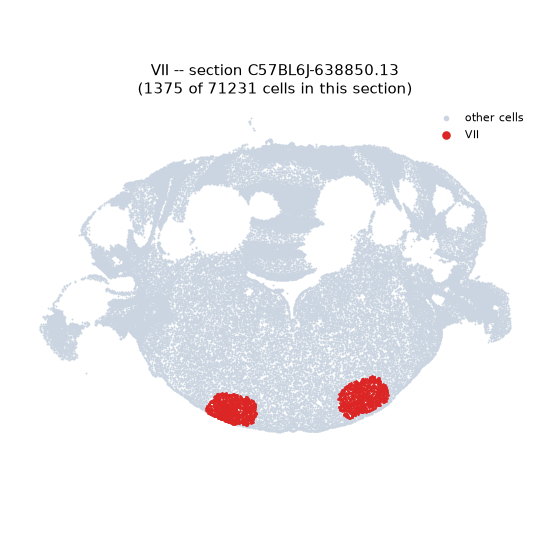
Regional expression figure
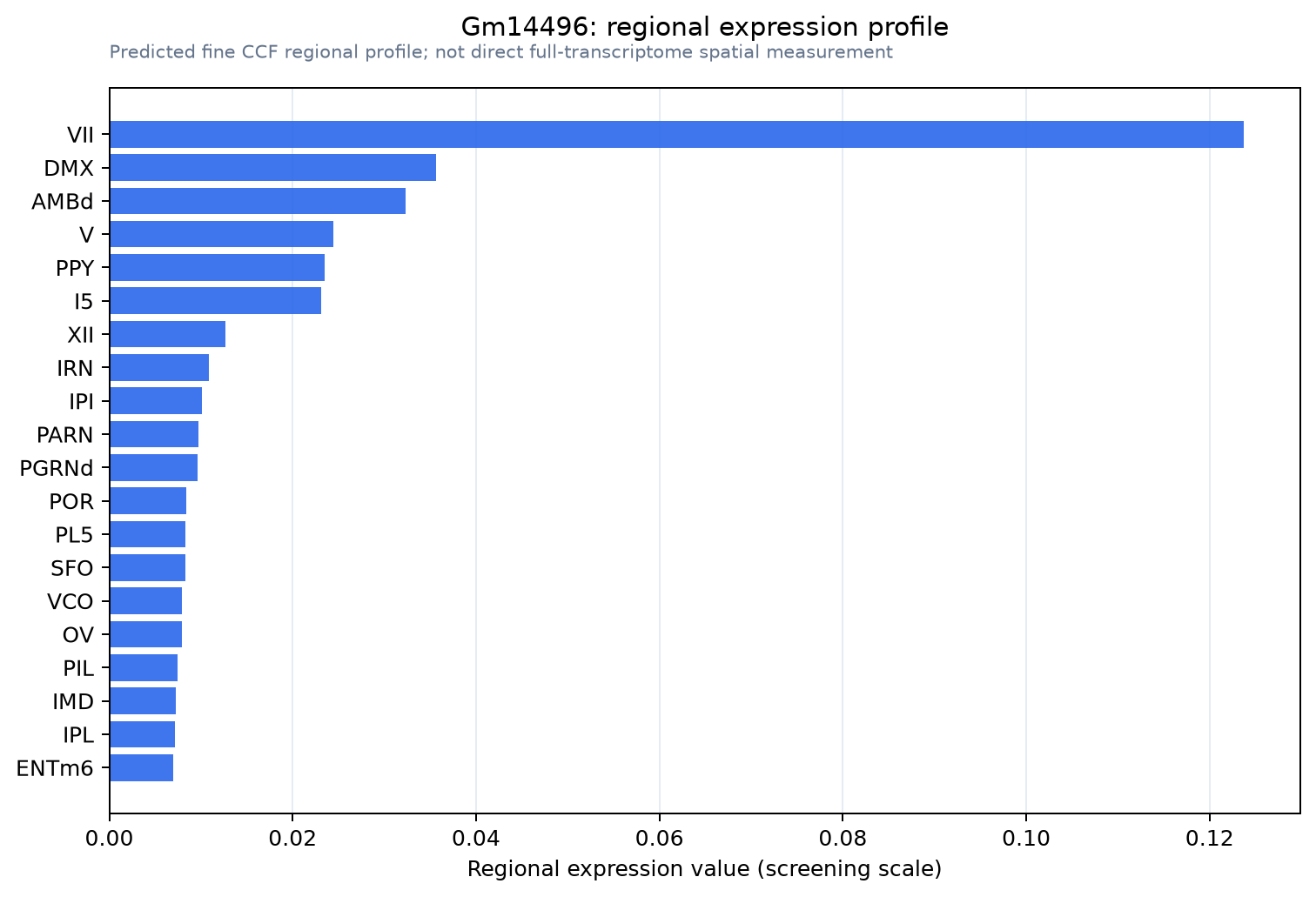
Predicted WMB × fine-CCF profile; not direct full-transcriptome spatial measurement.
Spatial profile
Evidence and specificity
- Evidence status
- PREDICTED_FINE
- Direct sources
- None; predicted localization only
- Exclusive threshold
- 12 positive regions out of 554
- Spatial specificity
- 0.451
- Top-region fraction
- 0.276
- Filter status
- PASS
Interpretation limits
- Cell-type-to-region projection is imputed expression, not direct spatial measurement.
- Adult reference atlases do not establish stability across age, sex, strain, state, or disease.
- Transcript abundance does not guarantee protein abundance or genetic-tool performance.