Clic5
Chloride intracellular channel protein 5 (Glutaredoxin-like oxidoreductase CLIC5) (EC 1.8.-.-)
Spatial tier: REGION_BIASED · Class: ION_CHANNEL · Top region: MOp6b (Primary motor area, Layer 6b) · Positive regions: 31/554
Function in MOp6b: evidence, prediction, innovation
- Gene function
- CLIC5 belongs to the chloride intracellular channel family, metamorphic proteins that switch between a soluble glutaredoxin-like fold and a membrane-inserted form. Rather than behaving as classical channels, CLIC5A scaffolds ezrin/radixin/moesin and actin at specialised membrane domains (hair-cell stereocilia, podocyte foot processes, cilia), and recent work shows CLIC5 can act as a membrane fusogen.
- Region function
- Layer 6b is the thin deepest neocortical layer, the surviving remnant of the subplate; it is the only cortical layer directly excited by orexin/hypocretin and projects to higher-order thalamus and across cortex, giving it disproportionate control over brain state and cortical oscillations.
- Published in this region
- expression only No region-specific literature found. Clic5 appears among deep-layer-6/6b enriched transcripts in cortical cell-type surveys (Kim 2025 consensus definition of deep layer 6 excitatory neurons), but no study has examined CLIC5 protein or function in layer 6b; its characterised roles are in stereocilia, podocytes and cilia (Ott 2023).
- Predicted function
- Prediction: in layer 6b neurons CLIC5 most plausibly works as an actin-ERM membrane scaffold that stabilises the long apical dendrite and its tuft in layer 1, the compartment through which layer 6b amplifies cortical activation. Conditional deletion (Nxph4-CreER or Ctgf-dgCre crossed to a Clic5 floxed allele) should coarsen apical dendritic morphology and spine density and weaken orexin-driven, layer-6b-dependent brain-state transitions and EEG desynchronisation, rather than change intrinsic chloride currents.
- Innovation
- ★★★★★ 5/5 Layer 6b has only recently become experimentally tractable and no one has tested any CLIC family member there.
- Tools
- Layer 6b driver lines Ctgf-2A-dgCre and Nxph4-2A-CreER (Allen/JAX); Clic5 mutant mouse alleles (jitterbug); anti-CLIC5 antibodies; no selective pharmacology.
- References
Direct evidence located at the region
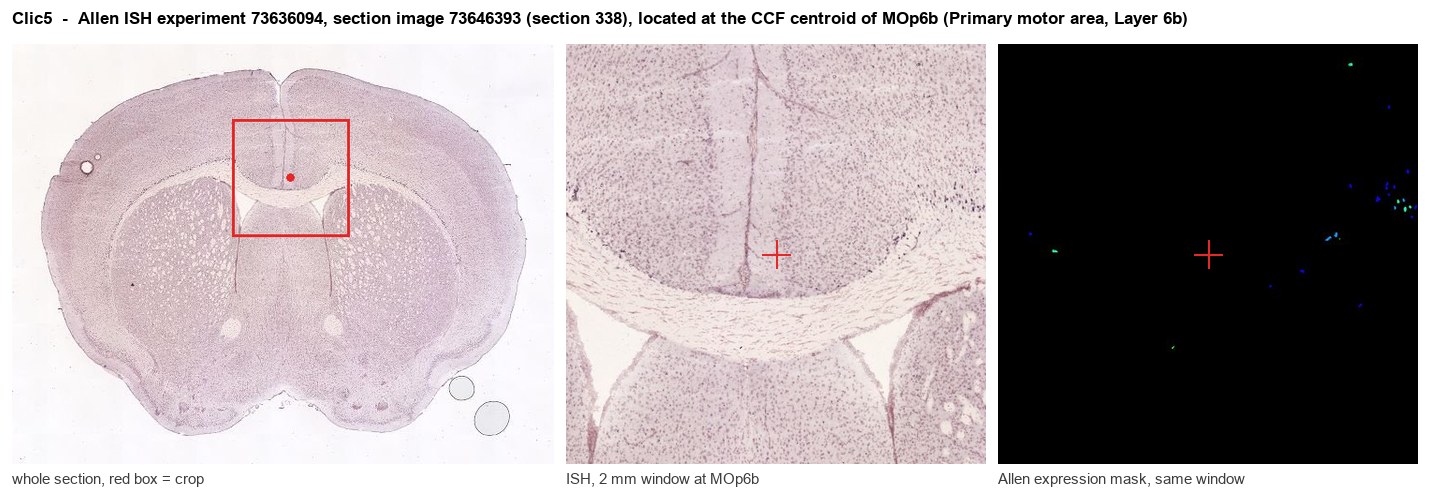
Allen ISH experiment 73636094, section image 73646393 (section 338): the section that contains the CCF centroid of Primary motor area, Layer 6b according to the Allen image-to-atlas alignment (reference_to_image), with a 2 mm window around that point. Left: whole section, red box = window. Middle: ISH signal. Right: Allen's expression-mask view of the same window. open this image in the Allen viewer
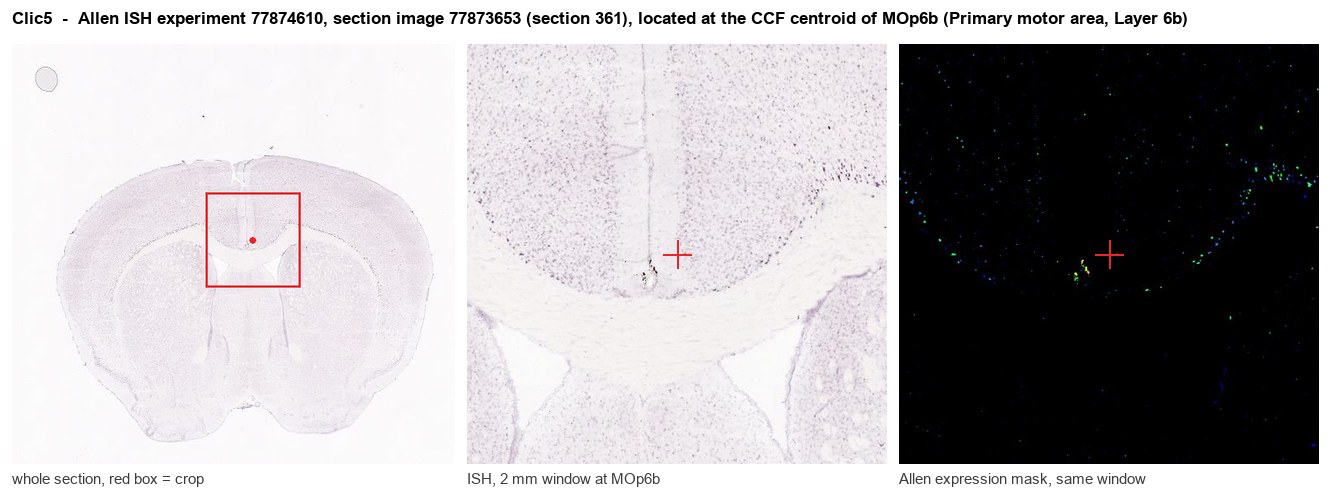
Allen ISH experiment 77874610, section image 77873653 (section 361): the section that contains the CCF centroid of Primary motor area, Layer 6b according to the Allen image-to-atlas alignment (reference_to_image), with a 2 mm window around that point. Left: whole section, red box = window. Middle: ISH signal. Right: Allen's expression-mask view of the same window. open this image in the Allen viewer
Direct spatial evidence
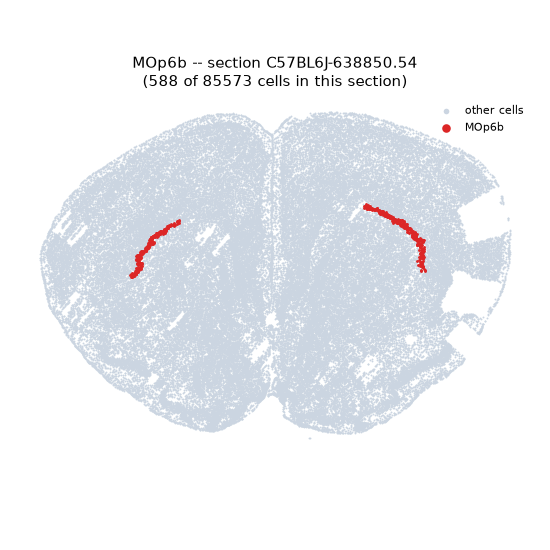
Regional expression figure
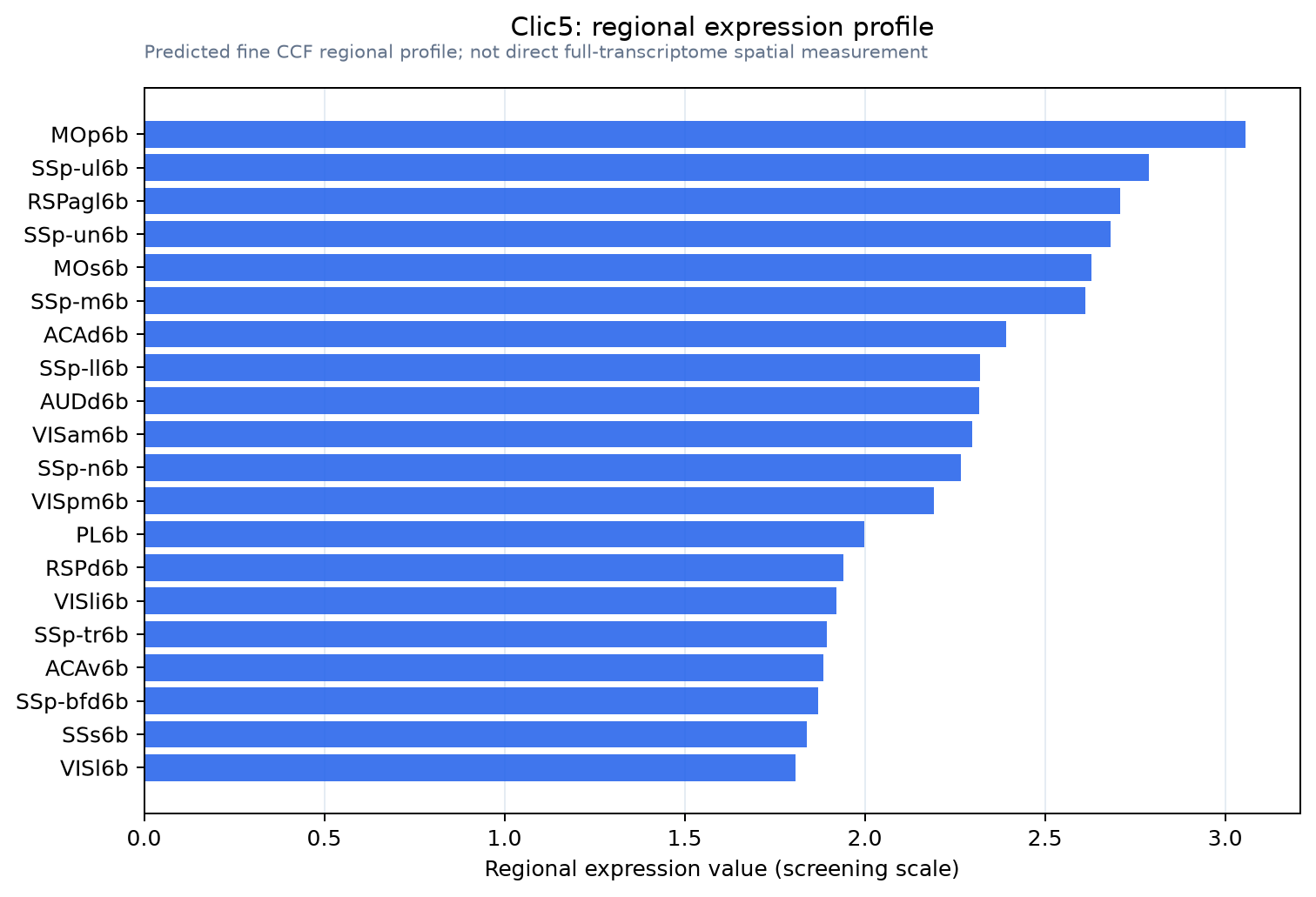
Predicted WMB × fine-CCF profile; not direct full-transcriptome spatial measurement.
Spatial profile
Evidence and specificity
- Evidence status
- PREDICTED_FINE
- Direct sources
- None; predicted localization only
- Exclusive threshold
- 12 positive regions out of 554
- Spatial specificity
- 0.321
- Top-region fraction
- 0.043
- Filter status
- PASS
Interpretation limits
- Cell-type-to-region projection is imputed expression, not direct spatial measurement.
- Adult reference atlases do not establish stability across age, sex, strain, state, or disease.
- Transcript abundance does not guarantee protein abundance or genetic-tool performance.