Asic5
Bile acid-sensitive ion channel (BASIC) (Acid-sensing ion channel subunit family member 5) (Amiloride-sensitive cation channel 5) (Brain-liver-intestine amiloride-sensitive Na(+) channel) (BLINaC)
Spatial tier: STRICT_EXCLUSIVE · Class: ION_CHANNEL · Top region: DCO (Dorsal cochlear nucleus) · Positive regions: 4/554
Function in DCO: evidence, prediction, innovation
- Gene function
- ASIC5 (also called BLINaC or BASIC) is the most divergent member of the DEG/ENaC acid-sensing ion channel family. Unlike other ASICs it is barely activated by protons; it carries a constitutive Na+-permeable leak current that is gated by bile acids and by changes in membrane mechanics or lipid environment. In neurons such a standing cation conductance sets resting potential and intrinsic excitability.
- Region function
- The dorsal cochlear nucleus is a cerebellum-like auditory structure that combines primary auditory-nerve input with multimodal somatosensory and vestibular input via a granule-cell parallel fibre system, supporting spectral cue processing for sound localisation and implicated in tinnitus.
- Published in this region
- expression only Boiko et al. 2014 (PLoS One) mapped Asic5 with a lacZ reporter and found expression essentially restricted in brain to vestibulocerebellar unipolar brush cells plus staining in the dorsal cochlear nucleus, without further characterising the DCO cells. Kreko-Pierce et al. 2020 (Sci Rep) showed Asic5 knockout reduces the intrinsic excitability of type II (mGluR1alpha+, calretinin-negative) unipolar brush cells and causes ataxia, and note that type II UBCs reside chiefly in the vestibulocerebellum and dorsal cochlear nucleus. No DCO-specific physiology has been published.
- Predicted function
- Prediction: ASIC5 provides a tonic depolarising Na+ leak in DCO unipolar brush cells, the intrinsic amplifier of the granule-cell/parallel-fibre input layer. Knockout should hyperpolarise these cells, reduce spontaneous firing and blunt the prolonged UBC response to mossy fibre glutamate, degrading multisensory gain control over fusiform cells. Behaviourally this predicts impaired sound-localisation and altered gap-detection/tinnitus-like phenotypes rather than deafness; chemogenetic silencing of Asic5+ DCO cells should reproduce the deficit.
- Innovation
- ★★★★★ 5/5 Only a single passing sentence documents Asic5 in the DCO despite an existing knockout line and a well-defined UBC circuit.
- Tools
- Asic5 knockout / lacZ reporter mouse (Boiko 2014; Kreko-Pierce 2020); UBC subtype markers mGluR1alpha and calretinin; bile acids as activators and the DEG/ENaC blockers amiloride and diminazene; Allen mouse ISH dataset 69236771. No Asic5-Cre line reported.
- References
Direct evidence located at the region
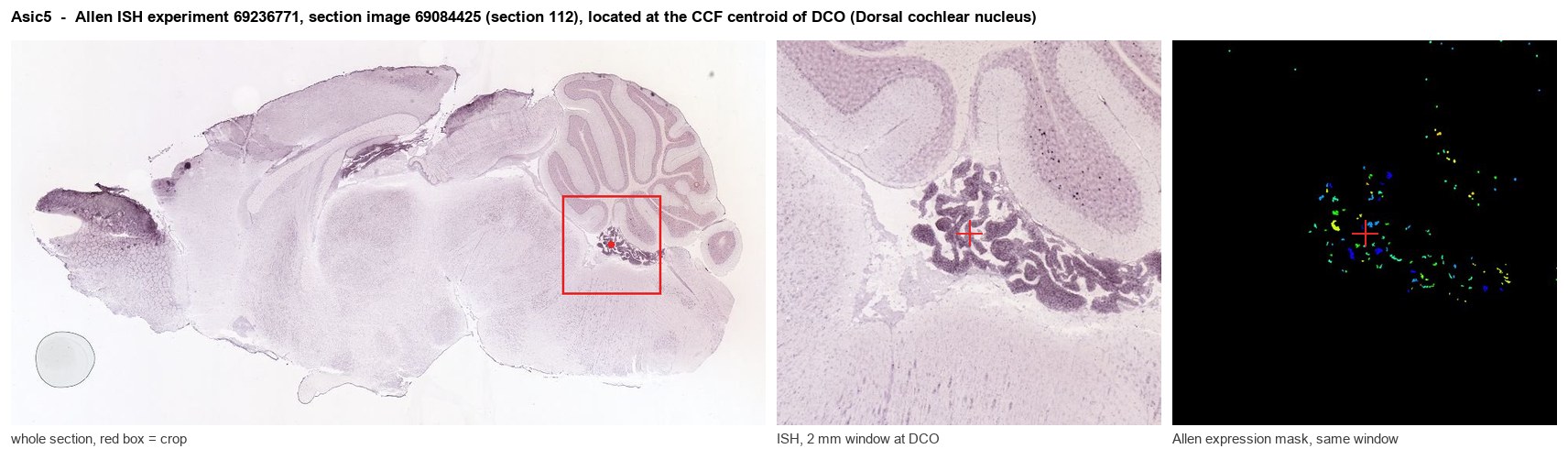
Allen ISH experiment 69236771, section image 69084425 (section 112): the section that contains the CCF centroid of Dorsal cochlear nucleus according to the Allen image-to-atlas alignment (reference_to_image), with a 2 mm window around that point. Left: whole section, red box = window. Middle: ISH signal. Right: Allen's expression-mask view of the same window. open this image in the Allen viewer
Direct spatial evidence
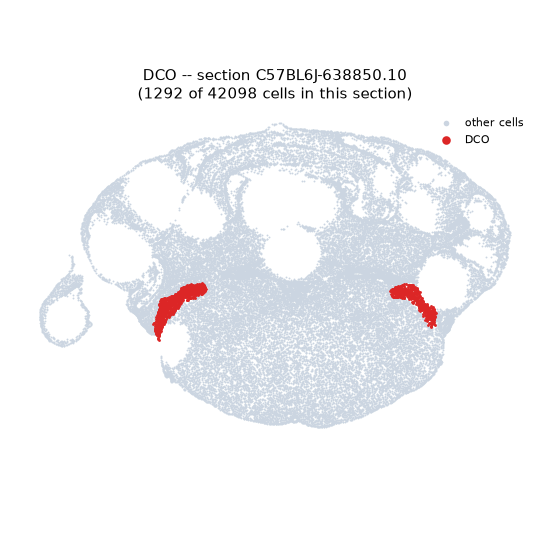
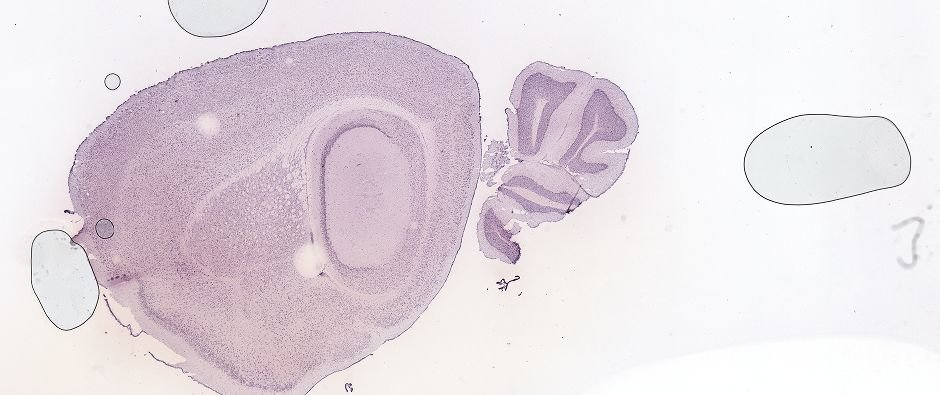
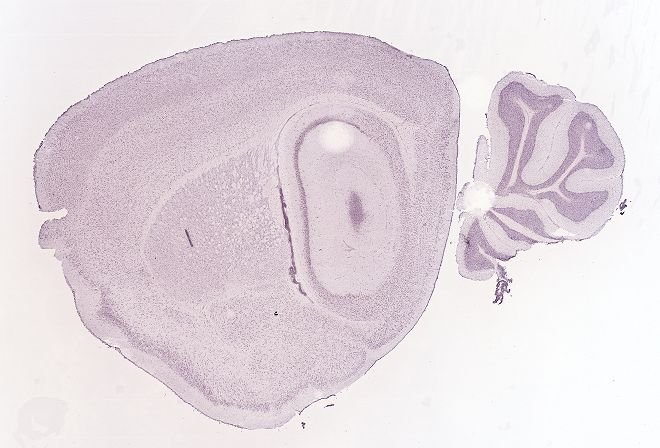
Regional expression figure
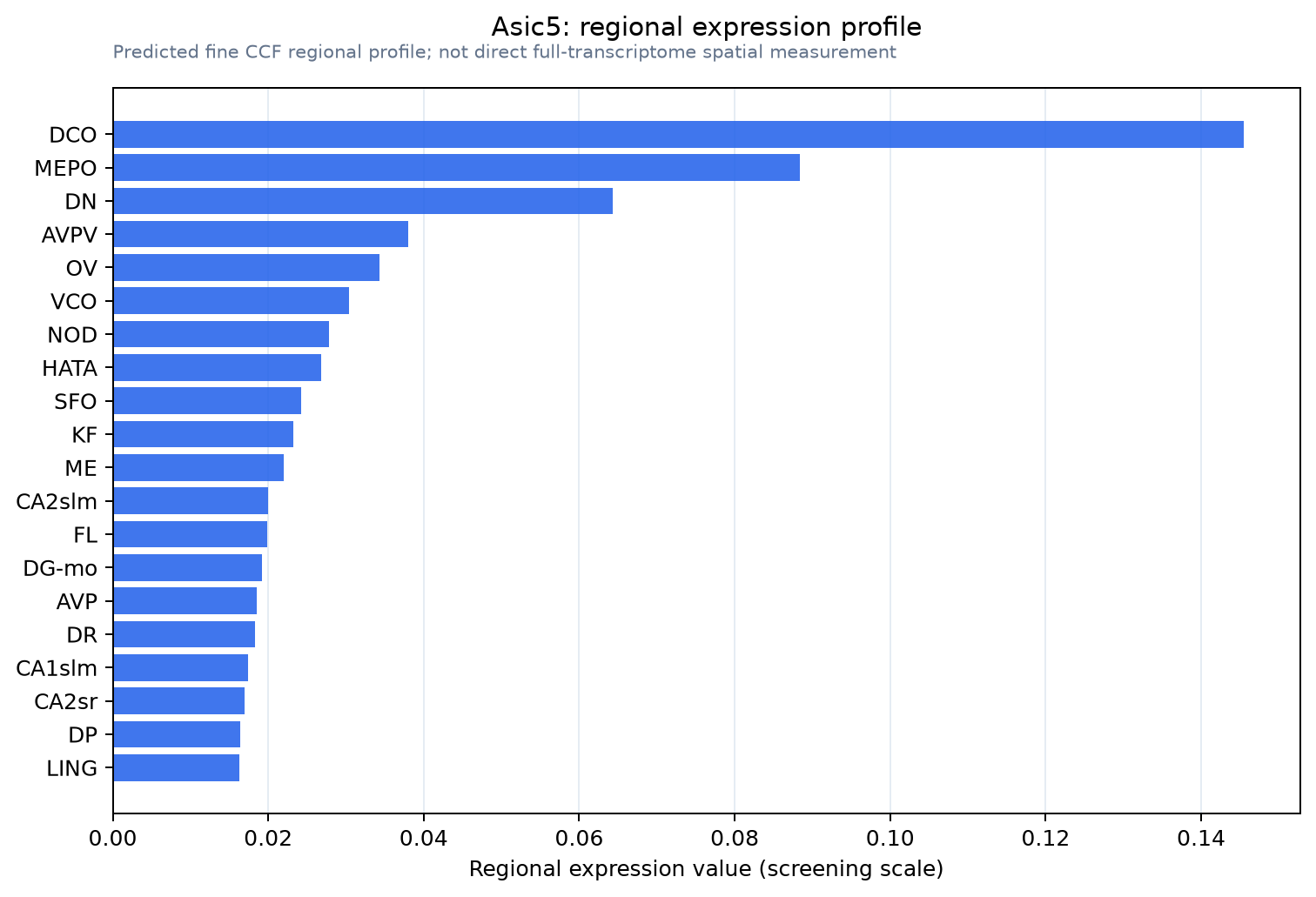
Predicted WMB × fine-CCF profile; not direct full-transcriptome spatial measurement.
Spatial profile
Evidence and specificity
- Evidence status
- PREDICTED_FINE
- Direct sources
- None; predicted localization only
- Exclusive threshold
- 12 positive regions out of 554
- Spatial specificity
- 0.408
- Top-region fraction
- 0.174
- Filter status
- PASS
Interpretation limits
- Cell-type-to-region projection is imputed expression, not direct spatial measurement.
- Adult reference atlases do not establish stability across age, sex, strain, state, or disease.
- Transcript abundance does not guarantee protein abundance or genetic-tool performance.