Adora2a
Adenosine receptor A2a
Spatial tier: STRICT_EXCLUSIVE · Class: GPCR · Top region: CP (Caudoputamen) · Positive regions: 6/554
49.2Discovery Score
44.1Targetability Score
CEvidence grade C
What this means: Adora2a: predicted fine-region profile is strict-exclusive, with 6 positive regions out of 554 (limit 12); direct spatial validation is required.
Function in CP: evidence, prediction, innovation
- Gene function
- Adora2a encodes the adenosine A2A receptor, a Gs/Golf-coupled GPCR that raises cAMP and activates PKA. In the striatum it forms heteromers with dopamine D2 receptors (and mGlu5), where A2A activation opposes D2 signalling. It is the principal target of caffeine and of the anti-parkinsonian antagonist istradefylline.
- Region function
- The caudoputamen is the input nucleus of the basal ganglia, where D1 direct-pathway and D2/A2A indirect-pathway spiny projection neurons integrate cortical glutamate and dopamine to select actions and support habit and reward learning.
- Published in this region
- direct Svenningsson et al. 1999 (Prog Neurobiol) established that striatal A2A receptors are concentrated on enkephalin-positive striatopallidal neurons and drive cAMP/PKA there. Higley and Sabatini 2010 (Nat Neurosci) showed A2A and D2 receptors competitively regulate synaptic calcium influx at the spines of these neurons. Ferre et al. 2002 (PNAS) demonstrated synergistic A2A-mGlu5 control of striatal neuron function; A2A knockout or blockade underlies the motor stimulation caused by caffeine.
- Predicted function
- Prediction: A2A sets the excitability and plasticity threshold of indirect-pathway caudoputamen neurons, so agonism (CGS21680) suppresses locomotion and promotes action withholding while antagonism (istradefylline, SCH58261, caffeine) disinhibits movement and relieves bradykinesia. Conditional Adora2a deletion should increase locomotion and blunt haloperidol-induced catalepsy.
- Innovation
- ★☆☆☆☆ 1/5 Adora2a is the canonical marker and a clinically drugged target of indirect-pathway striatal neurons.
- Tools
- Adora2a-Cre BAC line Tg(Adora2a-cre)KG139Gsat (GENSAT; MMRRC 036158-UCD), Drd2-Cre ER44, floxed Adora2a and global A2A knockouts, Adora2a-eGFP reporter (GENSAT), agonist CGS21680, antagonists istradefylline (KW-6002), SCH58261 and ZM241385, validated anti-A2A antibodies.
- References
Direct evidence located at the region
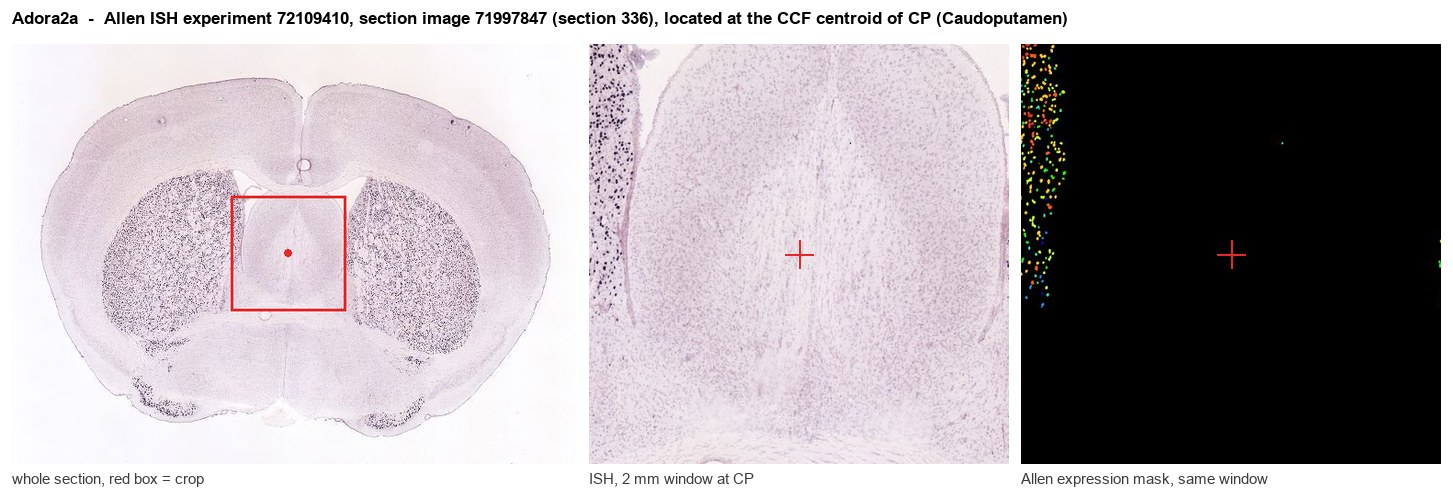
Allen ISH experiment 72109410, section image 71997847 (section 336): the section that contains the CCF centroid of Caudoputamen according to the Allen image-to-atlas alignment (reference_to_image), with a 2 mm window around that point. Left: whole section, red box = window. Middle: ISH signal. Right: Allen's expression-mask view of the same window. open this image in the Allen viewer
Look it up yourself: Allen Mouse Brain ISH for Adora2aAllen reference atlas: CP (structure 672)ABC Atlas MERFISH viewer(in the ABC Atlas choose dataset MERFISH-C57BL6J-638850-CCF, colour cells by gene "Adora2a" or by parcellation_substructure "CP")All genes confined to CP + 3-D brain
Direct spatial evidence
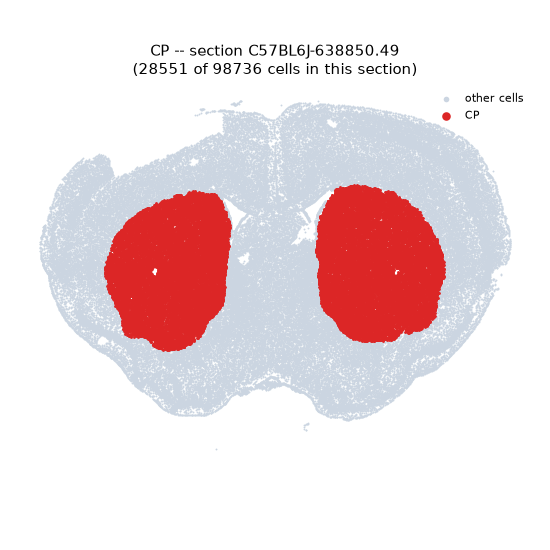
MERFISH REGION LOCATOR
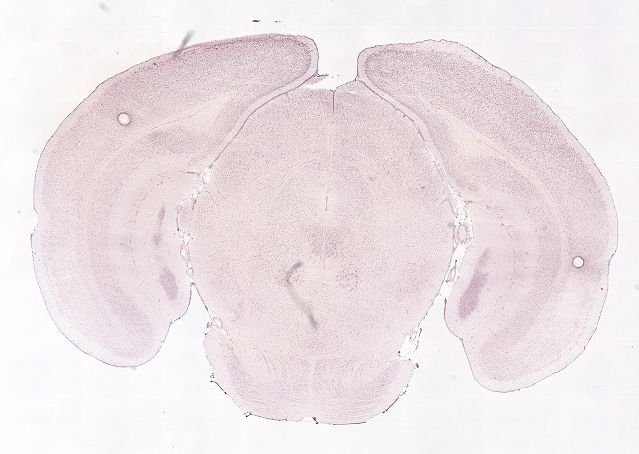
DIRECT ALLEN ISH
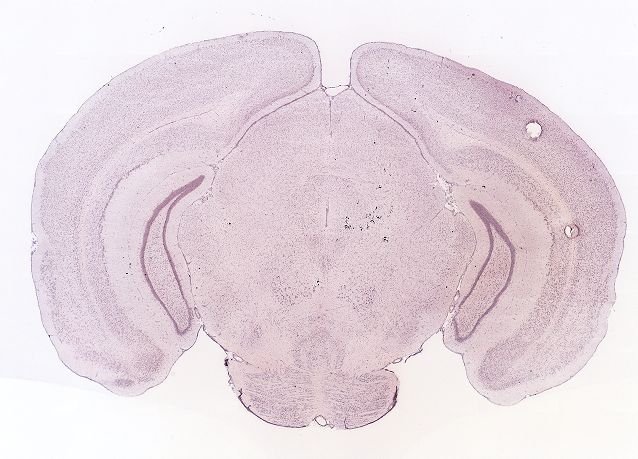
DIRECT ALLEN ISH
Regional expression figure
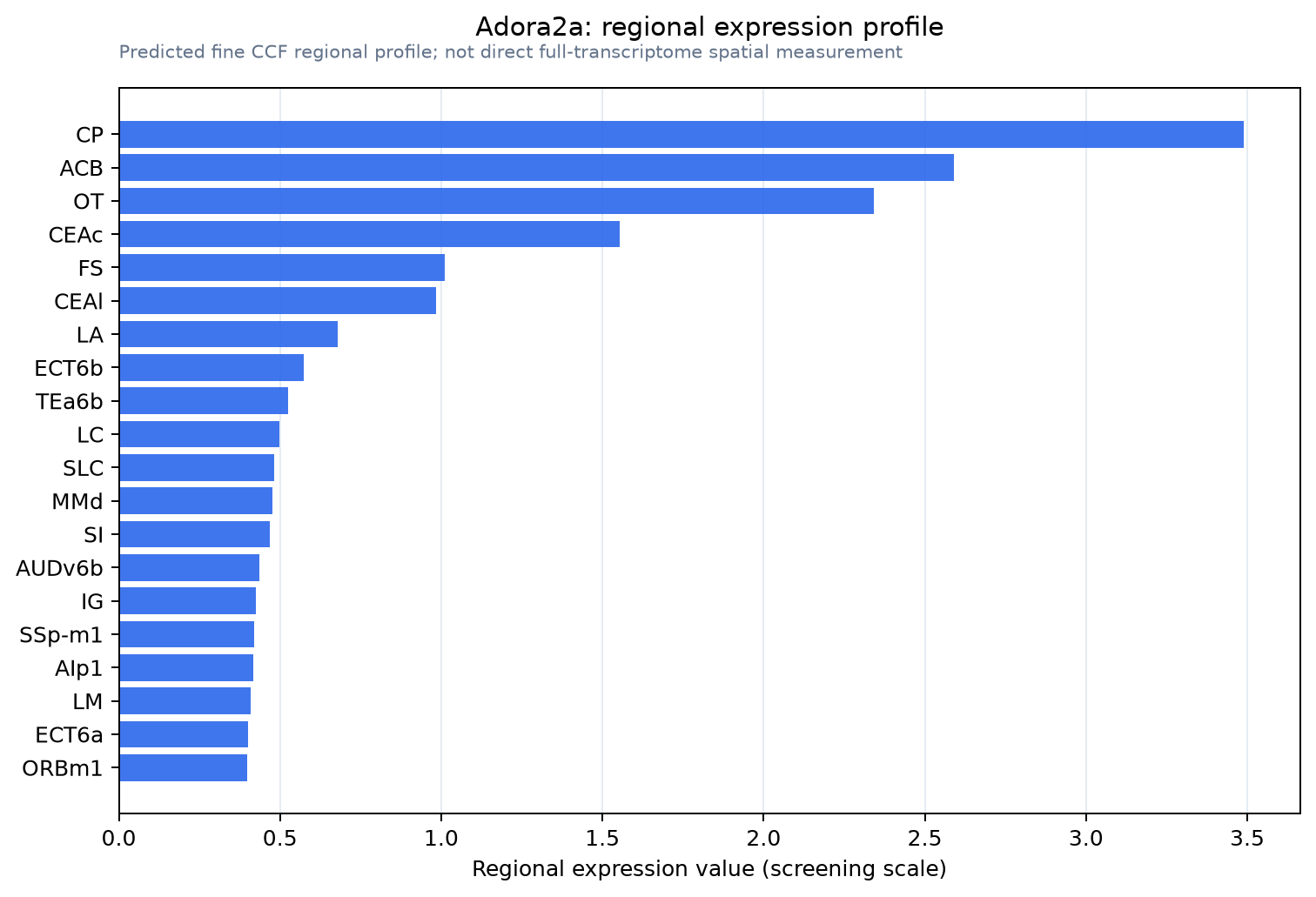
Predicted WMB × fine-CCF profile; not direct full-transcriptome spatial measurement.
Spatial profile
Evidence and specificity
- Evidence status
- PREDICTED_FINE
- Direct sources
- None; predicted localization only
- Exclusive threshold
- 12 positive regions out of 554
- Spatial specificity
- 0.388
- Top-region fraction
- 0.143
- Filter status
- PASS
Interpretation limits
- Cell-type-to-region projection is imputed expression, not direct spatial measurement.
- Adult reference atlases do not establish stability across age, sex, strain, state, or disease.
- Transcript abundance does not guarantee protein abundance or genetic-tool performance.