Adgrv1
Adhesion G protein-coupled receptor V1 (ADGRV1) (EC 3.4.-.-) (G protein-coupled receptor 98) (Monogenic audiogenic seizure susceptibility protein 1) (MASS1) (Neurepin) (Protein rueda) (Very large G pr
Spatial tier: RESTRICTED · Class: GPCR · Top region: SCO (Subcommissural organ) · Positive regions: 23/554
44.1Discovery Score
42.2Targetability Score
CEvidence grade C
What this means: Adgrv1: fine CCF profile is restricted toward SCO (top regions: SCO, ME, OV, PVi, PVpo; 23 positive regions); direct spatial validation is still required.
Function in SCO: evidence, prediction, innovation
- Gene function
- Adgrv1 encodes ADGRV1 (VLGR1/GPR98), the largest known GPCR: a roughly 6,300-residue adhesion receptor with a huge extracellular Calx-beta and pentraxin ectodomain, an autoproteolytic GAIN domain and a seven-transmembrane core. It is a structural member of the Usher syndrome type 2 protein network at hair-cell ankle links and photoreceptor connecting cilia. Mutations cause Usher syndrome 2C and audiogenic seizure susceptibility in mice.
- Region function
- The subcommissural organ is a tiny ependymal secretory gland at the entrance of the cerebral aqueduct beneath the posterior commissure; it releases SCO-spondin into the CSF, where it condenses into Reissner's fibre, and its failure causes aqueductal stenosis and hydrocephalus.
- Published in this region
- inferred No region-specific literature found. ADGRV1 has been characterised in cochlear hair-cell stereocilia, where it is required for proper stereocilia maturation (Yagi 2007), and at photoreceptor cilia; its ciliary and apical-membrane localisation is the closest link to the ciliated secretory ependymocytes of the subcommissural organ, but no SCO expression or function has been reported.
- Predicted function
- Prediction: because ADGRV1 organises ankle links and periciliary membrane complexes in other ciliated cells, in SCO ependymocytes it would most plausibly stabilise the apical and ciliary membrane and help couple cilia to CSF flow and to SCO-spondin secretion. Conditional deletion in ependyma is predicted to disorganise SCO cilia, reduce or misdirect Reissner's-fibre assembly, and mildly predispose to aqueductal obstruction and hydrocephalus, rather than to produce any behavioural phenotype; note also that SCO-mapped signal may partly reflect neighbouring posterior-commissure and periaqueductal tissue.
- Innovation
- ★★★★☆ 4/5 A ciliary adhesion GPCR at a ciliated CSF-secreting gland is a plausible and untested link to hydrocephalus, and the knockout mice already exist.
- Tools
- Adgrv1/Vlgr1 knockout and Vlgr1-del7TM mice, plus the Frings MASS1 audiogenic-seizure strain; anti-VLGR1 antibodies from Usher-syndrome work; FoxJ1-CreER (JAX 027012) for ependymal conditional deletion; no Adgrv1-Cre line.
- References
Direct evidence located at the region
No Allen ISH section could be located at this region's centroid for the recorded experiments.
Look it up yourself: Allen Mouse Brain ISH for Adgrv1Allen reference atlas: SCO (structure 599626923)ABC Atlas MERFISH viewer(in the ABC Atlas choose dataset MERFISH-C57BL6J-638850-CCF, colour cells by gene "Adgrv1" or by parcellation_substructure "SCO")All genes confined to SCO + 3-D brain
Direct spatial evidence
MERFISH REGION LOCATOR
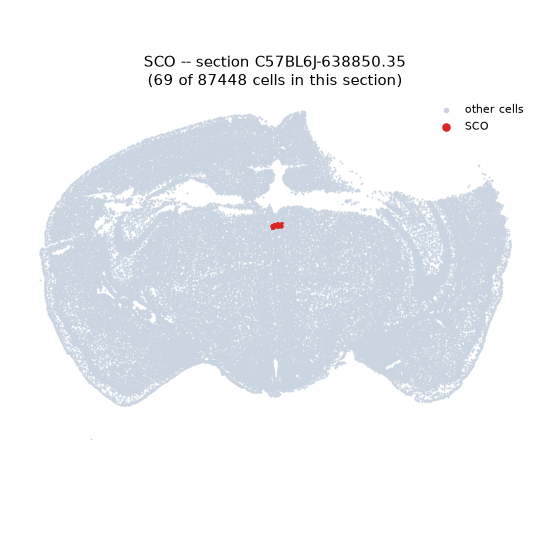
Regional expression figure
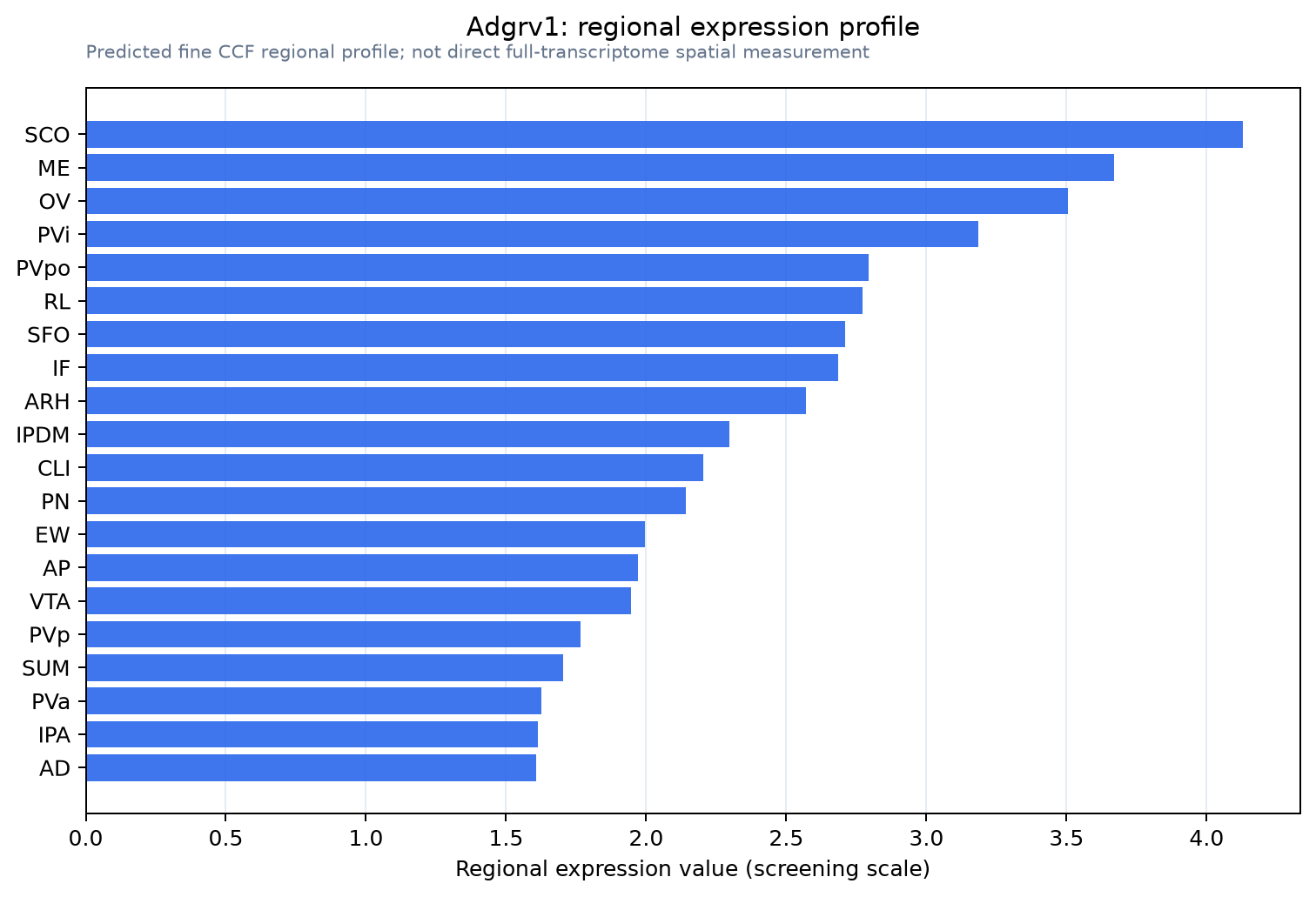
Predicted WMB × fine-CCF profile; not direct full-transcriptome spatial measurement.
Spatial profile
Evidence and specificity
- Evidence status
- PREDICTED_FINE
- Direct sources
- None; predicted localization only
- Exclusive threshold
- 12 positive regions out of 554
- Spatial specificity
- 0.332
- Top-region fraction
- 0.059
- Filter status
- PASS
Interpretation limits
- Cell-type-to-region projection is imputed expression, not direct spatial measurement.
- Adult reference atlases do not establish stability across age, sex, strain, state, or disease.
- Transcript abundance does not guarantee protein abundance or genetic-tool performance.