Adgrg5
Adhesion G protein-coupled receptor G5 (G protein-coupled receptor 114) (G protein-coupled receptor PGR27) [Cleaved into: Adhesion G protein-coupled receptor G5, N-terminal fragment (ADGRG5 N-terminal
Spatial tier: RESTRICTED · Class: GPCR · Top region: PO (Posterior complex of the thalamus) · Positive regions: 20/554
53.2Discovery Score
40.8Targetability Score
CEvidence grade C
What this means: Adgrg5: fine CCF profile is restricted toward PO (top regions: PO, Eth, MGv, MGd, SMT; 20 positive regions); direct spatial validation is still required.
Function in PO: evidence, prediction, innovation
- Gene function
- Adgrg5 encodes GPR114/ADGRG5, an adhesion G protein-coupled receptor. Its long extracellular region ends in a GAIN domain that self-cleaves, exposing a tethered peptide agonist (the Stachel sequence) which folds back into the seven-transmembrane core to activate Gs and raise cAMP. Cleavage is required for activation, and the receptor shows high constitutive and mechanically sensitive activity.
- Region function
- The posterior complex of the thalamus (PO) is a higher-order thalamic nucleus carrying whisker-touch, self-motion and nociceptive signals, relaying between brainstem, cortical layer 5 and secondary somatosensory/motor cortex rather than acting as a simple first-order relay.
- Published in this region
- none No region-specific literature found. Published ADGRG5 work is entirely biochemical and immunological - tethered-agonist activation and cleavage dependence (Bernadyn et al. 2023; Wilde et al. 2016), cryo-EM of Stachel-bound ADGRG receptors (Ping et al. 2022), and expression restricted to eosinophils, lymphocytes, monocytes and dendritic cells (Hamann et al. 2015). No study reports ADGRG5 in brain, thalamus or neurons.
- Predicted function
- Prediction: if the PO signal is genuinely neuronal rather than from perivascular or thalamic immune cells, ADGRG5 would most plausibly act as a constitutively active, mechanically tuned Gs/cAMP source in higher-order thalamocortical relay neurons, setting resting cAMP tone and thereby HCN-dependent burst-versus-tonic firing mode and the gain of layer-5 driver input. Knockout or Stachel blockade would then shift PO neurons toward burst firing and degrade whisker-touch and nociceptive transmission to secondary somatosensory cortex. The required first experiment is RNAscope plus a cell-type check to confirm neuronal expression.
- Innovation
- ★★★★★ 5/5 The receptor has never been reported in brain at all, so any validated neuronal role in a higher-order thalamic nucleus would be entirely new.
- Tools
- No Cre/Flp driver, validated antibody or characterised brain knockout reported. Available chemistry only: dihydromunduletone (ADGRG1/ADGRG5 antagonist), gedunin- and khivorin-derived partial agonists, and synthetic Stachel peptide agonists. Detection currently requires RNAscope or a knock-in epitope tag; PO itself is accessible by standard thalamic AAV targeting.
- References
Direct evidence located at the region
No Allen ISH section could be located at this region's centroid for the recorded experiments.
Look it up yourself: Allen Mouse Brain ISH for Adgrg5Allen reference atlas: PO (structure 1020)ABC Atlas MERFISH viewer(in the ABC Atlas choose dataset MERFISH-C57BL6J-638850-CCF, colour cells by gene "Adgrg5" or by parcellation_substructure "PO")All genes confined to PO + 3-D brain
Direct spatial evidence
MERFISH REGION LOCATOR
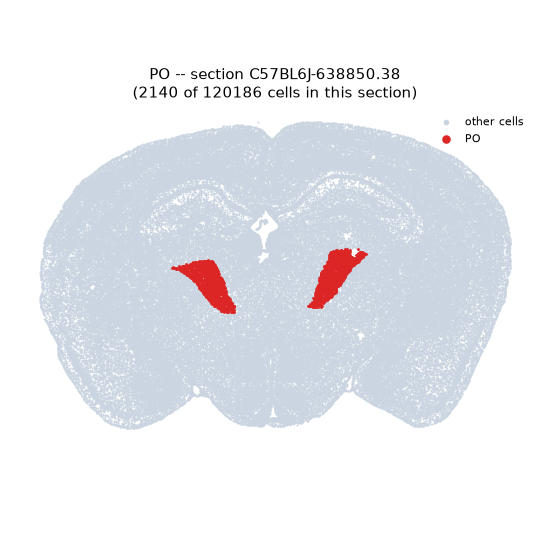
Regional expression figure
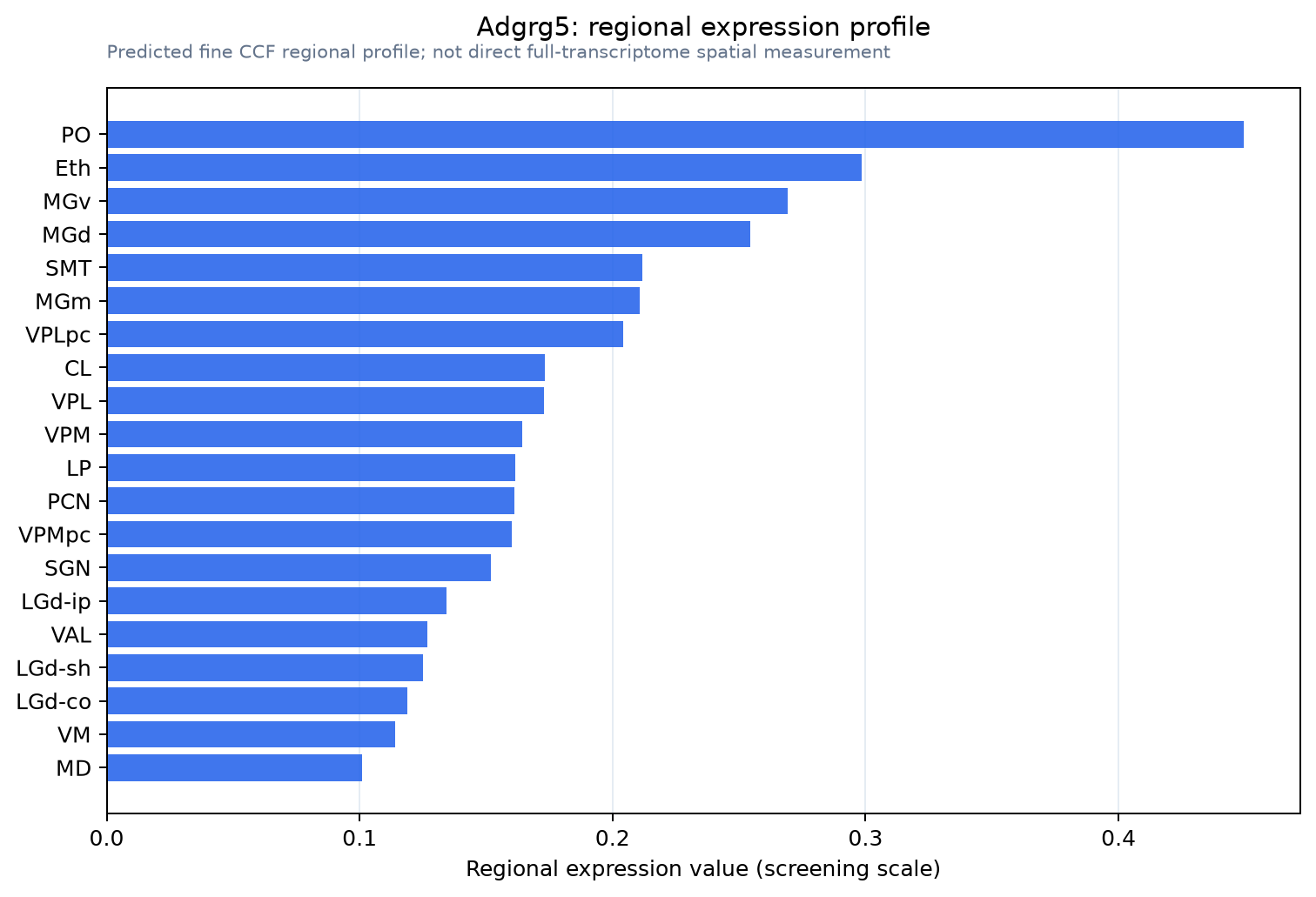
Predicted WMB × fine-CCF profile; not direct full-transcriptome spatial measurement.
Spatial profile
Evidence and specificity
- Evidence status
- PREDICTED_FINE
- Direct sources
- None; predicted localization only
- Exclusive threshold
- 12 positive regions out of 554
- Spatial specificity
- 0.447
- Top-region fraction
- 0.098
- Filter status
- PASS
Interpretation limits
- Cell-type-to-region projection is imputed expression, not direct spatial measurement.
- Adult reference atlases do not establish stability across age, sex, strain, state, or disease.
- Transcript abundance does not guarantee protein abundance or genetic-tool performance.