Adgrg2
Adhesion G protein-coupled receptor G2 (G protein-coupled receptor 64) (Mouse epididymis-specific protein 6) (Me6) [Cleaved into: Adhesion G protein-coupled receptor G2, N-terminal fragment (ADGRG2 N-
Spatial tier: RESTRICTED · Class: GPCR · Top region: IO (Inferior olivary complex) · Positive regions: 22/554
43.5Discovery Score
40.2Targetability Score
CEvidence grade C
What this means: Adgrg2: fine CCF profile is restricted toward IO (top regions: IO, TMd, PVT, MMm, Xi; 22 positive regions); direct spatial validation is still required.
Function in IO: evidence, prediction, innovation
- Gene function
- ADGRG2 (GPR64) is an adhesion-class G-protein-coupled receptor with a large mucin-rich extracellular region and a GAIN domain that self-cleaves to expose a tethered Stachel agonist. Peeters et al. 2015 showed it constitutively activates SRE and NF-kappaB signalling. Its best-defined physiology is in the epididymis, where it is required for fluid reabsorption and male fertility; it also marks intestinal tuft cells and dampens calcium-sensing receptor signalling in parathyroid tumours.
- Region function
- The inferior olivary complex is the sole source of climbing fibres to cerebellar Purkinje cells; its neurons are electrically coupled by connexin-36 gap junctions, generate subthreshold oscillations, and supply the error or teaching signal that drives cerebellar motor learning and timing.
- Published in this region
- inferred No region-specific literature found. ADGRG2 has been studied almost exclusively outside the nervous system - epididymis, intestinal tuft cells and parathyroid (Balenga et al. 2017; Grunddal et al. 2021) - and no central nervous system report exists for any species.
- Predicted function
- Prediction: inferior olivary neurons are unusual in being embedded in a gap-junction-coupled glomerular neuropil where dendritic spines from many cells interdigitate, and adhesion GPCRs are well suited to organising exactly this kind of specialised cell-cell contact. ADGRG2 is therefore predicted to act as a mechanically gated adhesion receptor stabilising the olivary glomerulus and its connexin-36 electrical coupling. Adgrg2 deletion restricted to the inferior olive is predicted to loosen glomerular architecture, reduce electrical coupling and subthreshold oscillation coherence, and consequently desynchronise complex spikes across Purkinje cells, impairing cerebellar-dependent eyeblink conditioning and adaptive locomotor timing without causing ataxia at rest.
- Innovation
- ★★★★★ 5/5 A completely unstudied brain gene in a circuit where cell-cell adhesion and electrical coupling are the defining functional features, making the hypothesis specific and testable.
- Tools
- Adgrg2 knockout mice from the epididymal fertility literature; synthetic Stachel peptide agonists for the ADGRG subfamily; anti-GPR64 antibodies; inferior olive access with retrograde AAV from cerebellar cortex or Cartpt-Cre, plus harmaline to probe oscillation and connexin-36 knockout for comparison.
- References
Direct evidence located at the region
No Allen ISH section could be located at this region's centroid for the recorded experiments.
Look it up yourself: Allen Mouse Brain ISH for Adgrg2Allen reference atlas: IO (structure 83)ABC Atlas MERFISH viewer(in the ABC Atlas choose dataset MERFISH-C57BL6J-638850-CCF, colour cells by gene "Adgrg2" or by parcellation_substructure "IO")All genes confined to IO + 3-D brain
Direct spatial evidence
MERFISH REGION LOCATOR
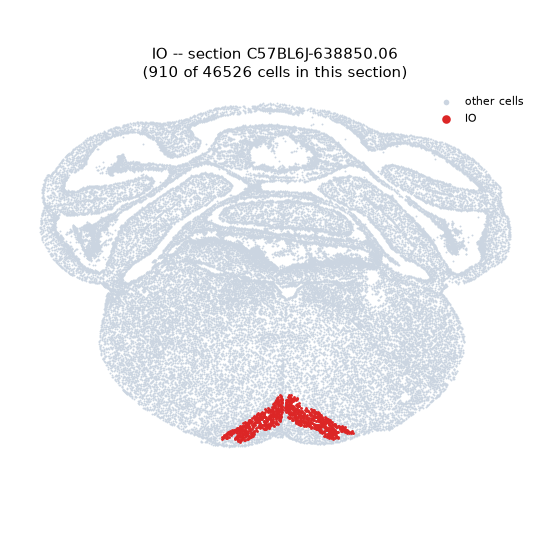
Regional expression figure
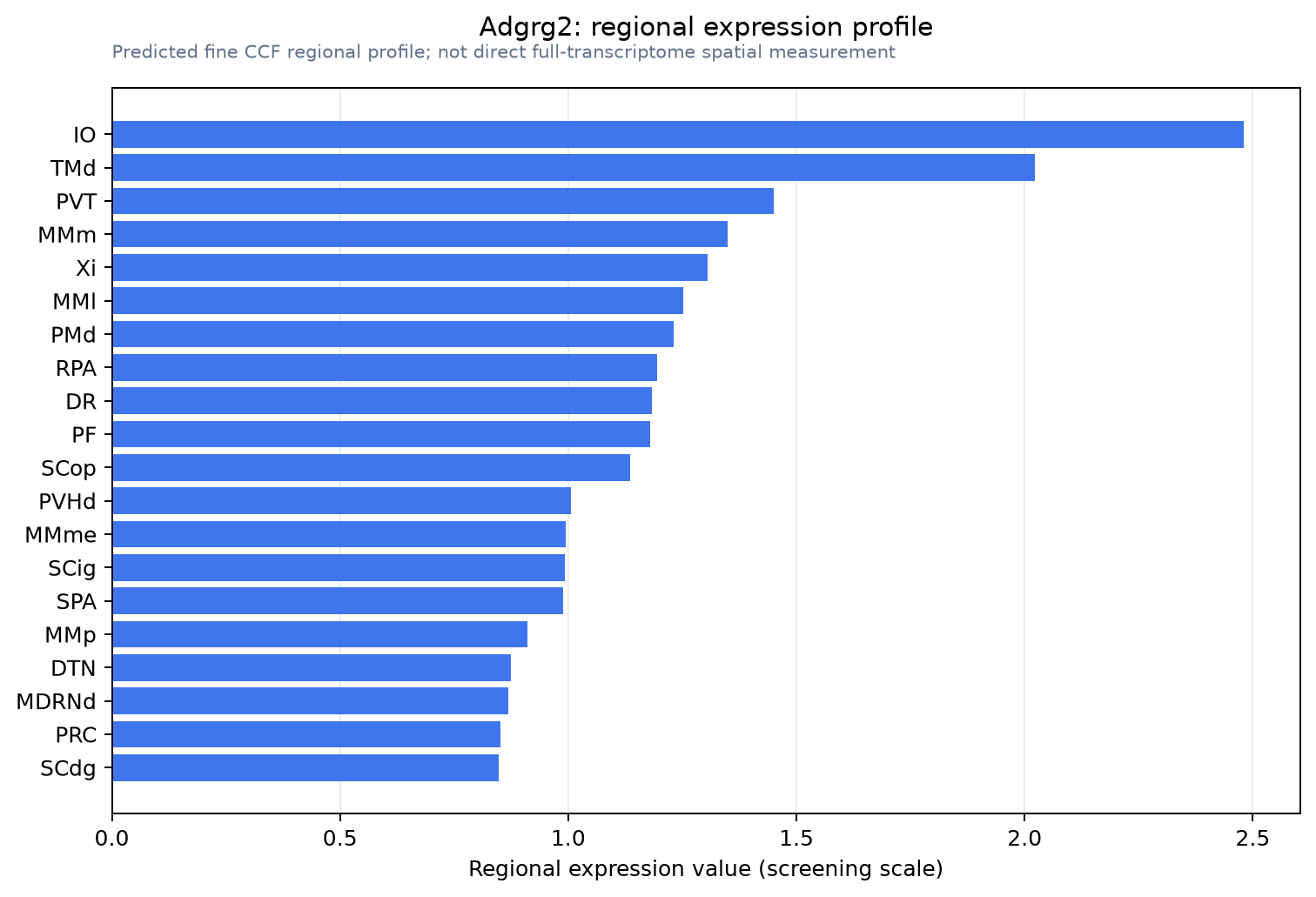
Predicted WMB × fine-CCF profile; not direct full-transcriptome spatial measurement.
Spatial profile
Evidence and specificity
- Evidence status
- PREDICTED_FINE
- Direct sources
- None; predicted localization only
- Exclusive threshold
- 12 positive regions out of 554
- Spatial specificity
- 0.305
- Top-region fraction
- 0.062
- Filter status
- PASS
Interpretation limits
- Cell-type-to-region projection is imputed expression, not direct spatial measurement.
- Adult reference atlases do not establish stability across age, sex, strain, state, or disease.
- Transcript abundance does not guarantee protein abundance or genetic-tool performance.