Adgrf4
Adhesion G protein-coupled receptor F4 (G protein-coupled receptor 115)
Spatial tier: REGION_BIASED · Class: GPCR · Top region: AV (Anteroventral nucleus of thalamus) · Positive regions: 33/554
42.7Discovery Score
38.0Targetability Score
CEvidence grade C
What this means: Adgrf4: fine CCF profile is region-biased toward AV (top regions: AV, AMd, IAD, PCN, VAL); this is a discovery lead, not direct proof.
Function in AV: evidence, prediction, innovation
- Gene function
- ADGRF4 (GPR115) is an adhesion GPCR: a seven-transmembrane receptor with a long extracellular region cleaved at a GAIN/GPS domain, so that a tethered Stachel peptide activates the receptor when the N-terminal fragment is shed under mechanical or ligand stress. Its known biology is epithelial: Chiba et al. 2020 showed it is required for enamel mineralisation via Car6, and Winkler et al. 2022 showed it drives keratinocyte stratification along KRT1 filaments.
- Region function
- The anteroventral thalamic nucleus relays mammillary body and subicular signals to retrosplenial and cingulate cortex within the extended hippocampal circuit, and carries a large head-direction cell population supporting spatial orientation.
- Published in this region
- none No region-specific literature found. The closest data are the IMPC Adgrf4 knockout (MGI:1925499), which reports only an eye/vision phenotype and no adult brain expression, and the absence of any Adgrf4 ISH experiment in the Allen Mouse Brain Atlas.
- Predicted function
- Prediction: as a mechanically gated adhesion GPCR, ADGRF4 in AV would most plausibly act at adhesive contacts between relay neurons and mammillothalamic or retrosplenial afferents, or during thalamocortical wiring, coupling contact force to Gq/G12-13 signalling. AV-restricted deletion should spare gross anatomy but degrade head-direction cell tuning and allocentric tasks. A Stachel agonist peptide plus AAV-Cre in floxed mice is a feasible first test.
- Innovation
- ★★★★★ 5/5 An epithelial adhesion GPCR with zero CNS literature, paired with a head-direction circuit that has well-defined physiological readouts.
- Tools
- IMPC/KOMP Adgrf4 knockout and conditional-ready alleles (MGI:1925499); GPR115 antibodies validated in skin (Winkler 2022); generic adhesion-GPCR Stachel agonist peptides. No Cre driver or small-molecule ligand known.
- References
Direct evidence located at the region
No Allen ISH section could be located at this region's centroid for the recorded experiments.
Look it up yourself: Allen Mouse Brain ISH for Adgrf4Allen reference atlas: AV (structure 255)ABC Atlas MERFISH viewer(in the ABC Atlas choose dataset MERFISH-C57BL6J-638850-CCF, colour cells by gene "Adgrf4" or by parcellation_substructure "AV")All genes confined to AV + 3-D brain
Direct spatial evidence
MERFISH REGION LOCATOR
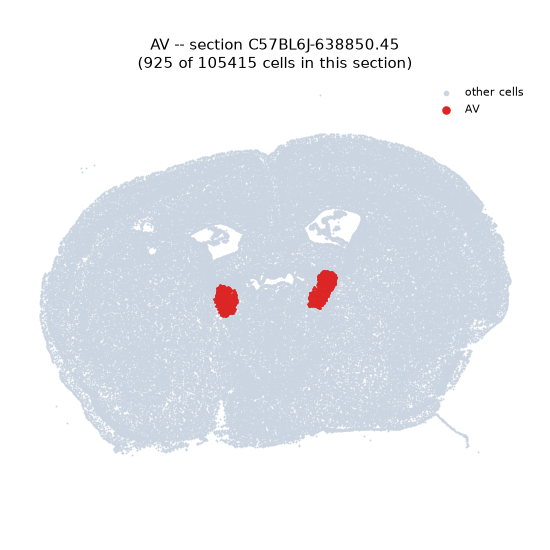
Regional expression figure
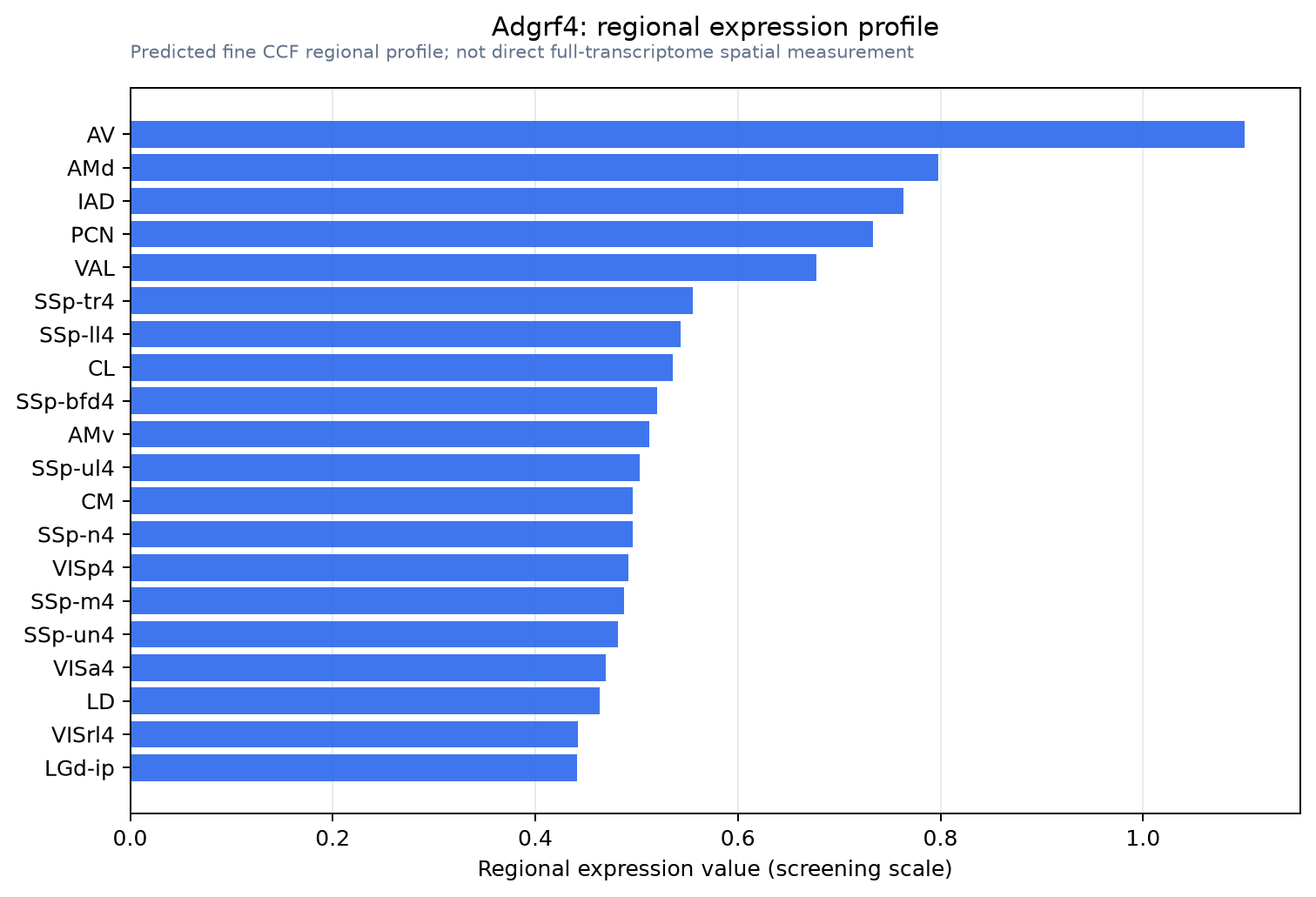
Predicted WMB × fine-CCF profile; not direct full-transcriptome spatial measurement.
Spatial profile
Evidence and specificity
- Evidence status
- PREDICTED_FINE
- Direct sources
- None; predicted localization only
- Exclusive threshold
- 12 positive regions out of 554
- Spatial specificity
- 0.297
- Top-region fraction
- 0.055
- Filter status
- PASS
Interpretation limits
- Cell-type-to-region projection is imputed expression, not direct spatial measurement.
- Adult reference atlases do not establish stability across age, sex, strain, state, or disease.
- Transcript abundance does not guarantee protein abundance or genetic-tool performance.